

Hotel Marketing Guide in 2026: Strategies, Campaigns & Ideas to Grow Direct Bookings
Hotel marketing in 2026 is no longer limited to OTA listings or occasional seasonal promotions. Today’s travelers discover, compare, and book hotels across multiple digital touchpoints, from Google Search and Instagram to online reviews and AI-powered travel recommendations.
As competition increases and OTA commissions continue rising, hotels need a more balanced marketing strategy that improves visibility, strengthens guest trust, increases direct bookings, and protects long-term profitability.
In this guide, we’ll explore the most effective hotel marketing strategies, campaign ideas, and revenue-focused tactics hotels can use to improve discoverability, strengthen guest engagement, and reduce OTA dependency in 2026.
What Is Hotel Marketing?
Hotel marketing refers to the strategies hotels use to attract guests, increase bookings, improve visibility, and maximize revenue across online and offline channels.
In simple terms, hotel marketing helps travelers discover your property, trust your brand, and eventually book a stay.
Today, hotel marketing starts long before a guest visits your website. In fact, according to Reputation Lab, nearly 81% of travelers read online reviews before booking, making reputation, content quality, pricing consistency, and booking experience critical factors in hotel booking decisions.
For example, a boutique resort in Jaipur may attract guests through destination-focused SEO, Instagram reels, Google reviews, and WhatsApp offers, all working together as part of one marketing ecosystem.
Why Hotel Marketing Is Important in 2026
Hotel marketing today is about much more than promotions and discounts. Hotels now need to balance discoverability, guest engagement, direct bookings, and profitability across multiple digital channels.
- Rising OTA Dependency Is Reducing Hotel Profit Margins
OTAs help hotels gain visibility, but over-dependence comes at a cost.
For example:
| Booking Value | OTA Commission | Revenue Lost |
| ₹10,000 | 20% | ₹2,000 |
| 500 bookings/month | ₹2,000 each | ₹10 lakh/month |
That’s why hotels are increasingly prioritizing direct booking growth and better distribution control.
- Travelers Discover Hotels Across Multiple Channels
Modern travelers compare hotels across:
- Google Search
- YouTube
- Google Maps
- OTAs
- AI-powered recommendation tools
The booking journey is no longer linear. Guests may discover your hotel on Instagram, compare reviews on Booking.com, ask ChatGPT for recommendations, and finally book through your website.
- Direct Bookings Have Become a Revenue Priority
Direct bookings improve profitability because hotels avoid OTA commissions while owning the guest relationship.
Hotels that invest in improving their direct booking strategy often report 35–50% growth in direct reservations within 6–12 months, according to hospitality industry benchmarks.
- AI and Personalization Are Reshaping Hotel Marketing
AI is changing how travelers discover and evaluate hotels. Around 40% of travelers now use AI tools during trip planning, making AI-driven discoverability increasingly important.
At the same time, hotels are investing more heavily in personalization, AI-driven pricing, and automated guest engagement to improve marketing performance and long-term revenue growth.
The Hotel Marketing Funnel Explained
Hotels today need to engage travelers at multiple stages of the booking journey, from initial discovery to repeat stays.
Understanding this funnel helps hotels create marketing strategies that improve both visibility and long-term guest retention.
| Funnel Stage | Goal | Marketing Channels | Example |
| Awareness | Get discovered | SEO, Instagram, OTAs | Traveler searches “best hotels in Jaipur” |
| Consideration | Build trust | Reviews, website, email | Guest compares properties |
| Conversion | Drive bookings | Booking engine, offers | Guest books directly |
| Loyalty | Encourage repeat stays | CRM, WhatsApp, loyalty programs | Guest receives exclusive return offer |
Hotels that focus only on conversions often become overly dependent on OTAs, while properties investing across the full funnel usually build stronger direct bookings and guest retention over time.
Core Types of Hotel Marketing
Hotels today rely on both traditional and digital marketing strategies to improve visibility, attract guests, and increase bookings across channels.
Traditional Hotel Marketing
Traditional hotel marketing focuses on offline channels such as:
- Print advertisements
- Travel agents
- Outdoor promotions
- Events and sponsorships
- Local partnerships
These strategies still help build local visibility and regional brand awareness in many markets.
Digital Hotel Marketing
Digital hotel marketing helps hotels reach travelers online through:
- SEO and content marketing
- OTAs and booking platforms
- Social media marketing
- Email campaigns
- Paid advertising
- Influencer collaborations
These channels help hotels improve online discoverability and connect with travelers across multiple digital touchpoints.
Most modern hotels now combine both approaches, but digital marketing plays a much larger role in driving discoverability, direct bookings, and measurable revenue growth in 2026.
Where Digital Marketing Fits Into the Hotel Industry
Digital marketing now influences almost every stage of the hotel booking journey. From hotel discovery and guest reviews to direct bookings and loyalty campaigns, most traveler interactions happen online before a reservation is made.
Why Digital Visibility Matters More Than Ever
Travelers today compare hotels across Google, OTAs, social media, maps, reviews, and increasingly, AI-driven travel platforms before making a booking decision. This shift has made digital visibility one of the most important drivers of hotel growth and direct revenue.
How Travelers Discover Hotels Today
Modern travelers now interact with hotels across multiple digital touchpoints before making a reservation:
- Search engines and Google Hotel Ads
- OTAs and metasearch platforms
- Social media and influencer content
- Hotel websites and booking engines
- Guest reviews and reputation platforms
Digital marketing has become one of the fastest-growing and highest-ROI components of modern hotel marketing strategies.
Read our comprehensive blog on Hotel Digital Marketing Strategies in 2026 to explore the digital channels, strategies, and trends hotels are using to increase visibility, drive direct bookings, and grow revenue.
Why Brand Experience Matters in Hotel Marketing
Hotel marketing is not just about promoting rooms; it also shapes how travelers perceive and remember a hotel brand. In a competitive hospitality market, guest experience often influences booking decisions as much as pricing or location.
What Shapes a Hotel’s Brand Experience:
Several factors contribute to a hotel’s overall brand perception:
- Visual identity and storytelling
- Guest reviews and online reputation
- Personalized guest experiences
- Consistent service across touchpoints
- Local experiences and partnerships
- Loyalty and repeat guest engagement
Hotels that create stronger guest experiences often benefit from better word-of-mouth marketing, repeat bookings, and long-term brand loyalty.
Manage All Your OTAs from One Place
12 Proven Hotel Marketing Strategies for 2026
Hotels today need marketing strategies that improve visibility, strengthen guest trust, and increase direct bookings across digital channels.
-
Strengthen Your Hotel SEO Strategy
Hotel SEO helps properties appear when travelers search for accommodations online.
How hotels can implement this:
-
- Optimize location and room pages with relevant keywords
- Improve website speed and mobile usability
- Add schema markup and structured hotel information
- Keep OTA and website details consistent
- Create destination-focused content that travelers actively search for
Hotels that improve both search visibility and AI-readability are more likely to drive stronger direct booking growth.
-
Improve Direct Booking Experience
A slow or confusing booking journey often pushes travelers back to OTAs.
How Hotels Can Implement This
-
- Simplify the booking flow across devices
- Offer transparent pricing and cancellation policies
- Enable secure and fast payment options
- Optimize the booking engine for mobile users
- Add instant confirmations and guest communication
A smoother booking experience improves trust and increases direct reservation conversions.
-
Focus on OTA Optimization
OTAs remain one of the biggest hotel discovery channels, especially for new and international travelers.
How hotels can implement this:
-
- Maintain pricing consistency across channels
- Use high-quality room images and descriptions
- Keep inventory updated in real time
- Respond actively to guest reviews
- Monitor OTA performance regularly
Hotels with stronger OTA visibility often improve occupancy while maintaining better trust signals across booking platforms.
-
Invest in Social Media Marketing
Travel remains highly visual, and social media strongly influences how travelers discover hotels and destinations.
How Hotels Can Implement This
-
- Share guest experiences and local attractions
- Post short-form videos and reels consistently
- Highlight seasonal offers and events
- Collaborate with travel creators and influencers
- Use location tags and destination hashtags
Strong social visibility helps hotels stay relevant throughout the traveler’s booking journey.
-
Build a Strong Reputation Management Strategy
Online reviews now influence both booking decisions and AI-powered hotel recommendations.
How Hotels Can Implement This
-
- Encourage guests to leave reviews after their stay
- Respond professionally to both positive and negative feedback
- Monitor ratings across OTAs and Google
- Resolve recurring service issues proactively
- Highlight guest testimonials on the hotel website
Consistent guest satisfaction often translates directly into stronger visibility and long-term revenue growth.
-
Use Personalized Email Marketing
Email marketing remains one of the highest-ROI hotel marketing channels when used strategically.
How Hotels Can Implement This
-
- Send pre-arrival and post-stay emails
- Segment guests based on booking behavior
- Share personalized offers and upgrades
- Promote loyalty and seasonal packages
- Automate guest communication workflows
Personalized messaging helps hotels maintain stronger guest relationships beyond a single booking.
-
Strengthen Loyalty and Repeat Guest Campaigns
Acquiring new guests is usually far more expensive than retaining existing ones.
How Hotels Can Implement This
-
- Offer exclusive member-only benefits
- Create referral and rewards programs
- Share personalized return-stay offers
- Recognize repeat guests during check-in
- Provide flexible perks for direct bookings
Hotels with stronger guest retention strategies typically reduce dependency on expensive acquisition channels.
-
Optimize for Local and Experience-Based Marketing
Modern travelers increasingly search for experiences, not just accommodations.
How Hotels Can Implement This
-
- Promote nearby attractions and activities
- Create destination-focused packages
- Partner with local businesses and tour operators
- Highlight regional food and cultural experiences
- Use storytelling in content and social campaigns
Experience-driven marketing helps hotels create stronger emotional connections with travelers.
-
Use WhatsApp and Conversational Marketing
Travelers increasingly expect faster and more personalized communication from hotels.
How Hotels Can Implement This
-
- Send booking confirmations and reminders
- Share personalized offers and upgrades
- Answer guest queries instantly
- Provide pre-arrival support and local recommendations
- Automate routine guest communication
Conversational marketing improves convenience while strengthening guest engagement.
-
Run Seasonal and Event-Based Campaigns
Hotel demand changes constantly across seasons, holidays, and local events.
How Hotels Can Implement This
-
- Launch festive and holiday offers early
- Promote staycation and weekend packages
- Align campaigns with local events and travel trends
- Create urgency with limited-time deals
- Adjust pricing and inventory based on demand
Well-timed campaigns help hotels maximize both occupancy and revenue opportunities.
-
Use Influencer and Creator Collaborations
Travel creators now influence destination discovery more than traditional advertising in many markets.
How Hotels Can Implement This
-
- Collaborate with niche travel influencers
- Focus on engagement quality over follower count
- Create experience-led campaigns
- Encourage user-generated content
- Track campaign-driven traffic and bookings
Influencer marketing works best when the content feels genuine and experience-focused.
-
Improve Distribution and Revenue Management
Marketing performance depends heavily on pricing accuracy, inventory visibility, and distribution consistency across channels.
How Hotels Can Implement This
-
- Use channel management software for real-time updates
- Monitor demand and competitor pricing trends
- Optimize inventory distribution across OTAs
- Track booking source performance regularly
- Automate pricing and revenue workflows where possible
Solutions like AxisRooms Channel Manager help hotels centralize OTA distribution, inventory management, and pricing updates more efficiently across channels.
Hotels that combine smarter marketing with better distribution management are better positioned to improve visibility, direct bookings, and long-term revenue growth.
What Makes a Great Hotel Marketing Campaign?
Successful hotel marketing campaigns are not just about discounts or promotions.
The best campaigns combine the right audience, timing, messaging, and channels to attract travelers and increase bookings effectively.
Key Elements of a Successful Hotel Marketing Campaign
- Clear audience targeting → Personalized campaigns perform better for families, couples, business travelers, and staycation guests
- Strong offer positioning → Flexible cancellations, experiences, and direct booking benefits improve conversions
- Right timing and seasonality → Campaigns aligned with holidays and events capture demand more effectively
- Multi-channel promotion → Combining SEO, OTAs, email, social media, and paid ads improves reach and consistency
What Every Hotel Marketing Campaign Should Include
| Campaign Element | Example |
| Target Audience | Families, couples, business travelers |
| Offer Strategy | Summer package, free breakfast, early-bird discount |
| Promotion Channels | Instagram, email marketing, OTAs |
| Booking CTA | Book Direct, Limited-Time Offer |
| Campaign Timing | Holiday season, weekends, local events |
Hotels that align audience targeting, timing, and promotion channels effectively usually see stronger engagement and booking conversions.
Top 5 Hotel Marketing Campaign Examples
Some of the most successful hotel marketing campaigns focus on storytelling, personalization, loyalty, and experience-driven marketing.
Successful Hotel Campaign Examples
| Brand/Campaign | Goal | Strategy | Results | Takeaway |
| Marriott International – Bonvoy | Increase repeat bookings | Loyalty perks & direct booking rewards | Stronger retention | Loyalty drives repeat revenue |
| Airbnb – Experiences | Differentiate brand | Experience-led storytelling | Higher traveler engagement | Travelers value experiences |
| IHG Hotels & Resorts – Personalized Campaigns | Improve conversions | Personalized guest offers | Better engagement | Personalization improves bookings |
| Boutique Hotel Instagram Campaigns | Improve visibility | Reels & influencer content | More social traffic | Visual discovery matters |
| Seasonal Staycation Campaigns | Increase occupancy | Limited-time local offers | Higher regional bookings | Timing impacts performance |
Many successful hotel campaigns focus less on aggressive selling and more on creating memorable guest experiences and long-term brand trust.
How to Build Your Hotel Marketing Strategy
A successful hotel marketing strategy is not built around one campaign or channel alone.
It requires a clear understanding of your audience, business goals, pricing, visibility, and guest experience across every stage of the booking journey.
Step 1: Define Your Hotel Audience
Identify the travelers most likely to book your property, such as business travelers, families, couples, or staycation guests.
Step 2: Analyze Competitors
Study competitor pricing, guest reviews, offers, and marketing channels to identify gaps and opportunities.
Step 3: Set Revenue Goals
Establish measurable goals such as increasing direct bookings, improving occupancy, boosting repeat stays, or reducing OTA dependency.
Step 4: Choose Marketing Channels
Focus on channels where your audience actively discovers and compares hotels, including SEO, OTAs, email, paid ads, and social media.
Step 5: Optimize Distribution
Keep pricing, inventory, and availability updated consistently across OTAs, metasearch platforms, and direct booking channels.
Step 6: Improve Direct Booking Experience
Ensure your website and booking engine remain fast, mobile-friendly, and easy to use across devices.
Step 7: Measure KPIs
Monitor booking trends, occupancy, campaign performance, conversion rates, and guest feedback regularly.
Step 8: Automate Marketing & Distribution
Use hotel technology tools to automate pricing updates, campaign workflows, guest communication, and channel management.
Hotels that combine visibility, guest experience, and data-driven decision-making usually build stronger long-term marketing performance.
Hotel Marketing KPIs You Must Track
Tracking the right marketing KPIs helps hotels understand which channels, campaigns, and strategies are actually driving bookings and revenue growth.
| KPI | Meaning | Why It Matters | Sample Formula |
| RevPAR | Revenue per available room | Revenue efficiency | Revenue ÷ available rooms |
| CAC | Customer acquisition cost | Marketing efficiency | Spend ÷ customers acquired |
| Direct booking % | Share of direct reservations | OTA dependence | Direct bookings ÷ total bookings |
Sample Calculation
If your hotel generates ₹8 lakh revenue from 100 available rooms:
RevPAR = ₹8,00,000 ÷ 100 = ₹8,000
Simple KPI calculations like these help hotels identify revenue gaps faster and improve pricing strategies more effectively.
Why AxisRooms is the Best Hotel Marketing Solution
Managing hotel marketing across OTAs, direct bookings, pricing, and distribution channels can quickly become difficult without connected systems.
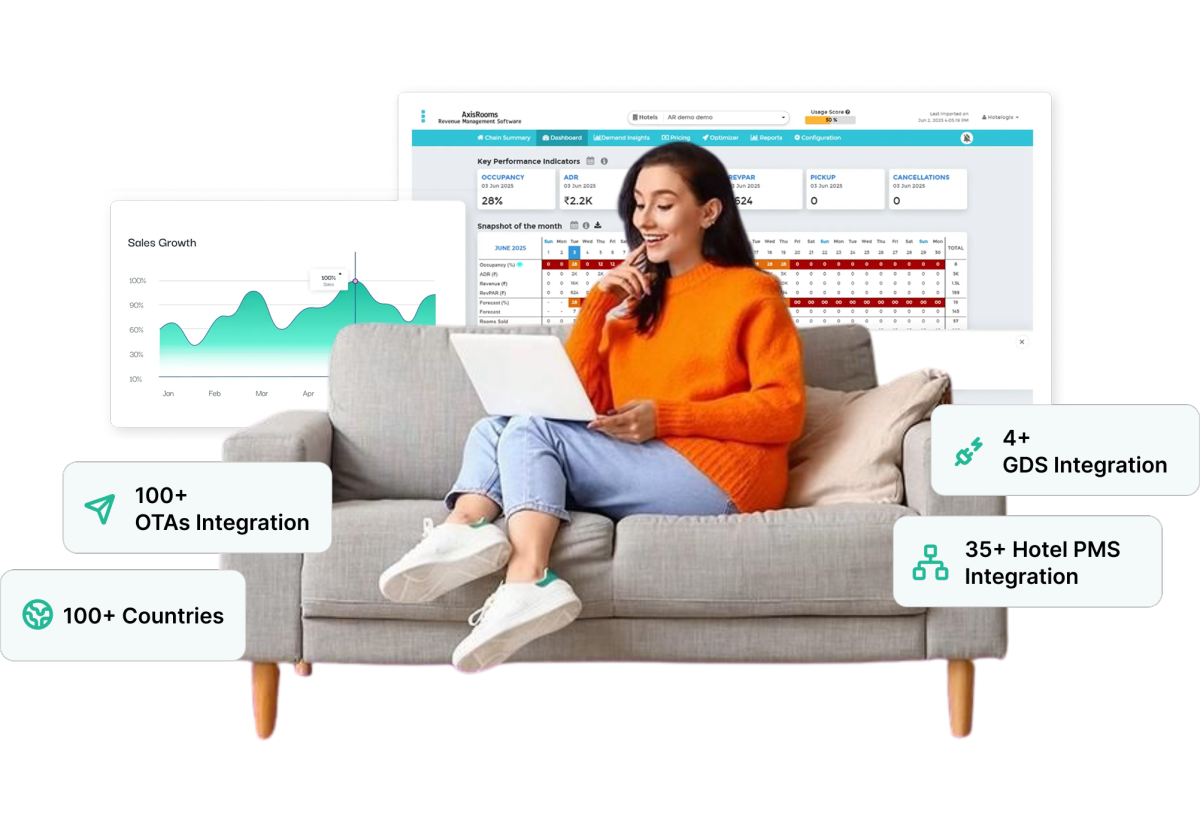
AxisRooms Channel Manager helps hotels centralize distribution, automate inventory updates, and improve booking performance through one integrated platform.
- Channel Manager – Syncs rates and inventory across 100+ OTAs in real time, reducing rate disparity and overbooking risks
- Web Booking Engine – Converts direct website visitors into bookings while helping hotels reduce OTA commission dependency
- Revenue Management Service – Uses dynamic pricing intelligence and market demand data to help maximize RevPAR and profitability
- OTA Integrations – Connects hotels with platforms like Booking.com, Agoda, and MakeMyTrip to improve visibility and booking reach
- PMS Integrations – Connects operational and marketing data efficiently, allowing hotels to manage bookings, inventory, and guest information faster
When distribution, pricing, and booking systems work together in real time, hotels can market more efficiently, improve occupancy, and make faster revenue decisions.
Conclusion
Hotel marketing in 2026 is no longer limited to promotions or advertising alone. It now combines brand positioning, guest experience, digital visibility, distribution strategy, and revenue optimization into one connected growth strategy.
Hotels that balance strong marketing foundations with modern digital visibility and guest-focused experiences are better positioned to improve direct bookings, strengthen loyalty, and stay competitive in an increasingly crowded hospitality market.
Ready to simplify your hotel marketing and distribution strategy? Book a free demo today to explore how AxisRooms Channel Manager helps hotels improve visibility, manage channels efficiently, and grow direct revenue in 2026.