

Hotel pricing moves faster than ever in 2026. Rates change hourly across OTAs, metasearch platforms, and AI-powered travel apps, yet many hotels still rely on manual checks or static pricing strategies. The result? Missed revenue opportunities, weak OTA competitiveness, and delayed pricing decisions.
Hotel rate intelligence helps hotels understand exactly how the market is moving from competitor pricing and booking pace to demand spikes and rate parity gaps so they can react faster and price smarter.
In this guide, we’ll explain what hotel rate intelligence is, how it works, the difference between hotel rate shopping and rate intelligence, and how hotels use it to improve RevPAR and pricing performance in real time.
What Is Hotel Rate Intelligence?
Hotel rate intelligence is the process of tracking competitor pricing, market demand, booking pace, and pricing trends to make faster and smarter revenue decisions in real time. Instead of relying on fixed seasonal rates or manual OTA checks, hotels use live market data to adjust pricing faster and stay competitive.
For example, if hotels in a city suddenly increase rates before a major concert or exhibition, rate intelligence helps identify the demand shift early so hotels can respond before rooms start selling out.
What is a Hotel Rate Intelligence Report?
A hotel rate intelligence report gives hotels a real-time view of pricing movements, booking pace, occupancy trends, and rate parity across the market. Revenue teams use these reports to identify where they may be overpriced, underpriced, or missing revenue opportunities across OTAs and direct channels.
For instance, a hotel may notice competitors increasing rates ahead of a city-wide event and adjust pricing earlier to capture higher ADR opportunities.
What Is Hotel Competitive Group Rate Intelligence?
Hotel competitive group rate intelligence helps hotel groups monitor pricing performance across multiple properties while benchmarking against local competitors. This helps brands maintain pricing consistency, avoid internal rate cannibalisation, and identify underperforming properties across the portfolio.
For example, a 10-property hotel chain may use group rate intelligence to compare ADR performance across cities and identify which hotels are losing pricing competitiveness in their local markets.
Why Hotel Rate Intelligence Matters in 2026
Hotel pricing has become far more dynamic across OTAs, metasearch platforms, and AI-driven booking channels. Hotels that rely on delayed market data often react too late to demand shifts, pricing changes, or competitor movements.
Here’s why hotel rate intelligence has become essential for modern revenue management:
- Faster pricing decisions → Hotels can respond quickly to competitor rate changes, local events, and demand spikes before booking windows close.
- Better RevPAR optimization → Revenue teams can balance occupancy and ADR more effectively instead of focusing only on filling rooms.
- Reduced manual rate checks → Automated market tracking eliminates the need for constant OTA monitoring across multiple channels.
- Improved rate parity across OTAs → Hotels can identify pricing inconsistencies faster and maintain stronger distribution control.
- Smarter demand forecasting → Booking pace and market trend analysis help hotels prepare pricing strategies earlier.
- Stronger competitive positioning → Hotels can benchmark pricing performance against local competitors in real time instead of relying on historical data.
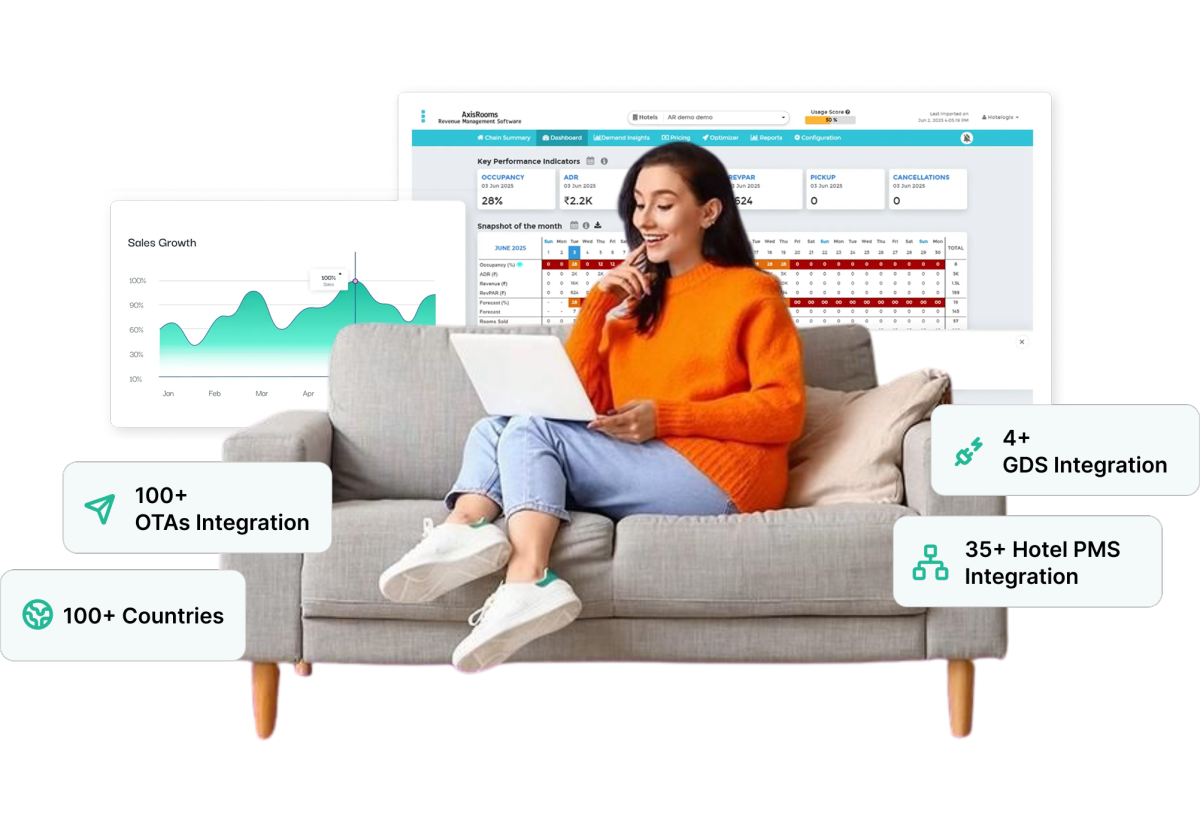
As pricing decisions become more dynamic across OTAs and direct channels, many hotels are moving toward connected revenue management platforms like AxisRooms.
What Is Hotel Rate Intelligence Software?
Hotel rate intelligence software automates competitor pricing analysis across OTAs, metasearch platforms, brand websites, and GDS channels.
Instead of manually checking rates across Booking.com, Expedia, Agoda, and Airbnb, the software continuously monitors market movements and presents the insights in real-time dashboards and reports.
How Hotel Rate Intelligence Software Works
| Step | What the Software Does |
| Data Collection | Tracks competitor pricing across OTAs, GDS, and brand websites |
| Rate Mapping | Matches similar room categories for accurate benchmarking |
| Market Analysis | Identifies pricing gaps, demand spikes, and booking pace changes |
| Insights & Alerts | Flags pricing opportunities and rate parity issues |
| Distribution Sync | Pushes updated pricing through PMS or channel manager integrations |
For example, if competitor hotels near an airport suddenly increase rates due to a surge in flight arrivals, the software can flag the pricing shift immediately. A hotel can then adjust rates before inventory starts disappearing.
Hotel Rate Intelligence vs. Hotel Rate Shopping: What’s the Difference?
Hotel rate shopping and hotel rate intelligence are often used interchangeably, but they solve very different revenue problems. Rate shopping tells you what competitors are charging, while rate intelligence helps you understand why rates are changing and what actions to take next.
| Dimension | Rate Shopping | Rate Intelligence |
| Primary focus | Tracks competitor room rates | Analyses pricing, demand, booking pace, and market signals |
| What you learn | What competitors are charging | Why is pricing changing across the market |
| Data depth | Price visibility only | Market context + revenue insights |
| Output | Rate comparison dashboard | Pricing recommendations and demand insights |
| Decision-making | Manual interpretation | Faster, data-backed pricing decisions |
| Best for | Basic competitor monitoring | Strategic revenue optimization |
| Typical setup | Standalone tool | Connected with RMS and channel manager |
For example, a hotel notices competitors’ increased rates from ₹7,000 to ₹9,500 ahead of a city-wide exhibition.
Rate shopping simply shows that competitor prices increased. Rate intelligence explains why pricing changed; booking pace may already be running 40% higher than last year, while inventory across the market continues tightening. That additional context helps hotels make faster and more confident pricing decisions instead of reacting blindly.
Platforms like AxisRooms Channel Manager combine rate intelligence with channel management, helping hotels update pricing across OTAs in real time without manual delays.
Key Elements of Hotel Rate Intelligence
Hotel rate intelligence combines competitor pricing, booking trends, and demand signals to support more informed revenue decisions. Instead of relying only on competitor rates, hotels can evaluate broader market conditions before adjusting pricing strategies.
| Element | What It Tracks | Why It Matters |
| Real-Time Competitor Rate Monitoring | Competitor pricing across OTAs, GDS, metasearch, and brand websites | Helps hotels respond quickly to market pricing changes |
| Rate Parity Monitoring | Pricing inconsistencies across booking channels | Protects direct bookings and guest trust |
| Booking Pace & Pickup Tracking | Reservation speed compared to previous periods | Signals when demand is rising or slowing |
| Demand & Event Intelligence | Local events, conferences, flights, and market demand trends | Helps hotels anticipate pricing opportunities earlier |
| Historical Trend Analysis | Past ADR, occupancy, and seasonal pricing patterns | Improves forecasting and pricing accuracy |
| AI-Powered Pricing Insights | Market anomalies, pricing recommendations, and demand predictions | Supports faster and smarter pricing decisions |
| Structured Reporting | Daily or weekly pricing and occupancy reports | Makes revenue data easier to interpret and act on |
Together, these elements help hotels move beyond reactive pricing and build a more dynamic, market-driven revenue strategy.
Key Benefits of Hotel Rate Intelligence Software
Beyond market visibility, hotel rate intelligence also improves revenue performance, pricing control, and operational efficiency.
- Higher RevPAR and ADR
Dynamic pricing helps hotels improve revenue performance instead of relying on fixed seasonal rates.
- Competitive Positioning Without Guesswork
Hotels can benchmark rates against competitors in real time instead of depending on instinct or manual OTA checks.
- Better Rate Parity Control
Automated monitoring helps identify OTA undercutting early and protects direct booking revenue.
- Faster Decisions for Revenue Teams
Rate intelligence software replaces hours of manual rate tracking with centralized dashboards and live market insights.
- Earlier Demand Detection
Hotels can respond to events, booking pace changes, and demand spikes before competitors fully adjust pricing.
- Multi-Property Pricing Consistency
Hotel groups can maintain aligned pricing strategies across properties while adapting to local market demand.
For example, if competitors begin selling out faster during a festival weekend, hotels using rate intelligence can raise rates earlier instead of reacting after demand peaks.
Hotel Competitive & Group Rate Intelligence Explained
Hotel rate intelligence can work at both the individual property level and the multi-property group level, depending on how hotels manage pricing and revenue strategy.
Hotel Competitive Rate Intelligence
Hotel competitive rate intelligence means benchmarking your property against a carefully selected comp set.
Most hotels typically compare the following:
- Star category: Hotels within a similar positioning and pricing segment.
- Room inventory: Properties with comparable room count and accommodation mix.
- Location relevance: Hotels competing within the same market or demand zone.
- Guest segments: Properties targeting similar traveler types such as business, leisure, or luxury guests.
A poorly selected comp set often creates misleading pricing signals. For example, a luxury resort should not benchmark against budget business hotels simply because they operate nearby.
Hotel Group Rate Intelligence
Hotel group rate intelligence allows multi-property operators to monitor pricing performance across multiple hotels simultaneously.
For hotel groups, centralized dashboards also provide visibility into:
- Portfolio-wide ADR trends: Compare pricing performance across properties.
- Underperforming hotels: Identify locations losing pricing competitiveness.
- Internal pricing conflicts: Detect rate overlaps between properties within the same group.
- Market-level RevPAR comparisons: Benchmark portfolio performance against local competitors.
This broader visibility helps hotel groups maintain pricing consistency while adapting to local market demand.
Local Hotel Negotiated Rate Intelligence
Hotel negotiated rate intelligence helps hotels compare contracted corporate rates with current market pricing to ensure negotiated accounts remain competitive and profitable.
For example:
Corporate negotiated rate in 2024 = ₹6,000
Current market ADR in 2026 = ₹8,200
That gap may indicate the hotel is underpricing corporate inventory and losing revenue during high-demand periods.
Rate intelligence helps hotels identify these gaps earlier and renegotiate contracts more strategically based on current market conditions.
Challenges of Hotel Rate Intelligence
Hotel rate intelligence can significantly improve pricing decisions, but only when the underlying data, integrations, and competitive benchmarks are reliable. Without the right setup, hotels risk reacting to incomplete or misleading market signals.
- Challenge 1 – Data freshness and accuracy → Delayed refreshes can miss rapid pricing shifts during high-demand booking windows.
- Challenge 2 – Room type mapping complexity → Mismatched room categories often create inaccurate competitor pricing comparisons.
- Challenge 3 – Incorrect comp set selection → Tracking hotels targeting different guest segments can distort pricing strategy.
- Challenge 4 – Too much data without context → Large dashboards become ineffective without clear and actionable insights.
- Challenge 5 – Integration gaps between systems → Separate systems create manual work, slower updates, and higher parity risks.
The real challenge is not collecting more market data but identifying which insights actually improve revenue decisions.
Manage All Your OTAs from One Place
The Future of Hotel Rate Intelligence: AI and Automation
Hotel pricing is becoming increasingly complex as booking behavior, demand patterns, and competitor rates change continuously across channels. AI-powered rate intelligence is helping hotels move beyond manual pricing toward more predictive and automated revenue strategies.
How AI Is Changing Hotel Pricing
Hotels are increasingly using AI to analyze market signals, booking trends, and competitor movements faster than manual revenue teams can process independently.
The shift toward AI-driven hotel operations is accelerating quickly. In fact, the AI in the hospitality market is projected to grow from $90 million in 2022 to $8.12 billion by 2033, highlighting how rapidly hotels are investing in automation and predictive decision-making.
Where Hotels Are Already Using AI
- Predictive pricing: Adjusting room rates based on expected future demand patterns.
- Booking pace forecasting: Identifying whether reservations are accelerating or slowing compared to previous periods.
- Anomaly detection: Flagging unusual pricing changes, booking spikes, or sudden demand shifts.
- Demand prediction: Using market signals, events, and traveler behavior to anticipate occupancy trends earlier.
- Automated pricing recommendations: Suggesting optimal room rates based on live market conditions.
- AI-generated revenue reports: Turning complex pricing and occupancy data into easier, actionable insights for revenue teams.
AI-driven pricing intelligence is essential as travelers employ AI tools for hotel searches. Statista reports that nearly 40% of global travelers have used AI for trip planning, highlighting its swift influence on hotel pricing and booking trends.
Early AI adoption will become a major competitive advantage for hotel revenue teams.
What to Look for in Hotel Rate Intelligence Software
Not all hotel rate intelligence platforms provide the same depth of market visibility, automation, or pricing support. Hotels should evaluate whether the software can deliver accurate, real-time insights that improve revenue decisions instead of simply displaying competitor prices.
| Feature | Why It Matters |
| Real-time data refresh | Helps hotels respond faster to sudden pricing and demand changes |
| OTA coverage | Tracks competitor pricing across the channels guests actually book from |
| Rate parity monitoring | Protects direct booking revenue and pricing consistency |
| PMS & channel manager integration | Reduces manual updates and operational delays |
| AI-driven insights | Improves forecasting and pricing recommendations |
| Multi-property support | Helps hotel groups manage portfolio-wide pricing strategies |
| Reporting dashboards | Simplifies revenue analysis and faster decision-making |
The best hotel rate intelligence software combines pricing visibility, automation, and actionable insights to help hotels react faster in increasingly dynamic markets.
Why AxisRooms Is One of the Best Hotel Rate Intelligence Solution
Managing hotel pricing manually across OTAs, booking engines, and multiple systems often slows down revenue decisions. Hotels need connected tools that turn market intelligence into faster pricing action.
AxisRooms Channel Manager helps hotels centralize pricing, distribution, and revenue visibility through one connected platform designed for real-time hotel revenue management.
- OTA Integrations: Sync pricing and inventory across multiple booking channels in real time.
- PMS Integrations: Connect operational and revenue data for smoother pricing updates.
- Payment Gateways: Support faster and more secure booking transactions across channels.
- Channel Manager: Centralize rate, inventory, and availability management from one dashboard.
- Revenue Management Services: Support dynamic pricing decisions using demand and competitor trends.
- Web Booking Engine: Improve direct booking visibility while reducing OTA dependency.
When pricing, distribution, and booking systems work together, hotels can respond to market changes faster and manage revenue more efficiently.
Conclusion
In 2026, hotel rate intelligence will no longer be optional for hotels competing online. Pricing visibility across OTAs, metasearch, and AI-driven travel discovery platforms now directly impacts bookings, revenue performance, and market positioning.
Static pricing strategies often react too late to demand shifts and competitor movements. Real-time pricing intelligence allows revenue teams to identify market changes earlier, optimize ADR faster, and improve RevPAR more consistently.
As AI-driven discovery and dynamic pricing continue evolving, hotels investing in connected pricing infrastructure today will be far better positioned for long-term revenue growth.
If your hotel seeks quicker pricing visibility, enhanced OTA competitiveness, and more informed revenue decisions, book a free demo today with AxisRooms to simplify the process while boosting pricing agility.