

Hotel room rates directly influence how hotels balance occupancy, profitability, OTA competitiveness, and guest demand. Yet many hotels still rely on only a few basic pricing structures when modern revenue management requires far greater flexibility.
Different rate types help hotels target specific guest segments, respond faster to demand changes, and improve revenue without relying only on discounts. From BAR pricing and corporate rates to package pricing and dynamic pricing every rate structure serves a different commercial purpose.
In this guide, we’ll explain the major hotel room rate types, how they work, and how modern hotels use them to improve profitability and pricing control in 2026.
What Is a Hotel Rate Type?
A hotel rate type is a structured pricing category hotels use to target different guest segments, booking behaviors, and market conditions. Instead of selling one room at one fixed price, hotels create multiple pricing structures for the same room depending on flexibility, demand, booking channel, or traveler type.
For example, the same Deluxe Room may have a BAR rate, a corporate negotiated rate, a non-refundable OTA rate, or a package rate, each designed for a different commercial purpose.
It’s also important to understand the difference between a rate and a rate type.
| Term | Meaning |
| Rate | The actual room price (₹4,500/night) |
| Rate Type | The pricing logic behind it (BAR, corporate, package, non-refundable) |
This distinction matters because many hotels confuse room pricing with pricing structure while configuring PMS and channel manager systems, often creating pricing inconsistencies across OTAs later.
Why Is It Important for Hotels to Use Different Rate Types?
Hotels use different room rate types to balance occupancy, profitability, guest segmentation, and OTA competitiveness more effectively.
In fact, according to Fortune Business Insights, the global hotels market size was valued at USD 2,080.57 billion in 2025, making pricing agility increasingly important for hotels competing across OTAs and direct booking channels.
Hotels typically use different rate types to:
- Fill rooms across demand periods → Different pricing structures target early planners, business travelers, and last-minute bookings more effectively.
- Reduce OTA dependency → Member-only and direct booking rates help lower commission costs.
- Serve guest segments strategically → Corporate, leisure, family, and MICE travelers respond differently to pricing flexibility and inclusions.
- Enable dynamic pricing automation → Structured rate architecture allows faster pricing updates through RMS and channel manager systems.
Types of Room Rates in Hotels with Names & Pricing Reference Table
Types of room rates in hotels with names help hotels organize inventory, target different traveler segments, and manage pricing more effectively.
Some room categories are designed for business travelers, while others target families, luxury guests, or long-stay bookings. Hotels also use different pricing structures to balance occupancy, profitability, and seasonal demand.
The table below explains the most common hotel room rate types, how they work, and where they are typically used in hotel revenue management.
| Rate Type | Also Called | Typical Range vs. Rack | Purpose / How It Works |
| Rack Rate | Published rate, Walk-in rate | Baseline (100%) | Hotel’s highest published room price acts as the pricing benchmark |
| Best Available Rate (BAR) | Lowest public rate | 70–90% of Rack | Dynamic public pricing is adjusted based on demand and occupancy |
| Corporate Rate | Negotiated rate | 65–85% of Rack | Contracted pricing for companies based on recurring booking volume |
| Group Rate | Block rate, MICE rate | 60–80% of Rack | Discounted pricing for conferences, weddings, and large group bookings |
| Package Rate | Bundle rate | Higher ADR, but bundled | Combines room pricing with breakfast, spa, transfers, or experiences |
| Non-Refundable Rate | Prepaid rate | 85–95% of BAR | Discounted rate offered in exchange for an advance payment, and no cancellation |
| Early Bird / Advance Purchase | Pre-pay rate | 75–90% of BAR | Lower pricing for bookings made well in advance |
| Last-Minute Rate | Flash rate, Same-day rate | 60–80% of BAR | Helps hotels fill unsold inventory close to arrival dates |
| Member / Loyalty Rate | Member rate | 85–95% of BAR | Exclusive pricing for loyalty members or direct bookings |
| Family Rate | Child discount rate | BAR + family inclusions | Designed for family travelers with extra beds or meal inclusions |
| Government / NGO Rate | Govt. rate, NGO rate | 60–75% of Rack | Special pricing for official or institutional travel bookings |
| Seasonal Rate | Peak / Off-season rate | Variable | Pricing changes based on predefined seasonal demand periods |
Different hotels use different combinations of rate types depending on their target audience, OTA strategy, location, and revenue goals.
Core Hotel Rate Types Every Property Must Have
Hotels may use many pricing structures, but a few core rate types form the foundation of modern hotel revenue management.
Rack Rate: Definition, Formula, and Sample Calculation
Rack Rate is the hotel’s highest published room rate before discounts, negotiated pricing, or promotional offers are applied.
Sample Rack Rate Calculation (Indian hotel example):
| Element | Value |
| Annual fixed costs | ₹1,20,00,000 |
| Annual variable costs | ₹80,00,000 |
| Target profit | ₹40,00,000 |
| Available occupied rooms/year | 10,220 |
Formula:
Rack Rate = (Fixed Costs + Variable Costs + Target Profit) ÷ Occupied Rooms
= ₹2,40,00,000 ÷ 10,220
= ₹2,348/night
This calculation helps hotels understand the minimum pricing level needed to maintain profitability.
Best Available Rate (BAR): The Dynamic Pricing Foundation
Best Available Rate (BAR) is the lowest publicly available flexible room rate a hotel offers for a specific date. It acts as the base pricing benchmark from which many other hotel rates are derived.
Unlike Rack Rate, which is relatively fixed, BAR changes dynamically based on occupancy, demand, competitor pricing, booking pace, and local events.
Sample BAR Tier Calculation:
| BAR Tier | Occupancy Threshold | Sample Formula | Final Rate |
| BAR1 | Above 75% occupancy | Rack Rate × 0.95 | ₹4,275 |
| BAR2 | 55–75% occupancy | Rack Rate × 0.85 | ₹3,825 |
| BAR3 | Below 55% occupancy | Rack Rate × 0.75 | ₹3,375 |
For example, if a hotel’s Rack Rate is ₹4,500 and occupancy suddenly increases because of a major conference or IPL weekend, the hotel may automatically shift from BAR3 to BAR1 pricing to capture stronger ADR opportunities.
This dynamic pricing structure helps hotels respond faster to changing market conditions while maintaining better control over profitability and inventory distribution across OTAs.
Corporate Rate in Hotel: Managing B2B and Negotiated Pricing
Corporate hotel rates are negotiated pricing agreements offered to companies, travel management firms, and government accounts in exchange for recurring bookings and volume commitments.
These rates help hotels maintain stronger weekday occupancy, especially in business-heavy markets like Bengaluru, Gurugram, Hyderabad, and Pune.
Hotels managing corporate pricing usually focus on:
- Negotiated pricing agreements → Annual RFPs and room-night commitments define pricing structures
- Tiered corporate pricing → Separate pricing levels for enterprise, SME, and volume-based accounts
- Business traveler inclusions → Flexible cancellation, breakfast, airport transfers, or lounge access
- Rate parity control → Preventing negotiated rates from undercutting public OTA pricing
- Dedicated rate management → Corporate pricing is usually configured through PMS and channel manager systems
Well-structured corporate pricing helps hotels balance occupancy stability with stronger revenue control.
Group Rate in Hotel: MICE, Events, and Block Bookings
Group hotel rates are discounted pricing structures used for conferences, weddings, corporate events, and bulk bookings.
Most hotels offer group pricing for bookings involving at least 10 rooms, usually at rates 15–30% lower than BAR, depending on volume and seasonality.
Hotels managing group bookings usually focus on:
- MICE demand: Meetings, incentives, conferences, and exhibitions remain a major revenue segment for Indian business hotels and convention properties.
- Attrition clauses: If a group fails to utilize the agreed room block, penalties may apply on unsold inventory.
- Restricted inventory control: Group room blocks are usually managed separately inside the PMS or channel manager to avoid accidental OTA exposure.
Example:
| Group Block | Rooms Sold | Unsold Rooms |
| 40 Rooms | 32 Rooms | 8 Rooms |
If the contract guaranteed 40 rooms but only 32 were utilized, the organizer may still be charged for part of the unsold inventory, depending on the agreed attrition clause.
Strong group pricing strategies help hotels secure large-volume business while maintaining better inventory control during high-demand periods.
Promotional and Special Rate Types in Hotels
Hotels also use promotional and segment-based pricing strategies to improve occupancy, increase booking value, and target different traveler behaviors more effectively.
Package Rate: The Revenue Multiplier
Package rates blend room pricing with extras like breakfast, spa access, airport transfers, or sightseeing. They are popular at resorts, honeymoon spots, and leisure-focused properties.
- Higher booking value: Hotels using package pricing often report 30–40% higher revenue per booking through bundled offers.
- Experience-focused selling: Packages help hotels promote experiences instead of only room pricing.
- Better inventory control: Hotels usually configure package inclusions directly inside the PMS or booking engine to avoid pricing inconsistencies across channels.
Example:
| Package Type | Example Price |
| Room Only | ₹7,000 |
| Room + Breakfast | ₹8,200 |
| Weekend Couple Package | ₹11,500 |
In this example, bundled packages help hotels increase overall booking value while improving upselling opportunities.
Early Bird and Advance Purchase Rates
Advance purchase rates reward guests who book early with discounted pricing, usually 10–25% lower than BAR.
- Improved cash flow: Advance bookings give hotels earlier revenue visibility.
- Better demand forecasting: Hotels can predict occupancy trends more accurately during peak travel periods.
- Popular for family travel: In India, advance purchase pricing is especially common on platforms like MakeMyTrip and Goibibo during holiday and festive travel seasons.
These rates are usually prepaid and booked 30–180 days before arrival.
Last-Minute and Flash Rates
Last-minute rates help hotels fill unsold inventory within 24–72 hours of arrival through deeper discounts and flash promotions.
- Occupancy recovery: Helps hotels sell perishable inventory during low-demand periods.
- Short booking windows: Commonly used for same-day or near-arrival bookings.
- Automation requirement: Manual last-minute pricing updates are often too slow, which is why many hotels use automated systems like AxisRooms to push real-time pricing updates across OTAs instantly.
These rates are especially effective during shoulder seasons, weekday gaps, and sudden occupancy drops.
Member, Loyalty and Exclusive Direct Booking Rates
Member-only rates help hotels encourage direct bookings while reducing OTA commission dependency.
- Lower OTA costs: Direct bookings can save hotels 15–25% in OTA commission costs.
- Repeat guest retention: Loyalty pricing encourages repeat bookings and long-term guest relationships.
- Parity management: Exclusive member pricing must still be managed carefully to avoid public rate parity violations across OTAs.
These rates are commonly offered through loyalty programs, website-only discounts, and repeat-guest campaigns.
Family Rate, Government Rate, and Other Segment Rates
Hotels also use segment-specific pricing structures designed for niche traveler categories.
- Family Rates: Include child accommodation, extra beds, or meal inclusions for leisure travelers.
- Government / NGO Rates: Special pricing for official travel bookings, usually requiring ID verification.
- Seasonal Rates: Predefined pricing structures based on peak, shoulder, and off-season demand periods.
These segment-based rate structures are commonly configured inside hotel PMS and channel management systems across Indian hotel properties.
How Room Rates Work in Practice: Dynamic Pricing Explained
Dynamic hotel pricing adjusts room rates in real time based on occupancy, demand, competitor pricing, booking pace, seasonality, and local events instead of relying on fixed seasonal pricing.
| Step | Process |
| Step 1 | RMS reads market demand signals |
| Step 2 | System calculates optimal BAR |
| Step 3 | Updated rates sync across OTAs through the channel manager |
Hotels are also gradually moving toward open pricing models, where different rates may be offered across channels instead of maintaining strict parity everywhere. However, hotels must still manage OTA agreements carefully to avoid pricing conflicts and commission leakage.
Properties using dynamic pricing strategies have reported RevPAR improvements of up to 21% on average, highlighting how important automated pricing has become for modern hotel revenue management.
Best Practices and Common Implementation Mistakes
Hotel rate management is not just about setting prices; it’s about maintaining pricing consistency, distribution control, and revenue visibility across every booking channel.
Many pricing problems in hotels come not from the pricing strategy itself, but from poor rate structure management inside the PMS, RMS, or channel manager.
| Best Practice | Common Mistake |
| Set a clear rate hierarchy: Configure Rack Rate first, then BAR, followed by all derived rates to maintain pricing consistency. | BAR drift: Updating rates manually across OTAs creates pricing inconsistencies within hours. |
| Keep rate structures lean: Most hotels perform better with 6–8 well-managed rate types instead of dozens of unused pricing codes. | Stale rate codes: Old or inactive pricing codes often create OTA mapping and inventory issues. |
| Review rate performance regularly: Analyze ADR, booking pace, and conversion performance quarterly instead of relying on annual reviews. | Ignoring performance data: Setting prices based on instinct instead of pickup trends weakens revenue decisions. |
| Manage rate parity actively: Define which rates are public, restricted, member-only, or direct-booking exclusive. | Rate cannibalization: OTA pricing lower than direct pricing increases commission costs unnecessarily. |
| Automate pricing updates: RMS and channel manager integrations help hotels react faster to market changes. | Undercutting profitable pricing: Excessive discounting may fill rooms while reducing overall profitability. |
Hotels that combine structured pricing strategies with automated distribution systems are usually better positioned to maintain both occupancy and long-term revenue performance.
Manage All Your OTAs from One Place
Rate Type × Room Type Matrix: Which Rates Work Best for Which Rooms?
Different room categories perform better with different pricing strategies. Matching the right rate types to the right room categories helps hotels improve occupancy, protect ADR, and avoid unnecessary discounting across OTAs.
| Room Type | Best Rate Types | Rates to Avoid | Revenue Strategy Note |
| Standard Room | BAR, Non-Refundable, Last-Minute, Early Bird | Presidential/Suite pricing logic | High-volume inventory optimizes occupancy before ADR |
| Deluxe Room | BAR, Package, Corporate (2nd tier) | Heavy last-minute discounts | Strong upsell category maintains ADR premium |
| Executive Room | Corporate (Primary), Member, Package | Aggressive promotional discounts | Business-focused inventory prioritizes flexibility |
| Suite / Presidential | Package, Rack-adjacent, Direct-only rates | Deep non-refundable discounts | Scarcity products protect premium positioning |
| Family Room | Family Rate, Package, Early Bird | Strict non-refundable pricing | Leisure-driven demand bundles meals and activities |
| Studio Room | Corporate, Extended Stay, Member | Last-minute discounting | Long-stay inventory optimizes the length of stay |
Hotels often lose revenue when room categories and pricing strategies are not aligned properly across OTAs and booking channels.
Rate Parity and OTA Distribution: What Every Hotelier Must Know
Rate parity means maintaining consistent public room pricing across OTAs, booking engines, and direct hotel channels.
Many OTA contracts restrict hotels from publicly offering lower rates elsewhere, making parity management one of the biggest operational challenges in hotel distribution.
Hotels commonly manage:
- Narrow vs. broad parity clauses → Some OTAs restrict only direct website pricing, while others extend restrictions across public channels
- Parity violation risks → Pricing inconsistencies can reduce OTA visibility and create distribution conflicts
- Channel manager automation → Connected systems help maintain pricing consistency across OTAs automatically
- Strategic parity overrides → Loyalty pricing, corporate rates, and closed-user discounts allow selective pricing flexibility
- The parity paradox → Member-only pricing often allows lower direct rates without publicly violating OTA agreements
For many hotels, rate parity management now directly impacts visibility, profitability, and long-term distribution strategy.
Why AxisRooms Is the Best Platform for Managing Hotel Room Rates Across All Channels
Managing multiple hotel rate types manually across OTAs can quickly become difficult, especially when rates change multiple times per day.
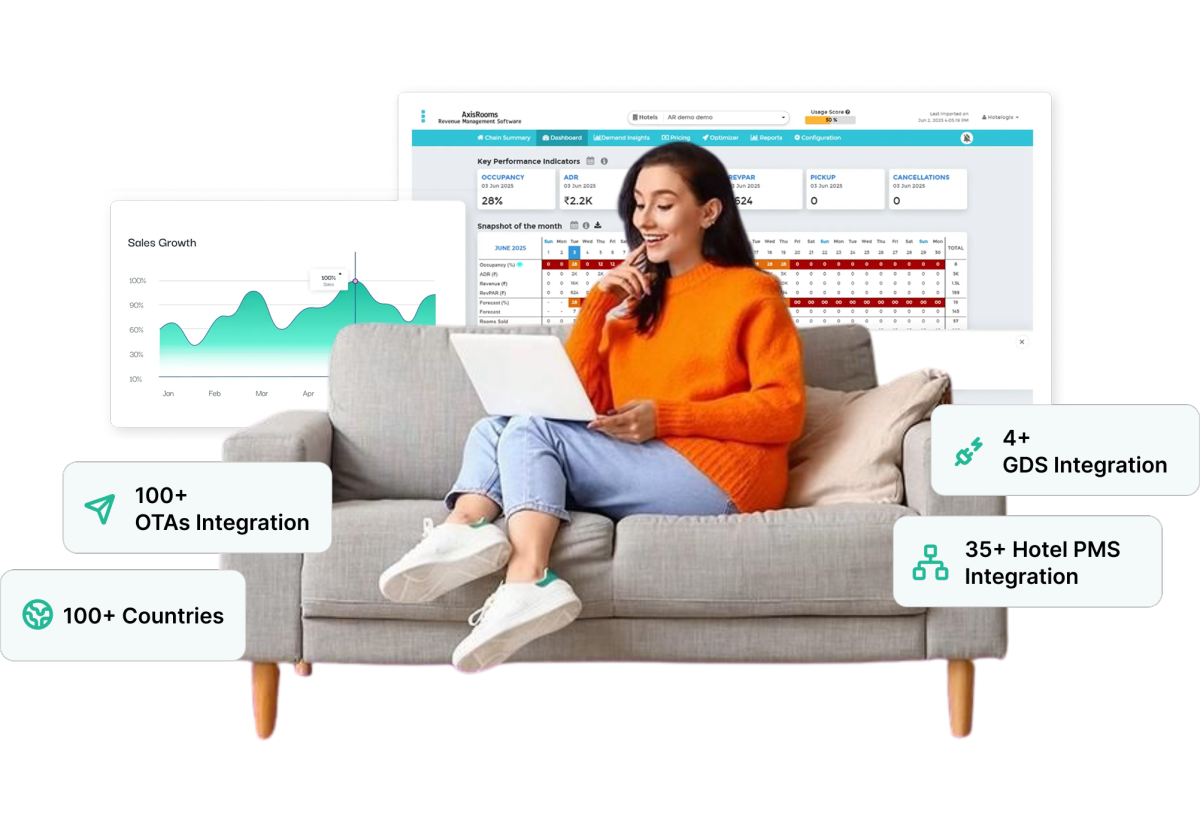
AxisRooms Channel Manager and Revenue Management tools help hotels control pricing, inventory, and distribution from one connected platform.
Hotels can manage:
- OTA Integrations: Update room rates, inventory, and availability across multiple OTAs in real time without manually logging into each platform separately.
- PMS Integrations: Connect front-desk operations, reservations, and distribution systems to maintain smoother inventory and pricing synchronization.
- Payment Gateways: Enable secure and smooth online booking transactions across direct booking channels and hotel websites.
- Channel Manager: Centralize room inventory, pricing updates, and availability management across all connected booking channels from one dashboard.
- Revenue Management Tools: Support smarter dynamic pricing decisions using occupancy trends, demand patterns, and competitor pricing insights.
- Web Booking Engine: Improve direct booking opportunities by offering guests a comfortable booking experience with real-time pricing and availability.
AxisRooms also supports multi-rate and multi-property management, helping hotels maintain pricing consistency while improving operational efficiency across channels.
Conclusion
Hotel room rate types are no longer just pricing labels; they are a critical part of modern hotel revenue strategy. From BAR pricing and negotiated corporate rates to dynamic pricing and loyalty discounts, the right rate structure helps hotels improve occupancy, protect ADR, and compete more effectively across OTAs and direct channels.
As hotel pricing becomes increasingly data-driven, structured rate management and automated distribution systems are becoming essential for maintaining pricing agility and long-term profitability.
If your hotel wants faster pricing updates, stronger OTA competitiveness, and better revenue control across channels, exploring an integrated platform like AxisRooms can help simplify rate management and pricing operations at scale.
Book a free demo today to see how connected hotel revenue management works in real time.