

The AI in the hospitality industry is no longer just about automating hotel operations; it’s changing how travelers discover, compare, and book hotels. Today, more than 90% of customers report some confidence in the travel information they receive through AI, making AI-powered search and recommendations an increasingly important part of the guest journey.
Beyond guest communication, AI is helping hotels optimize pricing, streamline operations, personalize experiences, and make faster, data-driven decisions. As AI adoption accelerates, understanding where it adds value and how to implement it effectively is becoming essential for hotels of every size.
In this guide, we’ll explore the use of AI in the hospitality industry, real-world hotel examples, top AI tools, implementation strategies, and future trends shaping hospitality in 2026.
What Is AI in the Hospitality Industry?
Artificial intelligence (AI) in the hospitality industry refers to the use of intelligent technologies to automate hotel operations, personalize guest experiences, optimize revenue, and support faster, data-driven decision-making. Rather than replacing hotel teams, AI takes over repetitive, data-intensive tasks, allowing staff to focus on delivering exceptional guest service.
Modern hospitality AI extends far beyond chatbots and virtual assistants. Revenue forecasting, dynamic pricing, guest messaging, review analysis, housekeeping optimization, and predictive maintenance are now among the most common AI applications in hotels. As these technologies become more accessible, AI is quickly evolving from a competitive advantage into a core part of everyday hotel operations.

Figure: How AI supports hotel operations across the guest journey, from AI-powered discovery and booking to personalized service and post-stay engagement.
Use of AI in Hospitality Industry: 10 Real-World Applications
From pricing decisions to guest communication, AI is reshaping almost every stage of hotel operations. Its biggest strength lies in turning large volumes of hotel data into actionable insights while automating repetitive tasks that improve both operational efficiency and the guest experience.
Most AI applications in hospitality fall into three key areas: revenue optimization, guest experience, and hotel operations.
Revenue Management & Distribution
1. Dynamic Pricing
AI continuously analyzes booking trends, competitor rates, seasonality, local events, and market demand to recommend or automatically adjust room prices in real time. This enables hotels to maximize revenue, respond to changing demand faster, and reduce the manual effort involved in pricing decisions.
Example: Global hotel brands like Marriott use AI-powered revenue management systems to optimize pricing across their properties.
2. Demand Forecasting
Rather than relying on historical data alone, AI combines booking pace, market trends, weather, events, and traveler behavior to predict future demand more accurately. These insights help hotels plan inventory, staffing, promotions, and pricing with greater confidence.
Example: Revenue teams use AI-powered forecasting tools to anticipate demand spikes during festivals, conferences, and holiday seasons.
3. Fraud Detection
AI helps identify unusual booking patterns, suspicious payment activity, and potential chargeback fraud before they affect hotel operations. This adds an extra layer of security while reducing financial risk.
Example: Hotels processing high online booking volumes use AI to detect fraudulent transactions in real time.
Guest Experience
4. Guest Messaging
AI-powered assistants can answer common guest questions, send booking confirmations, recommend hotel services, and provide instant support across websites, WhatsApp, and messaging apps. This improves response times while allowing front desk teams to focus on in-person guest interactions.
Example: Many hotels now use conversational AI to handle FAQs, reservation inquiries, and upselling opportunities 24/7.
5. Personalized Guest Experiences
By analyzing guest preferences, booking history, and previous stays, AI can deliver tailored recommendations such as room upgrades, dining offers, or local experiences. Personalization helps create more relevant guest interactions without increasing manual effort.
Example: Hilton uses AI and guest data to deliver more personalized experiences for loyalty members and returning guests.
6. Review Management
Hotels receive feedback across multiple platforms every day. AI can analyze thousands of guest reviews, identify recurring themes, measure sentiment, and highlight areas that need immediate attention, helping teams respond faster and improve service quality.
Example: Reputation management platforms use AI to summarize guest feedback and generate suggested responses.
Hotel Operations
7.Housekeeping Optimization
AI helps housekeeping teams prioritize room cleaning based on check-ins, check-outs, occupancy, and guest requests. This improves room readiness, reduces delays, and supports more efficient staff scheduling.
Example: Hotels use AI-powered housekeeping platforms to assign tasks dynamically throughout the day.
8. Predictive Maintenance
Instead of waiting for equipment to fail, AI monitors data from HVAC systems, elevators, and other assets to detect potential issues early. This reduces unexpected breakdowns, lowers maintenance costs, and minimizes disruptions to guests.
Example: Large hotel groups increasingly use predictive maintenance to improve operational reliability and extend equipment lifespan.
9. Energy Management
AI analyzes occupancy levels, weather conditions, and energy consumption to automatically optimize lighting, air conditioning, and heating across the property. This reduces operating costs while supporting sustainability initiatives.
Example: Smart hotel buildings use AI-driven energy management systems to minimize electricity consumption without compromising guest comfort.
10. Agentic AI
Unlike traditional AI tools that respond to individual requests, agentic AI can independently complete multi-step tasks by combining data, making decisions, and taking action. In hospitality, it has the potential to manage reservations, adjust pricing, coordinate guest requests, and automate operational workflows with minimal human intervention.
Example: Imagine a hotel receiving a sudden surge in bookings due to a local event. An agentic AI system could simultaneously update pricing, allocate rooms, coordinate housekeeping, and notify staff, completing the entire workflow autonomously.
Key takeaway: AI creates the greatest impact when it’s applied to everyday hotel operations, where even small improvements in pricing, communication, and efficiency can deliver measurable business results.
AI in Hospitality Examples: How Leading Hotel Brands Are Using AI
What was once limited to early technology adopters is now becoming mainstream across the hospitality industry. Global hotel groups and Indian hospitality companies are using AI to strengthen revenue management, streamline operations, and deliver more personalized guest experiences.
Global Hospitality Leaders
- Hilton: Hilton uses AI to personalize guest experiences through its loyalty program, improve customer service, and support revenue management with data-driven insights.
- IHG Hotels & Resorts: IHG leverages AI to enhance guest communications, optimize pricing strategies, and deliver more personalized recommendations across its brands.
- Marriott International: Marriott uses AI-powered revenue management systems to forecast demand, optimize room pricing, and improve operational efficiency across its global portfolio.
AI in Indian Hospitality
- OYO: OYO applies AI to forecast demand, automate pricing decisions, detect fraud, and improve operational efficiency across thousands of partner hotels.
- Taj Hotels: Taj Hotels uses AI to enhance guest engagement through personalized services, digital concierge experiences, and operational automation.
- Lemon Tree Hotels: Lemon Tree leverages AI and data analytics to strengthen revenue management, improve guest experiences, and support operational planning.
- MakeMyTrip AI: MakeMyTrip has introduced AI-powered travel planning and customer support features, enabling travelers to discover destinations, compare options, and plan trips more efficiently.
Benefits of AI in Hospitality
The value of AI extends well beyond automation. When supported by accurate data and connected hotel systems, AI helps hotels increase revenue, improve operational efficiency, deliver more personalized guest experiences, and make faster business decisions.
1. Revenue Optimization
Revenue teams can make smarter pricing and inventory decisions by using AI to analyze demand patterns, competitor rates, booking pace, and market trends in real time. This helps maximize occupancy, improve ADR and RevPAR, and uncover new revenue opportunities.
2. Cost Savings
By automating repetitive tasks such as guest messaging, housekeeping scheduling, and routine administrative work, AI reduces manual effort and operational costs. Hotel teams can spend less time on repetitive processes and more time delivering quality guest service.
3. Enhanced Guest Satisfaction
Guests increasingly expect fast, personalized, and seamless experiences. AI supports these expectations by delivering instant responses, tailored recommendations, and proactive communication throughout the guest journey, helping improve satisfaction and loyalty.
4. Higher Staff Productivity
Rather than replacing employees, AI acts as a productivity tool. Automating repetitive tasks allows front office, reservations, housekeeping, and revenue teams to focus on higher-value responsibilities that require human expertise and personal interaction.
5. Stronger Competitive Advantage
Hotels that embrace AI can adapt more quickly to changing guest expectations and market conditions. Faster decision-making, data-driven insights, and more personalized experiences help properties remain competitive in an increasingly digital hospitality landscape.
While these benefits are compelling, hotels only realize them when AI is built on accurate, connected operational data. Without a strong technology foundation, even the most advanced AI tools struggle to deliver meaningful results.
Challenges of Implementing AI in Hotels and How to Overcome Them
While AI offers significant opportunities for hotels, successful adoption depends on more than choosing the right software. Hotels must overcome technical, operational, and organizational challenges to realize long-term value.
Many of these challenges can be addressed by choosing technology that is built for integration and scalability. For example, platforms like AxisRooms combine AI-powered Revenue Management Services with connected hotel systems, enabling hotels to adopt AI more effectively while improving pricing decisions, operational efficiency, and overall revenue performance.
| Challenge | How to Overcome It |
| Legacy systems | Build a connected tech stack with cloud-based PMS, Channel Manager, and API integrations. |
| Staff resistance | Train employees early and position AI as a productivity tool, not a replacement. |
| Data privacy | Work with trusted vendors and implement clear data governance practices. |
| ROI concerns | Start with high-impact use cases and measure results before scaling AI investments. |
| Integration complexity | Choose AI solutions that integrate smoothly with existing hotel systems. |
AI adoption doesn’t have to happen all at once. Hotels that start with connected systems, clear business goals, and phased implementation are more likely to see measurable results while minimizing risk.
Conversational AI in Hospitality
Guest communication is becoming faster, smarter, and more personalized through conversational AI. Across hotel websites, mobile apps, WhatsApp, and voice assistants, hotels can now provide natural, human-like interactions that improve response times while reducing the workload on front desk teams.
1. Conversational AI vs. Chatbots
Traditional chatbots follow predefined rules and can only respond to specific commands. Conversational AI uses natural language processing (NLP) and machine learning to understand guest intent, maintain context, and handle more complex, multi-step conversations.
2. Natural Language Processing (NLP)
NLP enables conversational AI to understand how people naturally speak or type, making interactions feel more intuitive. It helps hotels respond accurately to guest queries, even when requests are phrased differently.
3. WhatsApp Automation
Hotels can use conversational AI to answer common questions, send booking confirmations, share check-in details, recommend hotel services, and provide 24/7 assistance through WhatsApp and other messaging platforms.
4. Review Management
AI can analyze guest feedback, identify recurring themes, perform sentiment analysis, and even generate personalized draft responses, helping hotels manage online reputation more efficiently.
5. Reservation Automation
Conversational AI assists guests throughout the booking process by answering availability questions, recommending room types, collecting booking details, and guiding them toward completing reservations.
6. Multilingual Support for Indian Hotels
With guests communicating in multiple languages, conversational AI helps hotels provide faster, more personalized support to both domestic and international travelers. This is particularly valuable for Indian hotels serving diverse guest segments across different regions.
As guest expectations continue to evolve, conversational AI is becoming an essential part of modern hotel operations. It enables hotels to deliver instant, personalized support at scale while allowing staff to focus on creating memorable in-person guest experiences.
Top AI Tools for Hotels
The hospitality AI ecosystem now includes specialized tools for revenue management, guest communication, operations, and reputation management. Here are some of the most widely used solutions across the hospitality industry.
| Category | Example Tools | Primary Use |
| Revenue Management AI | AxisRooms, IDeaS, Duetto, and Atomize | Dynamic pricing, demand forecasting, and revenue optimization |
| Guest Messaging AI | Hotelogix, Canary Technologies, EasyWay, and Visito | Automate guest communication, FAQs, and upselling |
| Reputation Management AI | AxisRooms, MARA Solutions, and Revinate | Analyze guest reviews, monitor sentiment, and generate responses |
| Housekeeping & Operations AI | Hotelogix, Alice (Actabl), and Flexkeeping | Automate housekeeping tasks and operational workflows |
| Dynamic Pricing (Independent Hotels) | AxisRooms and PriceLabs | Optimize room rates based on demand and market conditions |
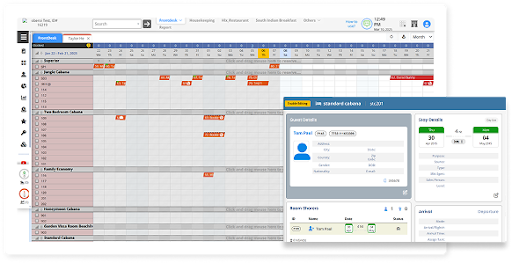
| AI-native PMS | Hotelogix, Mews, and Cloudbeds | Streamline hotel operations with AI-powered property management |
The effectiveness of these tools depends on accurate, real-time data. A connected PMS, Channel Manager, Booking Engine, and CRS provide the foundation AI needs to deliver meaningful insights and automate hotel operations effectively.
AI in the Hospitality Industry in India
India’s hospitality industry is entering a new phase of AI adoption. As cloud-based hotel technology becomes more accessible, independent hotels are beginning to embrace AI alongside larger hotel brands to improve pricing, guest communication, distribution, and operational efficiency.
AI Is Changing How Travelers Discover Hotels
Travel platforms such as MakeMyTrip, Ixigo, and Agoda are using AI to personalize travel planning and hotel recommendations. As AI-powered search becomes more common, hotels need accurate and consistent information across OTAs and direct booking channels to remain visible.
Independent Hotels Need a Strong Technology Foundation
Unlike many global markets dominated by branded hotel chains, India’s hospitality industry consists largely of independent hotels, boutique properties, and regional groups.
With cloud-based PMS, channel managers, and revenue management platforms becoming more accessible, AI is no longer limited to enterprise hotels. Even smaller properties can now automate pricing, improve distribution, and deliver more personalized guest experiences.
Connected Systems Are the Foundation
For many Indian hotels, the biggest challenge isn’t adopting AI; it’s having connected systems. AI relies on accurate, real-time data from the PMS, Channel Manager, Booking Engine, and CRS. Without this foundation, even the most advanced AI tools cannot deliver reliable insights or automation.
Preparing for the Future
Successful AI adoption doesn’t happen overnight. Hotels that first build a connected technology ecosystem and then introduce AI for high-impact use cases are more likely to achieve sustainable improvements in revenue, operational efficiency, and guest satisfaction.
How to Implement AI in Hotels
Implementing AI doesn’t require a complete technology overhaul. Most successful hotels start with one practical use case, measure the results, and expand AI adoption over time.
1. Assess Your Current Technology Stack
Evaluate whether your PMS, Channel Manager, Booking Engine, and other core systems are connected and capable of sharing accurate, real-time data. A strong technology foundation is essential for successful AI adoption.
2. Prioritize High-Impact Use Cases
Identify areas where AI can deliver immediate value, such as dynamic pricing, guest messaging, demand forecasting, or review management. Focus on solving one operational challenge before expanding further.
3. Start with a Pilot Project
Implement AI in a single department or workflow, monitor performance, and gather feedback from staff. A phased rollout minimizes risk while demonstrating measurable business value.
4. Train Your Team
AI works best when employees understand how to use it effectively. Provide training, encourage adoption, and position AI as a tool that enhances productivity rather than replacing people.
5. Measure Results and Scale
Track key performance indicators (KPIs) such as occupancy, ADR, RevPAR, response times, guest satisfaction, and operational efficiency. Use these insights to refine your AI strategy and expand adoption across the hotel.
Successful AI adoption is an ongoing process. Hotels that start small, measure results, and scale strategically are more likely to achieve long-term operational and revenue gains.
The Future of AI in Hospitality
AI adoption in hospitality is shifting from automation to intelligent decision-making. According to McKinsey, 90% of travel executives say their organizations already use generative AI in some capacity, showing how quickly AI has become part of the travel industry’s technology landscape.
In the coming years, hotels can expect AI to power more autonomous workflows, voice-enabled guest interactions, hyper-personalized experiences, AI-driven hotel discovery, and smarter sustainability initiatives. Hotels that invest in connected technology and high-quality data today will be best positioned to benefit from these advancements.
How AxisRooms Helps Hotels Build an AI-Ready Technology Stack
Building an AI-ready hotel isn’t about adopting more tools; it’s about connecting the ones you already use. Without accurate, real-time data flowing across hotel systems, even the most advanced AI solutions struggle to automate workflows, generate reliable insights, or personalize guest experiences.
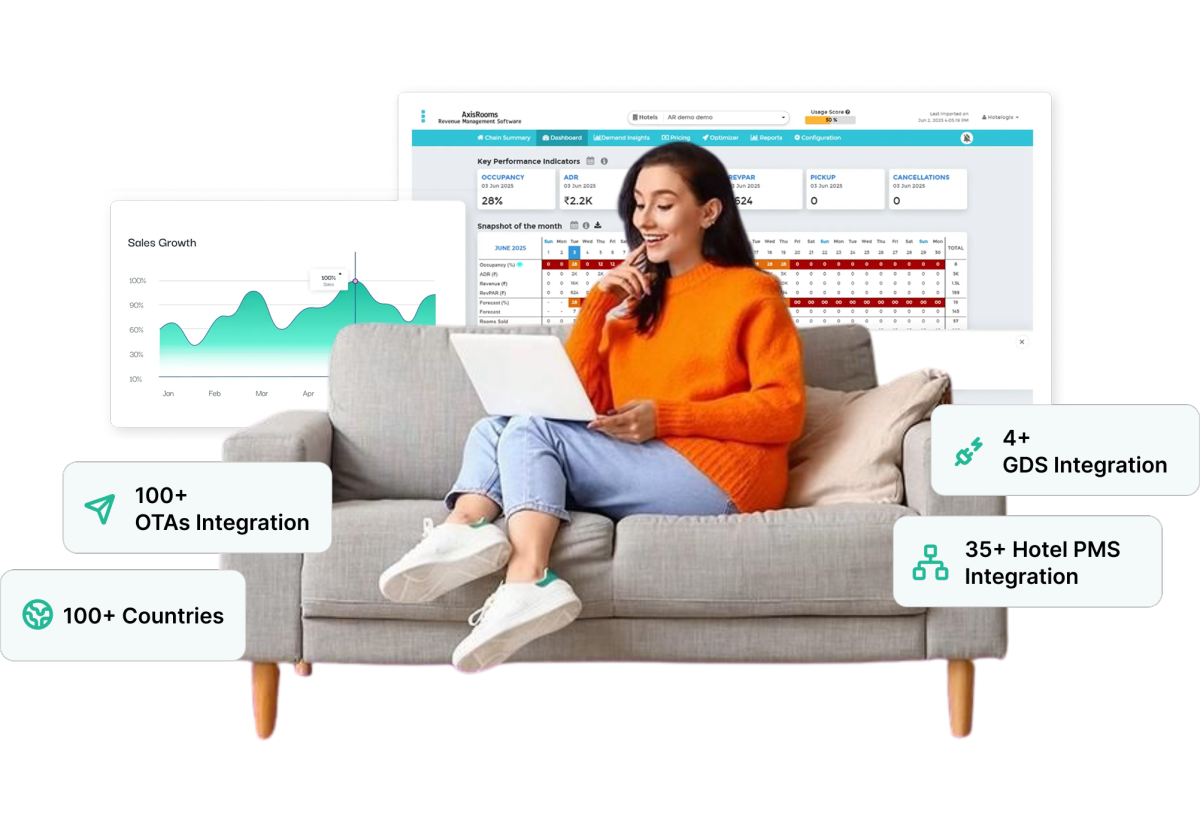
AxisRooms helps hotels build that connected foundation by effortlessly connecting core systems, centralizing real-time data, and enabling smoother operations across distribution, pricing, and guest management. With 100+ OTA integrations and effortless connectivity across the hospitality technology ecosystem, hotels can adopt AI with confidence through:
- OTA Integrations: Synchronize rates and inventory across multiple booking channels in real time.
- PMS Integrations: Connect your property management system for smooth data flow and operational efficiency.
- Payment Gateway Integrations: Simplify secure online payments and improve the guest booking experience.
- Channel Manager: Centralize distribution, prevent overbookings, and keep inventory updated automatically.
- Revenue Management Services: Support smarter pricing decisions with data-driven revenue optimization.
- Web Booking Engine: Increase direct bookings with a fast, user-friendly, and commission-free booking experience.
The future of AI is not based on standalone tools; it relies on integrated hotel technology like AxisRooms to establish a solid foundation for hotels.
Conclusion
AI is rapidly becoming part of everyday hotel operations, transforming how properties attract guests, optimize revenue, and improve operational efficiency. The real competitive advantage, however, won’t come from adopting every new AI tool; it will come from building connected systems and reliable data that allow those tools to perform at their best.
Whether you’re just beginning your AI journey or looking to expand existing capabilities, investing in the right technology foundation today will prepare your hotel for the future of hospitality.
Book a free demo today with AxisRooms to discover how a connected hotel technology ecosystem can help your property adopt AI with confidence while driving smarter revenue, distribution, and guest experiences.