
Average length of stay (ALOS) is one of the most important hotel KPIs because it directly impacts revenue, profitability, and operational efficiency. While metrics like occupancy, ADR, and RevPAR often get more attention, understanding how long guests stay can reveal valuable opportunities to increase revenue and reduce costs.
A longer stay means more room revenue from each booking, lower room turnover expenses, and greater opportunities for ancillary spending. However, ALOS is not the same for every property and can vary significantly based on factors such as destination, hotel type, seasonality, and guest segment.
In this guide, you’ll learn what average length of stay means, how to calculate it, industry benchmarks, and practical strategies to increase ALOS and maximize hotel revenue.
What is ALOS in Hotels? Meaning, Definition, and Why It Matters
Average Length of Stay (ALOS) is a hotel KPI that measures the average number of nights guests stay at a property during a specific period. It is calculated by dividing the total room nights sold by the total number of bookings. ALOS helps hotels understand guest stay patterns and evaluate overall business performance.
In the hospitality industry, the ALOS hotel metric is widely used by owners, general managers, and revenue teams to evaluate booking behavior, profitability, and operational efficiency.
Why ALOS Matters
- Increases revenue potential: Longer stays can generate more revenue from each booking.
- Reduces operational workload: Fewer check-ins, check-outs, and room turnovers improve efficiency.
- Supports revenue management: Stay patterns help hotels optimize pricing and packages.
- Improves forecasting: Hotels can plan inventory, staffing, and demand more accurately.
ALOS is commonly tracked by hotel owners, general managers, and revenue managers because it directly impacts both profitability and operational efficiency.
The ALOS Formula: How to Calculate Average Length of Stay in Hotels
The average length of stay calculation is one of the simplest hotel KPI calculations. It shows how many nights guests stay on average during a specific period and helps hotels understand booking patterns, operational efficiency, and revenue opportunities.
Average Length of Stay Formula for Hotels
ALOS = Total Room Nights Sold ÷ Total Number of Bookings
Understanding the Formula
- Total Room Nights Sold: The total number of nights occupied by rooms sold during the period.
- Total Bookings: The total number of reservations received during the same period.
- Calculation Period: ALOS can be measured daily, weekly, monthly, quarterly, or annually.
Example:
Calculating ALOS for a Bangalore Business Hotel
Let’s assume a hotel in Bangalore sold 300 room nights during a month and received 150 bookings.
ALOS = 300 ÷ 150 = 2 nights
This means the average guest stayed at the hotel for 2 nights per booking.
How to Calculate Average Length of Stay in Excel (Step-by-Step)
While many hotels use PMS reports to track KPIs automatically, Excel remains a simple way to calculate the Average Length of Stay formula in hospitality, especially for small properties or teams that are just beginning to monitor performance.
Step 1: Set Up Your Spreadsheet
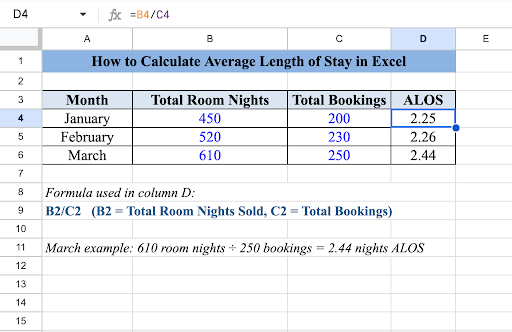
Create a spreadsheet with the following columns:
| Month | Total Room Nights Sold | Total Bookings | ALOS |
| January | 450 | 200 | 2.25 |
| February | 520 | 230 | 2.26 |
| March | 610 | 250 | 2.44 |
Step 2: Apply the Excel Formula
In the ALOS column, use the following average length of stay formula that Excel users commonly apply:
=B2/C2
Where:
- B2 = Total Room Nights Sold
- C2 = Total Bookings
Excel will automatically calculate the average number of nights guests stayed during that period.
Step 3: Calculate Monthly ALOS
For example, if your hotel sold 610 room nights in March and received 250 bookings:
ALOS = 610 ÷ 250 = 2.44 nights
This means the average guest stayed at your hotel for approximately 2.4 nights during the month.
Average Length of Stay Benchmarks: What’s Normal for Indian Hotels?
Average Length of Stay (ALOS) varies significantly across India depending on destination type, traveler intent, and seasonality. Business hubs typically see shorter stays, while leisure, heritage, and pilgrimage destinations often benefit from longer guest visits.
| Destination / Hotel Type | Typical ALOS |
| Goa Resorts | 3–5 nights |
| Jaipur & Udaipur Heritage Hotels | 2–4 nights |
| Bangalore Business Hotels | 1.5–2.5 nights |
| Mumbai & Delhi Mixed-Demand Hotels | 1.8–3 nights |
| Varanasi & Rishikesh Pilgrimage Hotels | 2–4 nights |
The typical benchmark data highlights a clear trend: leisure, heritage, and pilgrimage destinations generally see longer stays than business-focused cities, where corporate travel often results in shorter booking durations.
Example: How ALOS Changes by Destination
Goa Resorts: Leisure travelers, remote workers, and family vacations often contribute to longer stays, particularly during peak holiday seasons.
Jaipur & Udaipur Heritage Hotels: Guests frequently combine sightseeing, cultural experiences, and destination weddings, resulting in above-average stay durations.
Bangalore Business Hotels: The average length of stay in a hotel in Bangalore is typically shorter, ranging between 1.5 and 2.5 nights, driven largely by corporate travel and short business visits.
Mumbai & Delhi Hotels: These markets attract a mix of business, leisure, medical, and transit travelers, creating moderate stay durations throughout the year.
Varanasi & Rishikesh Hotels: Pilgrimage, wellness tourism, and spiritual retreats often encourage guests to stay longer than traditional city hotels.
Rather than comparing your ALOS against a national average, it’s more useful to benchmark against hotels in similar destinations, guest segments, and property categories.
Why ALOS Matters for Hotel Revenue and Profitability
The average length of stay hotel metric is more than a reporting metric. It directly affects revenue, operational efficiency, and overall profitability. When guests stay longer, hotels can generate more value from each booking while reducing the costs associated with frequent room turnover.
Higher Revenue Per Booking: Longer stays increase the total revenue generated from each reservation and create more opportunities for ancillary spending.
Lower Housekeeping Costs: Fewer check-ins and check-outs mean fewer room turnovers, helping reduce cleaning time, laundry expenses, and housekeeping workload.
Reduced Front Desk Workload: Longer stays decrease the number of arrivals and departures staff need to manage, improving operational efficiency.
Higher Guest Lifetime Value: Guests who stay longer often spend more on dining, spa services, activities, and other hotel amenities.
Revenue Impact Example
Consider a 50-room hotel with an average occupancy of 70%.
| Scenario | ALOS | Monthly Room Revenue* |
| Current Performance | 2.0 nights | ₹21,00,000 |
| Improved Performance | 2.4 nights | ₹23,10,000 |
*Illustrative example assuming stable occupancy and ADR.
A modest increase of just 0.4 nights in Average Length of Stay can create a noticeable increase in revenue while reducing operational costs, making ALOS one of the most valuable hotel KPIs to track.
ALOS vs ADR vs RevPAR
ALOS, ADR, and RevPAR are three of the most important hotel KPIs, but they measure different aspects of performance. The ALOS hotel metric focuses on guest stay duration, while ADR and RevPAR focus on pricing and revenue efficiency.
| KPI | What It Measures | Why It Matters |
| ALOS (Average Length of Stay) | Average number of nights guests stay per booking | Helps improve operational efficiency and guest value |
| ADR (Average Daily Rate) | Average revenue earned per occupied room | Indicates pricing strength |
| RevPAR (Revenue Per Available Room) | Revenue generated from available rooms | Measures overall revenue performance |
How These KPIs Work Together
- ALOS focuses on stay duration and booking efficiency.
- ADR focuses on how much guests pay per night.
- RevPAR combines pricing and occupancy to measure revenue performance.
There is no single KPI that defines hotel success. A hotel with a high ADR but low occupancy may generate less revenue than expected, while a property with high occupancy and short stays may face higher turnover and operating costs. The most successful hotels monitor ALOS, ADR, and RevPAR together to balance pricing, demand, and profitability.
For example, a hotel may achieve a high ADR but struggle with occupancy, resulting in weaker RevPAR. Similarly, increasing ALOS can reduce room turnover costs and generate more revenue per booking, even if occupancy remains unchanged.
Average Length of Stay by Hotel Type and Booking Channel
Average Length of Stay can vary significantly depending on both the type of hotel and the booking channel. Understanding these patterns helps hotels identify their most valuable guest segments and create strategies to attract longer stays.
Average Length of Stay by Hotel Type
| Hotel Type | Typical ALOS | Why It Varies |
| Luxury Hotels | 2–4 nights | Leisure travelers, premium experiences, and destination stays |
| Business Hotels | 1.5–2.5 nights | Corporate trips and short business visits |
| Resorts | 3–7 nights | Vacation-focused travel and longer leisure stays |
| Budget Hotels | 1–2 nights | Transit, short-stay, and price-sensitive travelers |
| Extended Stay Properties | 7+ nights | Long-term guests, relocations, and project stays |
Average Length of Stay by Booking Channel
| Booking Channel | Typical ALOS | Why It Varies |
| Direct Bookings | Higher | Greater loyalty and planned travel |
| OTAs | Moderate | Mix of leisure and short-term travelers |
| Corporate Bookings | Lower | Short business trips and weekday demand |
| Group Bookings | Higher | Events, conferences, weddings, and tours |
Key Takeaways
As a general rule, resorts, extended-stay properties, and group bookings tend to generate higher ALOS than business-focused hotels and corporate travel segments. Understanding these patterns helps hotels focus on the guest segments that deliver greater long-term value.
8 Proven Strategies to Increase Average Length of Stay
Increasing Average Length of Stay doesn’t always require major discounts. Often, a combination of pricing strategies, targeted offers, and guest experience enhancements can encourage travelers to stay longer and spend more during their visit.
8 Proven Strategies
- Implement Minimum Length of Stay Restrictions: Require a minimum number of nights during peak periods to maximize revenue and reduce room turnover.
- Create Packages and Bundles: Combine accommodation with dining, spa treatments, sightseeing, or airport transfers to encourage longer bookings.
- Build Loyalty Programs: Reward guests with benefits, discounts, or upgrades for extending their stay or returning in the future.
- Upsell Longer Stays at Booking: Offer discounted additional nights during the booking process or at check-in.
- Promote Local Experiences: Highlight nearby attractions, events, and activities that motivate guests to extend their trip.
- Launch Extended Stay Offers: Introduce weekly or long-stay rates for remote workers, digital nomads, and long-term travelers.
- Target the Right Guest Segments: Focus marketing efforts on travelers who naturally book longer stays, such as families and leisure guests.
- Use Revenue Management Strategically: Adjust pricing and availability to encourage longer stays during low-demand periods.

Manage All Your OTAs from One Place
Request a DemoIndia-Specific Strategies to Increase ALOS
| Opportunity | How It Can Increase ALOS |
| Wedding Packages | Encourage guests to stay multiple nights around ceremonies and events |
| Pilgrimage Circuits | Combine nearby religious destinations into longer itineraries |
| Festival Travel Packages | Extend stays around local festivals and cultural events |
| Corporate Extended Stays | Offer weekly rates for project teams and business travelers |
| Family Holiday Packages | Bundle activities and experiences to encourage longer vacations |
Average length of stay in hospitality in India: destination-specific packages often outperform generic discounts because they provide a stronger reason for guests to extend their stay, rather than simply reducing room rates.
How ALOS Changes by Season, Weekday, and Guest Segment
Average Length of Stay is not fixed throughout the year. It changes based on travel demand, guest purpose, seasonality, and destination type. Understanding these patterns helps hotels forecast demand more accurately and create targeted offers that encourage longer stays.
- Peak vs Off-Season: Leisure destinations often record longer stays during peak travel periods, while off-season demand may consist of shorter, price-sensitive bookings.
- Weekday vs Weekend: Business hotels typically see shorter weekday stays, whereas leisure travelers may extend weekend trips.
- Domestic vs International Travelers: International guests generally stay longer because they travel greater distances and often visit multiple attractions during a single trip.
- Leisure vs Corporate Guests: Leisure travelers, families, and vacationers usually book longer stays than corporate guests traveling for meetings or short-term projects.
Goa Resort Example: Seasonal ALOS Comparison
A resort in Goa may average 2–3 nights during the monsoon season, but see ALOS increase to 4–6 nights during the winter holiday period, when families, international tourists, and remote workers stay for longer vacations.
How AxisRooms Helps Hotels Increase Average Length of Stay and Revenue
Tracking Average Length of Stay manually through spreadsheets can make it difficult to identify trends, compare guest segments, and uncover revenue opportunities. As booking volumes grow and reservations arrive from multiple channels, hotels need better visibility into the data that influences profitability.
AxisRooms helps hotels centralize distribution, bookings, and performance insights through one connected platform. By bringing inventory, pricing, reservations, and reporting together, it becomes easier to understand stay patterns and make informed revenue decisions.
- OTA Integrations: Manage inventory and bookings across multiple channels while maintaining real-time visibility into booking trends.
- PMS Integrations: Connect operational and reservation data to gain a clearer view of guest behavior and stay patterns.
- Channel Manager: Keep rates and availability synchronized across channels while reducing manual updates.
- Revenue Management Services: Support smarter pricing decisions based on demand, booking pace, and market conditions.
- Web Booking Engine: Drive more direct bookings and create opportunities to attract longer-stay guests.
- Payment Gateways: Simplify transactions and provide a smoother booking experience for guests.
When distribution, pricing, and booking data come together, hotels gain a clearer view of what drives Average Length of Stay (ALOS). With better insights, they can fine-tune rates, optimize inventory, and unlock new revenue opportunities.
Conclusion
Average Length of Stay is one of the few hotel metrics that influences both revenue and operational efficiency at the same time. Longer stays can reduce room turnover, lower servicing costs, increase guest spending, and create stronger profitability across the property.
The most successful hotels don’t treat ALOS as just another number on a report. They analyze guest behavior, booking patterns, seasonality, and channel performance to uncover opportunities that drive more valuable stays. Small improvements can compound into meaningful business results over time.
With the right technology and real-time insights, tracking and improving ALOS becomes far easier. Book a free demo today and discover how AxisRooms can help you make smarter distribution, pricing, and revenue decisions.