

Hotel business profit margins are becoming harder to maintain, even as bookings and room revenue continue growing across India’s hospitality industry. Rising OTA commissions, staffing costs, discount-heavy pricing, and operational expenses are putting increasing pressure on hotel profitability.
India’s hotel market continued to strengthen in 2025, reaching 64% occupancy, ₹8,624 ADR, and ₹5,522 RevPAR, according to Horwath HTL. Yet stronger revenue does not always translate into stronger profit when operating and distribution costs rise alongside it.
In this guide, we’ll explain how hotel profitability works, how to calculate hotel profit margins, what affects margins most, which metrics hotel owners should track, and how Indian hotels can improve profitability more efficiently in 2026.
What Is Hotel Business Profit? (And Why It’s Not Just RevPAR)
Hotel business profit is the money a hotel retains after deducting its applicable expenses from total revenue.
Hotel revenue can come from rooms as well as food and beverage, events, spa services, transportation, and other ancillary offerings. Expenses may include operating costs, commissions, salaries, utilities, taxes, maintenance, rent, and other business expenses.
For example, if a hotel generates ₹13 lakh in monthly revenue and spends ₹9 lakh on operations and other applicable business expenses, the remaining ₹4 lakh represents the profit for that period.
Many hotel owners confuse revenue growth with profit growth. A hotel may increase occupancy and ADR significantly, but still see weak margins if higher OTA commissions, staffing costs, or operating expenses offset the additional revenue.
For instance, a hotel operating at 85% occupancy with aggressive OTA discounts may earn less profit than a hotel running at 70% occupancy with stronger direct bookings and better pricing control.
Key Hotel Profitability Terms
| Metric | Meaning |
| Gross Profit | Revenue remaining after direct operating costs, like room servicing and housekeeping |
| GOP (Gross Operating Profit) | Profit generated from the hotel’s core operations after applicable operating expenses |
| Net Profit | Profit generated from the hotel’s core operations after applicable operating expenses |
| RevPAR | Earnings remaining after operating and other applicable business expenses |
RevPAR is an important revenue-performance metric, but it does not represent profit because it does not account for the costs involved in generating that revenue.
To understand whether a hotel business is truly profitable, owners need to look beyond revenue and room performance and consider what remains after the costs of generating that revenue.
Why Is Hotel Profit Margin Important to Measure?
Hotel profit margin is important to measure because it shows how much of the revenue generated by a property remains as profit after accounting for its costs.
Looking only at room revenue or occupancy can give an incomplete picture of how well a hotel business is performing. A property may generate more bookings while seeing its margin decline if it relies heavily on discounts or incurs higher distribution, labour, energy, or maintenance costs.
Tracking profit margin helps hotel owners and operators:
- Compare performance over time: Tracking margins across different months, seasons, or years can show whether profitability is improving or declining.
- Identify cost pressures: Changes in profit margin can highlight areas where expenses are increasing faster than revenue.
- Evaluate pricing decisions: A higher room rate does not necessarily result in higher profit if it also affects occupancy or comes with higher acquisition costs.
- Make better business decisions: Understanding margins gives owners a clearer basis for decisions around pricing, distribution, staffing, and other operating expenses.
For Indian hotels, where costs and demand can vary significantly by location, property category, season, and operating model, monitoring profit margin provides a more useful view of business performance than revenue or occupancy alone.
Is Hotel Business Profitable in India? Average Hotel Profit Margins Explained
Hotel business can be profitable in India, but the level of profitability varies significantly from one property to another.
Hotel profitability depends on factors such as hotel category, location, ADR, occupancy, OTA dependency, operating costs, property ownership model, and additional revenue streams. A property with strong pricing and a lean cost structure may generate healthier margins than a hotel with similar revenue but significantly higher fixed or operating expenses.
| Hotel Segment | Typical ADR* (₹) | Profitability Trend | Biggest Margin Pressure |
| Budget Hotels | ₹1,500–₹3,000 | Tighter margins with a lean operating structure | OTA commissions and pricing pressure |
| Midscale Hotels | ₹3,500–₹6,000 | Balanced revenue potential with moderate operating costs | Staffing and operating costs |
| Upscale Hotels | ₹6,000–₹10,000 | Higher revenue potential with stronger ancillary opportunities | F&B, staffing, and service costs |
| Luxury Hotels | ₹10,000+ | Premium pricing and ancillary revenue create stronger profit potential | Maintenance, staffing, and service costs |
* Note: ADR ranges are indicative estimates based on India’s hotel industry benchmarking trends and are not exact national segment benchmarks for every hotel class.
For context, ICRA’s FY2026 outlook for a sample of 13 large hotel entities indicated operating margins of around 34–36%. This reflects operating profitability for that specific sample, not net profit margins or a benchmark for every hotel in India.
Budget hotels often operate with tighter margins because of pricing pressure and OTA dependency, while upscale and luxury hotels have greater revenue potential through higher ADR and ancillary spending. However, profitability across every segment ultimately depends on the balance between pricing, occupancy, distribution costs, and operating expenses.
What Is a Good Hotel Profit Margin in India?
There is no single hotel profit margin that can be considered good for every property in India, because hotel business margins vary by segment, location, ownership model, and cost structure.
A property with a lean cost structure and strong pricing may achieve a healthier margin than a hotel with similar revenue but higher labour, rent, debt, maintenance, or distribution costs.
For this reason, hotel owners should use profit-margin benchmarks as a reference rather than a guaranteed target. Comparing the property’s margin over time and, where relevant, against similar hotels can provide a more meaningful view of performance.
The more useful question is not only “What is the average hotel profit margin in India?” but also “How much of my hotel’s revenue is actually being retained as profit?”
Note: Hotel profit margins can vary significantly by property type, location, operating model, and cost structure. Any benchmark should therefore be treated as indicative rather than a universal industry standard.
How to Calculate Hotel Profit Margin: Formulas + Worked Examples
Hotel profit margin is calculated by dividing net profit by total hotel revenue and multiplying the result by 100.
Before calculating the margin, hotel owners need to determine how much revenue the property generates and how much it spends during the same period. The calculation becomes more useful when revenue and expenses are measured over the same month, quarter, or year.
How to Calculate Hotel Profit
The basic formula is:
Hotel Profit = Total Hotel Revenue − Total Hotel Expenses
Hotel revenue can include room revenue along with income from F&B, events, spa services, transportation, and other operations. Expenses may include employee costs, utilities, maintenance, OTA commissions, marketing, supplies, rent, and other applicable business expenses.
For example, if a hotel generates ₹50 lakh in total revenue and incurs ₹40 lakh in total expenses:
Hotel Profit = ₹50 lakh − ₹40 lakh = ₹10 lakh
The hotel’s profit for that period is therefore ₹10 lakh.
Hotel Profit Margin Formula
Once profit has been calculated, the margin can be determined using:
Hotel Profit Margin = (Net Profit ÷ Total Revenue) × 100
Using the example above:
Hotel Profit Margin = (₹10 lakh ÷ ₹50 lakh) × 100 = 20%
The hotel therefore retains ₹20 as net profit for every ₹100 of revenue generated, based on the expenses included in the calculation.
Key Hotel Profit Formulas
The following formulas provide a quick reference for the main profitability measures used in hotel financial analysis:
| Metric | Formula | What It Measures |
| Hotel Profit | Total Revenue − Total Expenses | Profit remaining after applicable expenses |
| GOP | Total Operating Revenue − Operating Expenses | Profitability from core hotel operations |
| Net Profit Margin | (Net Profit ÷ Total Revenue) × 100 | Percentage of revenue retained as net profit |
| GOP Margin | (GOP ÷ Total Operating Revenue) × 100 | Operating profit as a percentage of operating revenue |
These formulas should be applied using clearly defined revenue and expense categories so that results remain consistent when comparing performance across different periods.
GOP Margin vs Net Profit Margin
Hotel profitability can be measured at different levels, so GOP margin and net profit margin should not be treated as the same metric.
GOP Margin = (Gross Operating Profit ÷ Total Operating Revenue) × 100
Gross Operating Profit, or GOP, focuses on the hotel’s operating performance after operating expenses. Net profit goes further by accounting for other applicable expenses outside the operating level.
As a result, a hotel may have a healthy GOP margin while its final net profit margin is lower. GOP margin helps assess the efficiency of the hotel’s core operations, while net profit margin shows how much revenue remains after the broader costs included in the calculation.
Worked Example: Calculating Hotel Profit Margin for a 20-Room Hotel
Consider a 20-room hotel with an ADR of ₹2,500 and an average occupancy of 65%. The following simplified example shows how room revenue, operating expenses, and other applicable costs can be used to calculate hotel profit margin.
| Particulars | Calculation | Amount |
| Total Rooms | — | 20 |
| ADR | — | ₹2,500 |
| Occupancy Rate | — | 65% |
| Monthly Room Revenue | 20 × ₹2,500 × 65% × 30 days | ₹9,75,000 |
| OTA Commission | Illustrative distribution cost | ₹87,750 |
| Housekeeping & Utilities | Monthly operating costs | ₹1,20,000 |
| Staff Salaries | Monthly payroll | ₹80,000 |
| Fixed & Other Operating Costs | Rent, maintenance, software, etc. | ₹1,50,000 |
| Total Operating Expenses | Sum of listed operating costs | ₹4,37,750 |
| Gross Operating Profit (GOP) | ₹9,75,000 − ₹4,37,750 | ₹5,37,250 |
| Other Applicable Expenses | Illustrative costs outside operating expenses | ₹2,47,250 |
| Net Profit | ₹5,37,250 − ₹2,47,250 | ₹2,90,000 |
| Hotel Profit Margin | (₹2,90,000 ÷ ₹9,75,000) × 100 | 29.7% |
Based on these illustrative assumptions, the hotel generates a net profit of ₹2.9 lakh on ₹9.75 lakh in monthly room revenue, resulting in a 29.7% hotel profit margin.
The same approach can be applied to monthly, quarterly, or annual hotel performance, provided the revenue and expenses relate to the same period and the hotel uses consistent definitions for its operating and other expenses.
Illustrative example: The figures above demonstrate the calculation method and should not be treated as an industry-wide hotel profit benchmark. Actual margins will vary based on occupancy, ADR, distribution costs, staffing, property expenses, revenue mix, and other applicable costs.
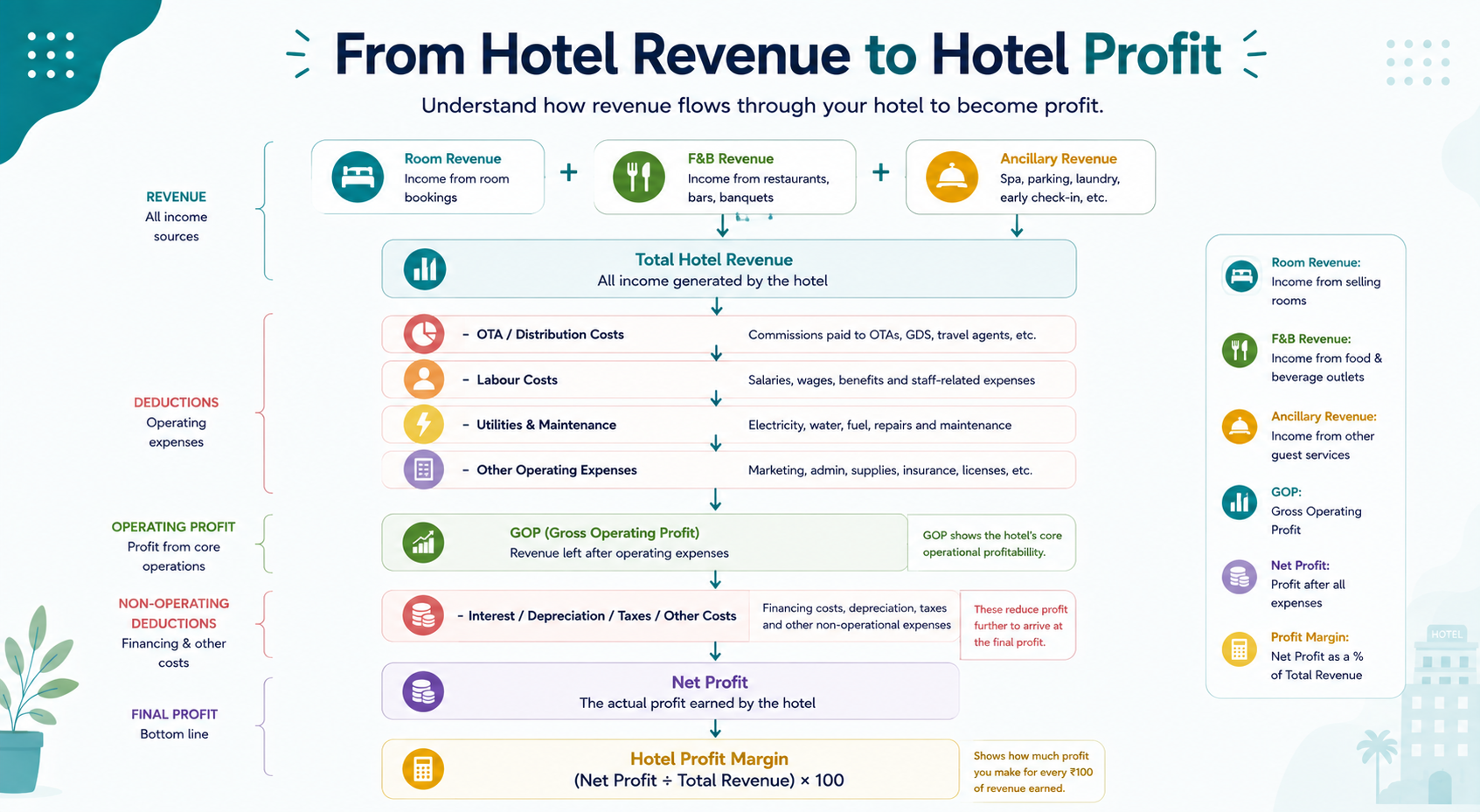
Image: How hotel revenue from rooms, F&B, and ancillary services flows through OTA commissions, labour, utilities, maintenance, and other operating expenses to arrive at GOP and net profit. It also shows how net profit is used to calculate the hotel profit margin.
What Affects Hotel Profit Margins the Most?
Hotel profit margins are affected by the relationship between revenue, pricing, distribution expenses, operating costs, and the property’s overall business model.
1- OTA Commission Drain
Hotels can incur significant acquisition costs when a large share of bookings comes through OTAs. These costs directly reduce the revenue retained from each commission-bearing reservation.
2- Labour Cost Pressure
Rising salaries, staffing shortages, and 24/7 operational requirements continue to increase payroll pressure across Indian hotels, especially in business and luxury segments.
3- Declared vs Actual Tariff Gap
Heavy discounting and inconsistent pricing across channels can affect the revenue a hotel ultimately retains from room sales. Hotels need clear control over published rates, discounts, and applicable taxes.
4- F&B Margin Contribution
Hotels with strong restaurant, banquet, and upselling performance can generate meaningful revenue beyond rooms. The profitability of these departments, however, depends on their own food, labour, and operating costs.
5- Occupancy vs ADR Balance
High occupancy with aggressive discounting does not necessarily produce stronger profitability. Similarly, a higher ADR may not deliver the desired result if occupancy falls significantly.
6- Energy & Maintenance Costs
Electricity, HVAC systems, laundry operations, repairs, and maintenance can gradually reduce margins if consumption and recurring expenses are not monitored closely.
7- Property Ownership and Fixed Costs
Rent, lease obligations, debt servicing, property taxes, and other fixed commitments can significantly affect the amount of revenue that reaches the bottom line. Two hotels with similar occupancy and ADR can therefore have very different profit margins.
8- Revenue Mix
Hotels relying almost entirely on room revenue have a different profitability profile from properties generating meaningful F&B, events, spa, banquet, transport, or other ancillary revenue.

Manage All Your OTAs from One Place
Request a DemoThe Hidden Margin Killer: OTA Commissions and What Indian Hotels Are Paying
OTA commissions can have a direct impact on the profit margin in the hotel business, particularly when a significant share of bookings comes through commission-based channels.
OTAs provide visibility and booking reach, but every commission-bearing reservation carries an acquisition cost. The financial impact becomes more noticeable as booking volumes increase.
Example OTA Commission Impact by Hotel Size:
| Hotel Size | OTA Share | Potential Impact |
| 20 Rooms | 60% | Commission expense can become a high recurring cost |
| 50 Rooms | 60% | Higher booking volume can magnify distribution costs |
| 100 Rooms | 60% | OTA costs can become a major contributor to acquisition expense |
The actual cost depends on the OTA contract, commission structure, promotions, room rates, booking volume, and the hotel’s direct acquisition costs. Hotels should therefore evaluate distribution not only by the number of bookings generated, but also by the revenue retained after acquisition costs.
AxisRooms Channel Manager can help hotels centralise OTA distribution and manage rates and availability across connected channels.
How Indian Hotels Improve Profit Margins Without Raising Occupancy
Improving hotel profitability is not always about filling more rooms. Hotels can also strengthen margins through better pricing, distribution, ancillary revenue, and operational efficiency.
Use Dynamic Pricing
Rather than relying on fixed rates throughout the year, hotels can adjust pricing based on demand, seasonality, booking pace, local events, and market conditions. The goal is to capture stronger ADR when demand supports it while remaining competitive during softer periods.
Reduce OTA Dependency
OTAs can provide valuable visibility, but hotels can also work towards increasing their share of direct bookings. A stronger direct channel can reduce reliance on commission-based distribution while giving properties greater control over the booking relationship.
Improve F&B and Ancillary Revenue
Hotels can look beyond room revenue by identifying opportunities in F&B, events, spa services, transfers, upgrades, and other relevant offerings. The focus should remain on revenue streams that contribute positively after their associated costs are considered.
Automate Routine Operations
Manual processes can consume staff time and create opportunities for errors in areas such as distribution, reservations, inventory, and reporting. Automating repetitive workflows can free teams to focus on higher-value operational and revenue activities.
Increase Upselling and Cross-Selling
Room upgrades, meal plans, early check-in, late check-out, experiences, and transfers can increase revenue from existing guests. These opportunities can complement room revenue without requiring additional occupancy.
Track GOPPAR and Other Profitability Metrics
Revenue growth does not automatically mean stronger profitability. Monitoring GOPPAR alongside occupancy, ADR, and RevPAR can help owners understand whether additional revenue is translating into stronger operating performance.
Control Energy and Property Costs
Hotels can review energy consumption, preventive maintenance, procurement, and other recurring expenses to identify areas where costs can be reduced without affecting the guest experience.
Which Hotel Metrics Should Owners Track for Profitability?
Hotel owners should track occupancy, ADR, RevPAR, GOP margin, GOPPAR, TRevPAR, CPOR, and direct booking share to understand what is driving profitability.
Each metric highlights a different part of hotel performance, from room utilisation and pricing to operating profit and distribution costs.
| Metric | What It Measures | Why It Matters for Profitability |
| Occupancy Rate | Percentage of available rooms occupied | Shows how effectively room inventory is being utilised |
| ADR | Average revenue earned per occupied room | Indicates the average price at which rooms are being sold |
| RevPAR | Revenue generated per available room | Shows room revenue efficiency by combining occupancy and ADR |
| GOP Margin | GOP as a percentage of operating revenue | Indicates how much operating revenue remains after operating expenses |
| GOPPAR | GOP per available room | Connects operating profit with available room inventory |
| TRevPAR | Total revenue per available room | Measures revenue generated across rooms and other hotel departments |
| CPOR | Operating cost per occupied room | Helps identify the cost associated with serving occupied rooms |
| Direct Booking Share | Percentage of bookings received directly | Shows reliance on commission-based distribution and its potential impact on margins |
These metrics work best when viewed together. For example, rising occupancy may increase revenue, but if ADR falls or operating and distribution costs increase, the hotel’s overall profit margin may still decline.
How PMS & Channel Managers Improve Hotel Profitability
PMS and channel managers can improve hotel profitability by reducing manual work, preventing distribution errors, and giving hotel teams better control over rates, inventory, and reservations.
A Property Management System (PMS) manages core hotel operations such as reservations, room status, guest information, and billing. A channel manager connects the hotel with OTAs and other booking channels, helping synchronise room rates and availability across platforms.
When these systems work together, hotels can reduce repetitive data entry and respond faster to changes in bookings, pricing, and inventory.
Manual vs Connected Hotel Operations
| Manual Hotel Operations | Connected Hotel Operations |
| OTA rates and availability updated manually | Rates and availability synchronised across connected channels |
| Staff spend time entering reservation data | Reservations can flow between connected systems |
| Higher risk of inventory mismatch and booking errors | Real-time inventory updates reduce distribution discrepancies |
| Pricing changes take longer to implement | Rate changes can be distributed more efficiently |
| Revenue reports are compiled manually | Centralised dashboards provide faster visibility |
| Difficult to identify revenue leakage | Connected data makes distribution and performance gaps easier to identify |
The financial benefit comes from reducing operational friction. Fewer manual updates and distribution errors can save staff time, minimise revenue leakage, and give hotel teams more time to focus on pricing, direct bookings, and revenue performance.
However, technology does not automatically increase hotel profit. Its value lies in helping teams execute pricing, inventory, distribution, and operational decisions more efficiently and consistently.
Why AxisRooms Is a Smarter Solution for Improving Hotel Profit Margins
As hotels look for ways to protect margins, managing distribution, pricing, direct bookings, and operational workflows through disconnected systems can create unnecessary complexity. The right technology can bring these activities into a more coordinated workflow and reduce some of the manual effort involved in managing them.
AxisRooms brings together hotel technology solutions that support distribution, direct bookings, revenue management, PMS connectivity, and payments. This gives hotels a connected technology environment for managing the processes that influence bookings and revenue.
Key Capabilities:
- Channel Manager: Manage room inventory, rates, and availability across connected booking channels while reducing repetitive manual updates.
- OTA Integrations: Connect with multiple OTAs and coordinate rates, availability, and reservations across distribution channels.
- PMS Integrations: Connect the PMS with distribution systems so reservation and inventory information can move more efficiently between platforms.
- Web Booking Engine: Capture direct bookings through the hotel website while keeping website availability aligned with other booking channels.
- Revenue Management Services: Support pricing decisions using demand, market, and booking insights to respond to changing business conditions.
- Payment Gateways: Support smoother payment processing as part of the hotel’s direct booking and distribution setup.
The value of this connected approach is not simply having more technology. It is about giving hotel teams greater control over the systems that influence pricing, inventory, bookings, distribution, and payments, while reducing the effort involved in managing disconnected processes.
Conclusion
Hotel profitability depends on how effectively a property converts revenue into retained profit. Occupancy, ADR, distribution costs, operating expenses, and ancillary revenue all influence that outcome, which is why owners need to monitor both revenue performance and profitability metrics.
For Indian hotels, the practical focus should be on improving pricing decisions, controlling costs, increasing profitable direct demand, and reducing operational inefficiencies. Connected hotel technology can support these decisions by giving teams better control over rates, inventory, bookings, and distribution.
Book a free demo today and see how AxisRooms can help your hotel manage revenue and distribution more efficiently.