
A guest checks in smoothly, receives a spotless room, enjoys dinner at the restaurant, and checks out without a problem. While it feels effortless to the guest, dozens of hotel departments work behind the scenes to make that experience possible.
Each department has a defined responsibility, from reservations and housekeeping to revenue management, finance, engineering, and marketing. The exact structure varies by property size and category, but clear roles and coordination remain essential for consistent operations.
In this guide, we’ll explain the main hotel departments, their functions, organizational structure, key performance metrics, and how hotels can connect these teams more effectively.
What Are Hotel Departments?
Hotel departments are specialized functional units that divide a hotel’s operations into specific areas of responsibility. These may include front office, housekeeping, food and beverage, sales, revenue management, finance, human resources, engineering, and IT.
Dividing operations this way gives teams clear responsibilities and accountability. It also makes it easier for managers to assign resources, monitor performance, maintain service standards, and coordinate work across the property.
What Are the Main Departments in a Hotel?
The main departments in a hotel include management, front office, housekeeping, food and beverage, kitchen, sales, marketing, revenue management, finance, human resources, engineering, security, procurement, and IT. The exact number of departments varies depending on the hotel’s size, category, facilities, and operational needs.
| Hotel Department | Primary Function | Key Roles |
| Hotel Management | Oversees overall hotel operations, strategy, profitability, and coordination between departments | General Manager, Operations Manager, Department Heads |
| Front Office | Manages reservations, check-in and check-out, guest assistance, and front desk operations | Front Office Manager, Receptionist, Concierge, Guest Relations Executive |
| Housekeeping | Maintains guest rooms, public areas, cleanliness, and room readiness | Executive Housekeeper, Housekeeping Supervisor, Room Attendant |
| Food & Beverage | Manages restaurants, bars, room service, banquets, and other food and beverage operations | F&B Manager, Restaurant Manager, Captain, Steward |
| Kitchen / Food Production | Prepares food while maintaining quality, hygiene, and kitchen standards | Executive Chef, Sous Chef, Chef de Partie, Commis |
| Sales | Generates business through corporate accounts, groups, travel partners, and events | Director of Sales, Sales Manager, Sales Executive |
| Marketing | Builds hotel visibility, brand awareness, demand, and direct booking opportunities | Marketing Manager, Digital Marketing Executive, Content/Social Media Executive |
| Events, Banquets & MICE | Plans and manages meetings, conferences, weddings, banquets, and other events | Banquet Manager, Events Manager, Conference Coordinator |
| Revenue Management | Optimizes room rates, inventory, demand, occupancy, ADR, and RevPAR to maximize revenue | Revenue Manager, Revenue Analyst |
| Accounts & Finance | Manages accounting, budgets, payments, financial reporting, and cost control | Financial Controller, Accounts Manager, Accountant |
| Human Resources | Handles recruitment, training, employee relations, payroll coordination, and workforce development | HR Manager, HR Executive, Training Manager |
| Engineering & Maintenance | Maintains hotel infrastructure, equipment, utilities, and technical systems | Chief Engineer, Maintenance Manager, Technician |
| Security | Protects guests, employees, property, and hotel assets while managing safety procedures | Security Manager, Security Supervisor, Security Officer |
| Purchase & Procurement | Sources and purchases food, supplies, equipment, and other materials required for hotel operations | Purchase Manager, Procurement Executive, Store Manager |
| Information Technology (IT) | Manages hotel technology systems, connectivity, integrations, cybersecurity, and technical support | IT Manager, IT Executive, System Administrator |
This overview provides the basic map of hotel operations. The responsibilities within each department become more specialized as the property grows.
The Hotel Department Hierarchy and Organizational Structure
Hotel department hierarchy explains how teams are positioned within the organization, who they typically report to, and how responsibilities are divided across the property. In most hotels, the General Manager oversees department heads, while each department head manages the teams responsible for their specific function.
The structure can differ by property size. A smaller hotel may combine several functions under one manager, while a larger property may have dedicated leaders for revenue management, sales, marketing, human resources, engineering, IT, and other functions.
Broadly, the structure can be viewed across three functional groups:
- Operations departments: Manage day-to-day guest services and property operations.
- Commercial and revenue functions: Drive demand, bookings, pricing, distribution, and revenue performance.
- Support departments: Provide financial, technical, workforce, security, procurement, and administrative support.
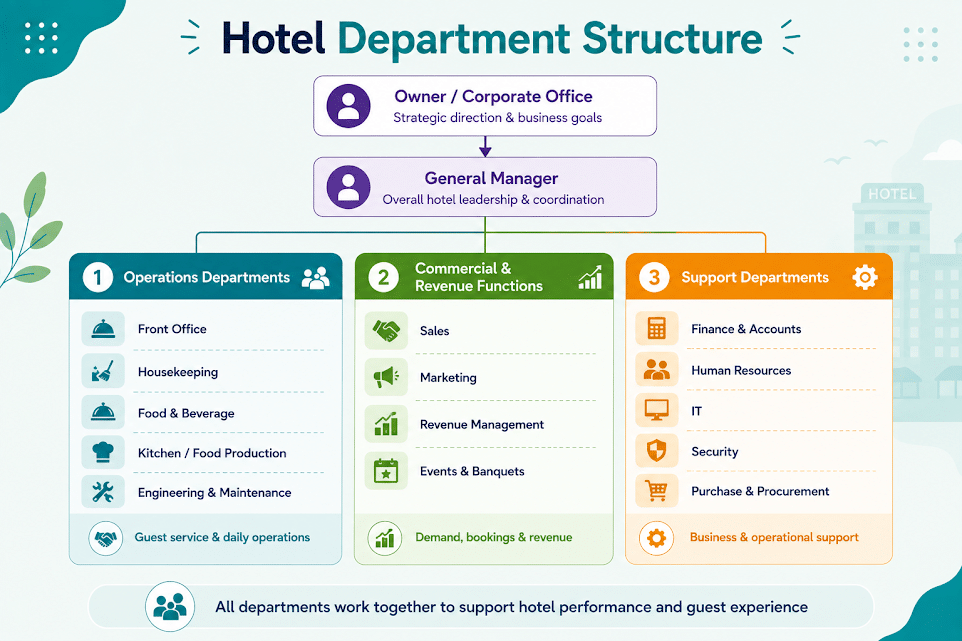

Figure: Typical hotel organizational structure showing the relationship between hotel leadership, department heads, operational teams, commercial and revenue functions, and support departments.
What Is the Hotel Management Department?
The hotel management department oversees the property’s overall operations, business performance, service standards, and coordination between departments. It provides the leadership layer that connects individual departmental responsibilities with the hotel’s broader operational and commercial goals.
The General Manager typically leads this function, supported by operations managers and department heads depending on the property’s size.
Key responsibilities include:
- Operational oversight: Monitor day-to-day hotel performance and resolve cross-department issues.
- Strategic planning: Set operational priorities and business objectives.
- Department coordination: Ensure department heads work toward shared property goals.
- Service standards: Maintain consistency across guest-facing and operational functions.
- Financial oversight: Monitor profitability, costs, and overall business performance.
- Decision-making: Address operational challenges and allocate resources based on property needs.
Major Departments in the Hotel Industry and Their Functions
While every hotel operates differently, the core departments in the hotel industry remain largely consistent across properties. These departments work together to manage guest services, revenue generation, and day-to-day hotel operations.
Here are all the hotel departments listed with a brief description and core functions:
What is the Hotel Housekeeping Department?
The hotel housekeeping department is responsible for maintaining cleanliness, hygiene, and room readiness across the property. It ensures guests enjoy a comfortable and well-maintained stay.
Core Functions
- Room Cleaning: Prepare and clean guest rooms according to hotel standards.
- Laundry & Linen Management: Maintain linen inventory, laundry operations, and replacements.
- Public Area Maintenance: Keep lobbies, corridors, and common areas clean and presentable.
- Lost & Found Management: Record, store, and return guest belongings left on the property.
Key Roles
Executive Housekeeper, Floor Supervisor, Room Attendant.
Why It Matters
Room cleanliness remains one of the strongest drivers of positive reviews, guest comfort, and return visits.
What is the Food & Beverage (F&B) Service Department?
The Food & Beverage (F&B) Service Department manages dining experiences across restaurants, bars, room service, and banquet venues. It plays a key role in guest satisfaction while generating significant non-room revenue.
Core Functions
- Restaurant Operations: Manage daily dining services and guest interactions.
- Room Service: Deliver food and beverages directly to guest rooms.
- Banquet Services: Coordinate food and service requirements for events and functions.
- Bar Operations: Oversee beverage service, inventory, and guest experience.
Key Roles
Executive Housekeeper, Floor Supervisor, Room Attendant.
Why It Matters
Strong F&B operations encourage higher guest spend while adding value to the overall stay experience.
What is the Food Production (Kitchen) Department?
The Food Production Department, commonly known as the kitchen department, is responsible for preparing meals and maintaining food quality standards. It supports restaurants, room service, banquets, and catering operations across the hotel.
Core Functions
- Meal Preparation: Prepare food according to recipes, menus, and service requirements.
- Menu Planning: Design menus based on guest preferences, seasonality, and business goals.
- Food Safety: Maintain hygiene standards and compliance with food safety regulations.
- Cost Control: Manage food costs, portion sizes, and kitchen inventory efficiently.
Key Roles
Executive Chef, Sous Chef, Chef de Partie, Commis Chef.
Why It Matters
Consistent food quality helps strengthen brand reputation while supporting efficient dining operations.
What is the Hotel Sales Department?
The Sales & Marketing Department drives hotel demand through promotional activities, partnerships, and distribution strategies. Its primary goal is to attract guests and maintain a steady flow of bookings throughout the year.
Core Functions
- Corporate Sales: Build relationships with businesses, travel agents, and group clients.
- OTA Strategy: Manage visibility and performance across online travel agencies.
- Digital Marketing: Drive traffic through SEO, social media, email, and paid campaigns.
- Brand Promotion: Strengthen brand awareness and market positioning.
Key Roles
Director of Sales, Sales Manager, Sales Executive.
Why It Matters
Effective sales and marketing efforts help hotels reach new audiences, strengthen demand, and maintain a healthy booking pipeline.
What is the Hotel Marketing Department?
The hotel marketing department builds brand visibility, generates demand, and supports the hotel’s booking strategy through marketing channels and campaigns. Its work can span digital platforms, content, social media, search, email, and paid advertising.
Core functions include:
- Digital marketing: Promote the property through relevant online channels.
- SEO and content: Improve visibility for travelers searching for accommodation and experiences.
- Social media: Build awareness and engagement across relevant platforms.
- Campaign management: Run email, paid, promotional, and seasonal campaigns.
- Brand promotion: Maintain consistent positioning and communication across channels.
Key roles: Marketing Manager, Digital Marketing Executive, Content/Social Media Executive.
Why It Matters
Marketing creates visibility and demand, while the sales function focuses more directly on converting business opportunities and managing commercial relationships.
What is the Events, Banquets & MICE Department?
The Events, Banquets & MICE Department manages weddings, conferences, meetings, and large-scale events hosted by the hotel. It plays a vital role in generating revenue beyond room bookings, particularly for business and destination hotels.
Core Functions
- Weddings: Plan and execute wedding ceremonies, receptions, and related guest services.
- Conferences: Coordinate business meetings, seminars, and corporate gatherings.
- Corporate Events: Manage product launches, training programs, and company events.
- Outdoor Catering (ODC): Deliver food and event services at off-site venues.
Key Roles
Banquet Manager, Event Coordinator, MICE Sales Executive.
Why It Matters
Events and banquets create valuable revenue opportunities while making better use of hotel spaces and facilities.
What Is ODC in Hotels?
(ODC Full Form in Hotel is Out-Door Catering)
ODC (Outdoor Catering) refers to food and beverage services provided by a hotel outside its premises, such as weddings, corporate events, private parties, and social gatherings.
For example, a hotel may provide catering for a wedding held at a farmhouse or manage food service for a corporate event at an external venue. ODC gives hotels an additional way to use their culinary and event capabilities beyond on-property functions.
What is the Revenue Management Department?
The Revenue Management Department focuses on maximizing hotel profitability through strategic pricing, inventory control, and demand forecasting. It helps hotels sell the right room to the right guest at the right price and time.
Core Functions
- Pricing Strategy: Set room rates based on demand, competition, and market conditions.
- Demand Forecasting: Predict future occupancy trends using historical and market data.
- Channel Performance Analysis: Evaluate booking performance across OTAs, direct bookings, and corporate segments to optimize distribution.
- Inventory Optimization: Allocate room inventory to maximize occupancy and revenue.
Key Roles
Revenue Manager, Revenue Analyst.
Why It Matters
Strategic pricing and inventory decisions help hotels capture demand more effectively and improve revenue performance.
What is the Accounts & Finance Department?
The Accounts & Finance Department manages the hotel’s financial operations, ensuring accurate record-keeping, compliance, and cash flow management. It supports informed decision-making through financial reporting and analysis.
Core Functions
- Billing & Invoicing: Process guest payments, invoices, and financial transactions.
- Payroll Management: Handle employee salaries, benefits, and reimbursements.
- Audits: Review financial records to ensure accuracy and accountability.
- GST Compliance: Manage tax reporting and regulatory compliance requirements.
Key Roles
Finance Manager, Accountant, Night Auditor.
Why It Matters
Accurate financial oversight supports informed decision-making and sustainable business growth.
What is the Human Resources Department?
The Human Resources Department is responsible for recruiting, developing, and retaining hotel employees. It helps build a skilled workforce while ensuring compliance with labor policies and organizational standards.
Core Functions
- Recruitment: Source, hire, and onboard new employees.
- Training & Development: Improve employee skills through ongoing learning programs.
- Employee Engagement: Support workplace culture, motivation, and retention initiatives.
- Compliance: Ensure adherence to labor laws, policies, and workplace regulations.
Key Roles
HR Manager, HR Executive, Training Coordinator.
Why It Matters
Skilled and engaged employees are essential for delivering reliable service and supporting long-term operational success.
What is the Maintenance & Engineering Department?
The Maintenance & Engineering Department ensures all hotel facilities, equipment, and infrastructure remain operational and safe. Its work helps prevent service disruptions and supports a comfortable guest experience.
Core Functions
- Electrical Systems: Maintain power supply, lighting, and electrical equipment.
- HVAC Management: Monitor heating, ventilation, and air conditioning systems.
- Plumbing: Address water supply, drainage, and sanitation requirements.
- Preventive Maintenance: Conduct routine inspections to reduce equipment failures.
Key Roles
HR Manager, HR Executive, Training Coordinator.
Why It Matters
Proactive maintenance helps keep facilities running smoothly and reduces unexpected service interruptions.
What is the Security Department?
The Security Department oversees safety, surveillance, access control, and emergency preparedness across the property. It works to prevent risks, respond to incidents, and protect both people and assets.
Core Functions
- Guest Safety: Ensure the safety and well-being of guests throughout their stay.
- CCTV Monitoring: Monitor surveillance systems and identify potential security risks.
- Emergency Response: Handle incidents, evacuations, and crisis situations effectively.
- Fire Safety: Conduct safety inspections and ensure compliance with fire regulations.
Key Roles
Security Manager, Security Supervisor, Security Officer.
Why It Matters
A well-managed security function builds guest confidence, reduces operational risks, and helps hotels respond effectively to unexpected situations.
What is the Purchase & Procurement Department?
The Purchase & Procurement Department manages the sourcing of goods and services required for daily hotel operations. It ensures departments receive supplies on time while maintaining quality standards and controlling costs.
Core Functions
- Vendor Management: Build and manage relationships with suppliers and service providers.
- Purchasing: Procure goods and services required across hotel departments.
- Inventory Procurement: Ensure timely availability of operational and guest supplies.
- Cost Control: Negotiate pricing and monitor purchasing expenses to improve profitability.
Key Roles
Purchase Manager, Procurement Executive, Store Manager.
Why It Matters
Reliable procurement processes ensure departments receive the resources they need without unnecessary spending.
What is the Information Technology (IT) Department?
The Information Technology (IT) Department manages the systems and infrastructure that support modern hotel operations. From PMS connectivity to cybersecurity, it ensures technology runs reliably across departments.
Core Functions
- PMS Support: Maintain and troubleshoot property management systems used by hotel staff.
- Network Management: Ensure reliable internet, Wi-Fi, and internal network performance.
- Cybersecurity: Protect guest and business data from security threats and unauthorized access.
- System Integrations: Manage connectivity between PMS, channel managers, booking engines, POS systems, and other hotel software.
Key Roles
IT Manager, System Administrator.
Why It Matters
Connected technology enables departments to share information effortlessly and respond faster to operational needs.
Department-wise Hotel Uniforms & Grooming Standards
Hotel uniforms help create a consistent professional appearance while making staff easier for guests to identify. Uniforms and grooming standards vary by property, but many hotels use department-specific dress codes based on the nature of the work.
| Department | Typical Uniform | Grooming Standard |
| Front Office | Formal suit, blazer, shirt, tie/scarf, name badge | Well-groomed appearance, neat hairstyle, professional presentation |
| Housekeeping | Comfortable housekeeping uniform with apron | Clean uniform, tied hair, minimal accessories |
| F&B Service | Formal service uniform, waistcoat, apron | Neat appearance, trimmed nails, polished shoes |
| Food Production (Kitchen) | Chef coat, apron, chef hat, safety shoes | High hygiene standards, hair restraints, clean attire |
| Sales & Marketing | Business formal attire | Professional corporate appearance |
| Security | Security uniform with identification badge | Well-maintained uniform and disciplined appearance |
The aim is not simply visual consistency. Department-specific uniforms also help guests quickly identify the right staff member when they need assistance.

Manage All Your OTAs from One Place
Request a DemoHotel Department Structure in Small, Mid-Sized, and Large Hotels
As hotel properties increase in size and operational complexity, their department structures typically become more specialized. Smaller hotels often merge responsibilities, while larger establishments tend to have dedicated teams and department heads.

Image: Hotel department structure by property size, showing how responsibilities typically evolve from combined functions in smaller hotels to specialized departments and dedicated teams in larger properties.
The following breakdown explains how departmental responsibilities typically differ across small, mid-sized, and large hotels:
- Small Hotels (10–30 Rooms): Staff often handle multiple responsibilities. A front desk employee, for example, may assist with reservations, guest relations, and basic administrative tasks, while managers oversee several operational areas.
- Mid-Sized Hotels (30–100 Rooms): Departments become more specialized, with dedicated teams for functions such as front office, housekeeping, F&B, sales and marketing, revenue management, finance, engineering, and HR. Department heads typically take responsibility for individual functions while coordinating with the General Manager.
- Large Hotels (100+ Rooms): Operations are generally divided into dedicated departments and specialized teams. Functions such as revenue management, IT, security, procurement, sales, marketing, and human resources may have dedicated leadership, with greater specialization across individual roles.
Revenue-Generating Departments in the Hotel Industry
While every department contributes to a hotel’s success, only a few directly generate revenue. For most properties, room revenue remains the largest income source, followed by food and beverage sales, events, and other ancillary services.
- Rooms Division (Front Office & Reservations): The primary revenue driver for most hotels, generating income through room bookings and occupancy.
- Food & Beverage (F&B): Restaurants, bars, room service, and catering services create valuable secondary revenue streams.
- Events, Banquets & MICE: Weddings, conferences, exhibitions, and corporate events can contribute significantly to hotel revenue, particularly in business and destination hotels.
- Revenue Management & Sales: These departments do not directly generate revenue but play a crucial role in maximizing occupancy, ADR, and overall profitability through pricing and distribution strategies.
Department-Wise Hotel KPIs Every Hotel Should Track
Hotel-wide metrics provide a snapshot of overall performance, but department-level KPIs reveal what’s happening behind the scenes. Tracking the right metrics helps managers identify improvement opportunities, measure results, and align teams with business goals.
- Front Office: Average check-in time and guest satisfaction scores to evaluate service speed and the arrival experience.
- Housekeeping: Room turnaround time and room readiness rate to measure room availability and workflow effectiveness.
- Food & Beverage: Average revenue per cover and guest feedback scores to track dining performance and guest preferences.
- Sales & Marketing: Booking conversion rate and campaign performance to assess demand generation and marketing impact.
- Revenue Management: RevPAR, ADR, and occupancy rate to monitor pricing strategy and revenue outcomes.
- Human Resources: Employee retention and training completion rates to evaluate workforce stability and team development.
- Maintenance & Engineering: Equipment downtime and maintenance response time to measure facility reliability and issue resolution speed.
How Do Hotel Departments Work Together?
Hotel departments work together by sharing information, coordinating workflows, and aligning their activities around guest needs and property performance. A booking, for example, can create requirements for revenue management, reservations, front office, housekeeping, finance, and other teams at different stages of the stay.

Image: The infographic illustrates how hotel departments work together across the guest journey, highlighting the connections among demand generation, booking, arrival, guest stay, billing, and performance reporting, with HR, IT, Engineering, Security, and Procurement supporting operations throughout.
Some common department dependencies include:
| Department | Works Closely With | Why |
| Front Office | Housekeeping | Room status, arrivals, departures, and room readiness |
| Revenue Management | Sales & Marketing | Demand, pricing, promotions, and booking strategy |
| Front Office | Finance | Guest billing and payment information |
| Events & MICE | F&B | Banquet menus, service requirements, and event execution |
| HR | All Departments | Staffing, training, workforce planning |
| IT | All Departments | Systems, connectivity, integrations, and technical support |
For example, when a guest books a room, revenue and distribution decisions affect availability and pricing, the reservation reaches the front office, housekeeping prepares the room for arrival, and finance records the associated transactions. The departments perform different tasks, but the information connecting those tasks needs to remain consistent.
How to Build a High-Performing Hotel Department Structure
A successful hotel department structure is not just about creating teams; it’s about ensuring every department works toward the same operational and revenue goals. The following steps can help hotels build a more efficient and collaborative operation.
Step 1: Define Clear Roles and Responsibilities
Document responsibilities, reporting relationships, and performance expectations for each department. Clear ownership reduces confusion and makes accountability easier to manage.
Step 2: Standardize SOPs Across Departments
Create standard operating procedures for recurring processes such as check-in, housekeeping, maintenance requests, guest services, and event operations. Consistent procedures help maintain service standards across shifts and teams.
Step 3: Establish clear cross-department workflows
Identify processes that require more than one department and define who is responsible at each stage. This is particularly important for room readiness, group bookings, guest requests, maintenance issues, and event operations.
Step 4: Review department performance regularly
Use department-level KPIs to identify operational gaps and track whether improvements are delivering results. Performance reviews should focus on actionable trends rather than simply collecting metrics.
Step 5: Adapt the structure as the hotel grows
A structure that works for a small property may become inefficient as room inventory, outlets, staff, and booking channels increase. Hotels should periodically review whether responsibilities need to be separated into more specialized roles.
What Technology Do Hotel Departments Use?
Hotel departments use different technology systems to manage reservations, distribution, revenue, guest services, payments, reporting, and day-to-day operations. The exact technology stack varies by property, but connected systems can reduce manual work and improve information flow between teams.
| Hotel Function | Common Technology | Primary Use |
| Front Office | Property Management System (PMS) | Reservations, check-in, guest records, room status |
| Distribution | Channel Manager | Synchronizing rates, availability, and inventory across OTAs |
| Revenue | Revenue Management System | Pricing and demand optimization |
| Direct Bookings | Booking Engine | Website reservations |
| F&B | POS System | Orders, billing, and outlet management |
| Finance | Accounting/Billing Software | Financial records and reporting |
| Marketing | CRM & Analytics | Guest data, campaigns, and performance analysis |
| Payments | Payment Gateway | Online payment processing |
| Management | BI & Reporting Tools | Property-level performance visibility |
The value of these systems increases when they can exchange information rather than operate as isolated tools. For example, reservation and distribution data can support front-office planning, while payment and booking information can feed finance and reporting workflows.
How AxisRooms Connects Hotel Departments, Distribution, and Revenue
Managing hotel departments efficiently is easier when teams work from connected systems instead of disconnected processes.
AxisRooms helps hotels streamline distribution, improve visibility, and maximize revenue by connecting reservations, pricing, inventory, and booking channels through a single ecosystem.
- 100+ OTA Integrations: Sync rates, inventory, and availability across multiple online travel agencies in real time.
- PMS Integrations: Connect operational departments with reservations and distribution for smooth data flow.
- Payment Gateways: Simplify guest payments and support secure, frictionless transactions.
- Channel Manager: Centralize inventory management and prevent overbookings across booking channels.
- Revenue Management Services: Support smarter pricing decisions based on demand, market trends, and performance data.
- Web Booking Engine: Enable direct bookings through your hotel website while reducing OTA dependency.
Together, these solutions help hotels improve operational coordination, increase revenue opportunities, and deliver a more connected guest experience.
Conclusion
Successful hotels aren’t built around a single department. They’re built around teams that work together to deliver consistent guest experiences, support business goals, and adapt to changing market demands.
As operations become more connected and data-driven, having the right structure, processes, and technology in place becomes increasingly important.
Ready to improve coordination, visibility, and revenue performance across your hotel? Book a free demo today and discover how AxisRooms can help your teams work smarter together.