
Hotel bill formats are no longer just checkout documents. Today, hotel invoices directly impact GST compliance, enhancing guest experience, improving accounting accuracy, and increasing operational efficiency.
Whether you run a small hotel in Jaipur, a business hotel in Bengaluru, or a resort in Goa, billing errors can quickly create guest disputes, audit risks, and reconciliation issues.
In this guide, we’ll explain what a hotel bill format should include,GST rules hotels must follow, sample invoice formats for different property types, and common billing mistakes to avoid in 2026.
What Is a Hotel Bill?
A hotel bill is an itemised record of the charges a guest incurs during a hotel stay, including room charges, additional services, applicable taxes, payments, and the final amount payable.
It is usually prepared at checkout and provides the guest with a clear summary of what was charged during the stay. For hotels, it also serves as an important record for accounting, reconciliation, tax documentation, and guest-service processes.
A hotel bill may include accommodation charges along with expenses such as food and beverages, laundry, minibar, transfers, or other services used during the stay. The exact details depend on the property’s services and the guest’s booking.
Hotel bill and hotel invoice are often used interchangeably, although they can serve different accounting or tax purposes depending on the transaction.
What Does a Hotel Bill Include?
A hotel bill typically includes the property and guest details, stay information, individual charges, applicable taxes, payment details, and the final amount payable.
Depending on the transaction, it may also include GSTIN, invoice number, SAC details, discounts, and other billing information.
| Hotel Bill Component | What It Shows |
| Hotel name and address | Identifies the property issuing the bill |
| GSTIN, where applicable | Identifies the hotel’s GST registration |
| Bill or invoice number | Helps with record keeping and tracking |
| Guest details | Identifies the person associated with the stay |
| Check-in and check-out dates | Shows the duration of the stay |
| Room details | Records the room number, type, or accommodation booked |
| Room charges | Shows the accommodation cost |
| Additional services | Includes food, laundry, minibar, transfers, or other applicable charges |
| Tax details | Shows applicable taxes and their breakup |
| Discounts or adjustments | Records reductions or billing adjustments |
| Payment details | Shows the amount paid and payment method |
| Total amount | Displays the final amount payable or paid |
Hotel Bill Format: What Should It Look Like?
A hotel bill format is the structured arrangement of guest, stay, charge, tax, and payment information into a document issued at checkout. While the exact layout can vary between properties, a well-designed hotel bill should make the stay details, individual charges, applicable taxes, and final amount easy to understand.
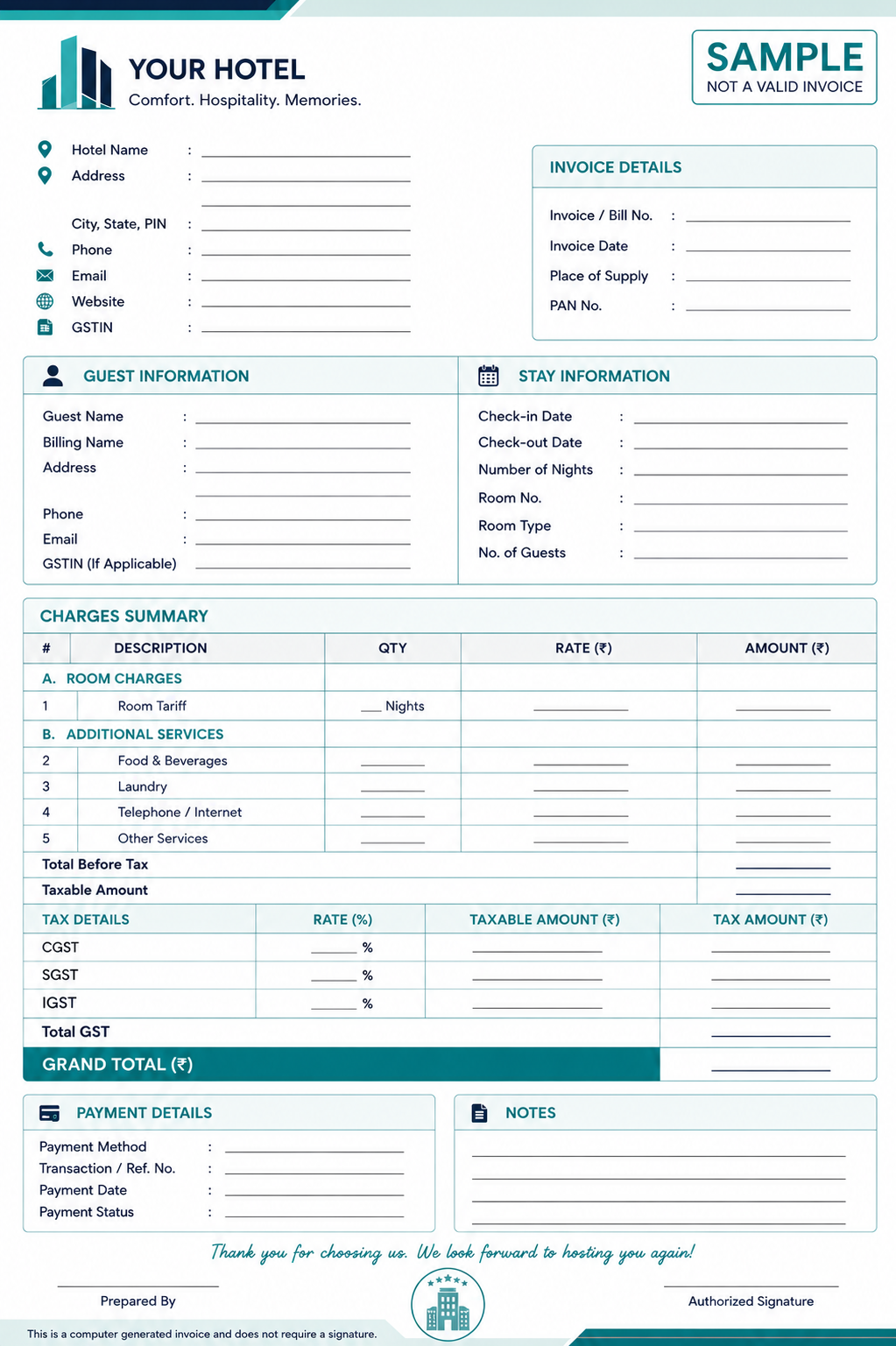
Image: Sample hotel bill format showing hotel and guest details, invoice and stay information, room and additional service charges, GST breakup, grand total, payment details, and signature fields.
The format can be adapted based on the hotel’s services, billing requirements, guest type, and applicable tax treatment. Corporate GST invoices may require additional business and tax details, while a simple B2C hotel bill may contain fewer fields.
Why Is a Hotel Bill Important?
Hotel bills are crucial as they influence guest trust, tax compliance, accounting accuracy, and operational efficiency.
Here’s why proper hotel billing matters:
- GST compliance → Hotels must issue invoices containing mandatory tax details to avoid compliance issues during audits.
- Guest transparency → Incorrect room charges or unclear taxes often lead to disputes and checkout delays.
- Accurate night audits → Billing directly impacts accounting reconciliation, revenue reporting, and financial accuracy.
- Faster front desk operations → Structured invoice formats help staff process checkouts more efficiently during busy hours.
Think of hotel billing as the financial handshake between the hotel and the guest. If the invoice feels confusing or inaccurate, trust drops instantly.
Hotel Bill vs Invoice vs Receipt vs Folio
A hotel may use several billing documents during a guest’s stay, and the terms are sometimes used interchangeably. However, a folio, bill, invoice, and receipt serve different purposes in the hotel billing process.
| Document | What It Represents |
| Hotel Folio | A running record of charges posted to a guest’s account during the stay |
| Hotel Bill | A summary of the charges presented to the guest, typically at checkout |
| Hotel Invoice | A formal billing document used for accounting and, where applicable, tax purposes |
| Receipt | Proof that payment has been received |
For example, a guest’s folio may accumulate room, restaurant, laundry, and other charges throughout the stay. At checkout, these charges can be consolidated into the final bill or invoice. Once payment is made, the hotel may provide a receipt as proof of payment.
For corporate stays, the distinction becomes more important because businesses may require specific invoice information for accounting, reimbursement, or applicable tax claims
Is Your Hotel Bill GST-Compliant?
A GST-compliant hotel invoice should include the required billing and tax details and apply the correct GST treatment to the transaction. Ensuring accurate GST information helps hotels maintain compliance, avoid billing discrepancies, and provide transparent invoices to guests.
A GST-compliant hotel invoice should generally include:
- GSTIN: Identifies the hotel as a registered GST entity.
- Invoice serial number: Helps with accounting, record keeping, and audit tracking.
- SAC: Classifies the relevant hospitality service.
- Taxable amount: Shows the value on which GST is calculated.
- Applicable GST breakup: Shows the relevant CGST and SGST or IGST details.
- Place of supply: Helps determine the applicable tax treatment.
- Guest or company details: Supports billing, reimbursement, and applicable ITC requirements.
- Final payable amount: Shows the total amount charged to the guest.
For hotel accommodation, the current GST treatment also depends on the value of the accommodation. Accommodation valued up to ₹7,500 per unit per day is currently taxed at 5% without ITC, while accommodation above ₹7,500 attracts 18% with ITC.
Note: GST treatment can vary depending on the specific supply and applicable rules. Hotels should verify the current requirements before issuing invoices.
B2C vs B2B GST Billing
| Factor | B2C Hotel Bill | B2B GST Invoice |
| Guest Type | Individual travelers | Corporate or business travelers |
| GST Details | Basic GST breakup | Includes company GSTIN |
| ITC Eligibility | Not applicable | Required for Input Tax Credit claims |
| Usage | Leisure stays | Official business travel reimbursement |
| Billing Complexity | Simpler checkout invoice | More detailed compliance documentation |
Corporate travelers often request invoices with GST breakups to claim Input Tax Credit (ITC). Missing information can create reimbursement delays and dissatisfaction.
How to Make a Hotel Bill: Step-by-Step Process
Creating a hotel bill involves recording the guest’s stay, adding room and service charges, applying the applicable taxes, and verifying the final amount before issuing the bill. Hotels can prepare bills manually using a spreadsheet or use a PMS to automate calculations and pull reservation and payment details directly into the billing workflow.
A typical hotel billing process involves these steps:
- Enter Hotel and Billing Details: Add the hotel’s name, address, contact details, GSTIN where applicable, and bill or invoice number.
- Add Guest and Stay Details: Enter the guest name, room number, room type, check-in and check-out dates, and number of nights.
- Calculate Room Charges: Enter the applicable room rate and calculate the accommodation charges for the stay.
- Add Additional Services: Include charges for food and beverages, laundry, minibar, transfers, or other services used during the stay.
- Apply Discounts or Adjustments: Record any approved discounts, packages, advance payments, or other adjustments before calculating the final amount.
- Calculate Applicable GST: Apply the relevant GST treatment to the taxable amount and show the applicable tax breakup on the bill.
- Add Payment Details: Record the amount received, payment method, transaction reference, and any balance due.
- Verify and Issue the Bill: Check the guest details, charges, taxes, payment information, and final amount before generating the final bill for the guest.
Hotel Bill Format Samples Based on GST Slabs
Hotel bill formats can vary depending on the room tariff, applicable GST rate, and services included in the guest’s stay. Below are sample hotel bill formats based on common GST slabs and billing scenarios.
1. Accommodation Up to ₹7,500 per Day
For accommodation valued at ₹7,500 or less per unit per day, the applicable GST rate is currently 5% without ITC.
For example:
| Item | Amount |
| Room Charge | ₹4000 |
| GST | ₹200 |
| Total | ₹4200 |
This format is commonly used by small hotels, guest houses, and budget stays with limited taxable services.
2. Accommodation Above ₹7,500 per Day
Accommodation valued above ₹7,500 per unit per day attracts 18% GST with ITC under the current rate structure.
For example:
| Item | Amount |
| Room Charge | ₹9,000 |
| GST @ 5% | ₹1620 |
| Total | ₹10,620 |
Most independent business hotels and mid-scale properties in India follow similar GST billing structures.
3. Additional Services
A hotel bill can also combine accommodation with other services, such as food and beverages, laundry, or other guest services. The applicable tax treatment should be determined for each relevant supply.
For example:
| Item | Amount |
| Room Charge | ₹9,000 |
| Food & Beverage | ₹2,000 |
| Taxable Amount | ₹11,000 |
| Applicable GST | ₹_____ |
| Total | ₹_____ |
The applicable GST treatment can differ by type of supply and transaction. Hotels should apply the rate relevant to the specific service rather than assuming that every charge on a guest bill is taxed at the accommodation rate.
Common Hotel Billing Mistakes Indian Hotels Make
Hotel billing mistakes are common, particularly during busy check-ins or when creating invoices manually. While some errors may seem minor, they can lead to guest disputes, compliance issues, revenue loss, or accounting mismatches.
Here are some of the most common hotel billing mistakes and how hotels can avoid them more efficiently.
| Common Billing Mistake | How Hotels Can Fix It |
| Incorrect GST calculations | Use automated billing systems that apply GST rates and tax rules accurately in real time. |
| Missing GSTIN details | Verify guest and company GST details before generating the final invoice. |
| Wrong SAC code usage | Standardize billing templates using SAC Code 9963 for accommodation services. |
| Manual invoice numbering errors | Use PMS-generated invoices with automatic serial numbering for audit consistency. |
| Incorrect room tariff entries | Sync billing directly with reservations and room inventory systems to avoid mismatches. |
| Missing add-on service charges | Integrate POS, restaurant, minibar, and laundry billing into one connected system. |
| Delayed invoice generation during checkout | Automate billing workflows to speed up checkout and reduce front desk pressure. |
As booking volumes, digital payments, and GST requirements increase, hotels often struggle to maintain billing accuracy through manual workflows.

Manage All Your OTAs from One Place
Request a DemoPMS-Generated Hotel Bills vs Manual Bill Formats
Hotels still using spreadsheets or handwritten invoices often struggle with billing consistency and audit accuracy.
The comparison below highlights how PMS-generated billing improves operational accuracy and simplifies hotel invoicing workflows.
| Manual Billing | PMS-Generated Billing |
| Higher risk of GST errors | Automated GST calculations |
| Slow checkout process | Faster invoice generation |
| Manual room charge entry | Real-time synced billing |
| Difficult audit tracking | Centralized reporting |
| Error-prone reconciliation | Accurate accounting records |
As hotels grow across multiple OTAs and booking channels, manual billing becomes harder to manage efficiently.
How AxisRooms Simplifies Hotel Billing and Operational Workflows
Hotel billing today involves much more than generating invoices at checkout. Hotels must manage GST compliance, OTA bookings, digital payments, and guest billing information accurately across multiple systems.
For many growing hotels, handling these processes manually often leads to billing errors, slower checkouts, and reconciliation challenges.
AxisRooms helps hotels streamline bookings, payments, distribution, and operational workflows through one connected platform.
Here’s how AxisRooms supports smoother and more accurate hotel operations:
- OTA Integrations → Synchronize bookings, rates, and inventory across OTAs in real time
- PMS Integrations → Connect reservations, billing, and operational workflows more efficiently
- Payment Gateways → Enable faster and more secure guest payment processing
- Channel Manager → Centralize pricing and inventory updates across booking channels
- Revenue Management Services → Support smarter pricing decisions using demand insights
- Web Booking Engine → Improve direct booking experiences with real-time availability
When billing, reservations, payments, and distribution systems work together, hotels can reduce operational errors and create smoother guest experiences.
Conclusion
Hotel bill formats today are closely connected with GST compliance, reservations, digital payments, OTA bookings, and revenue tracking across multiple hotel systems.
As hotels scale operations across multiple booking channels, maintaining billing accuracy manually becomes increasingly difficult and time-consuming.
Hotels using connected PMS, payment, and distribution systems are better positioned to simplify audits, reduce reconciliation issues, and manage guest billing more efficiently at scale.
AxisRooms helps hotels streamline bookings, payments, inventory, and operational workflows through one centralized hospitality platform.
Book a free demo today and see how connected hotel operations can simplify billing and improve operational control in real time.