
A hotel can achieve high occupancy and strong room revenue yet still struggle with profitability. That’s because revenue-focused metrics like ADR and RevPAR don’t tell you how much profit the hotel actually retains after operating expenses.
This is where GOPPAR becomes important. GOPPAR (Gross Operating Profit Per Available Room) helps hotels measure true profitability by combining revenue performance with cost efficiency. It gives owners, revenue managers, and hotel operators a clearer picture of how effectively the business is generating profit from its available inventory.
In this guide, we’ll explain what GOPPAR is, the GOPPAR formula, how to calculate GOPPAR, how it compares to RevPAR and ADR, and practical strategies hotels can use to improve profitability.
What is the meaning of GOPPAR?
GOPPAR (Gross Operating Profit Per Available Room) is a hotel profitability metric that measures how much operating profit a hotel generates for every available room after operating expenses are deducted. For anyone wondering what GOPPAR is in hotels, it is one of the most widely used metrics for evaluating profitability at the property level.
Unlike ADR and RevPAR, which focus primarily on revenue, GOPPAR shows how efficiently a hotel converts revenue into profit. The GOPPAR meaning is simple: it helps hoteliers understand the value generated by their available inventory, not just how much revenue it produces.
Because GOPPAR in hotel operations combines both revenue and costs, it provides a more complete view of business performance than occupancy or revenue metrics alone.
To understand how this metric works in practice, let’s look at the GOPPAR formula and how hotels calculate it.
GOPPAR Formula Explained
The GOPPAR hotel formula measures the gross operating profit generated by each available room in a hotel. It combines both revenue and operating costs, making it one of the most effective metrics for evaluating hotel profitability.
GOPPAR = Gross Operating Profit ÷ Available Rooms
In this formula,
- Gross Operating Profit (GOP) is the revenue remaining after operating expenses are deducted.
- Available Rooms refers to the total room inventory available for sale during a specific period.
The resulting figure shows how much profit each available room contributes to the business.
Let’s explore a practical example of how to calculate GOPPAR.
How to Calculate GOPPAR (Step-by-Step)
Calculating GOPPAR is a simple process once you know your hotel’s total revenue, operating expenses, and available rooms. The goal is to determine how much operating profit each available room generates during a specific period.
Let’s assume a hotel reports the following monthly figures:
| Metric | Value |
| Total Revenue | $500,000 |
| Operating Expenses | $300,000 |
| Available Rooms | 3,000 |
Before calculating GOPPAR, you first need to determine your Gross Operating Profit (GOP). GOP is the profit remaining after operating expenses are deducted from total revenue.
GOP = Total Revenue − Operating Expenses
Step 1: Calculate Gross Operating Profit (GOP)
Gross Operating Profit is calculated by subtracting operating expenses from total revenue.
GOP = Total Revenue − Operating Expenses
GOP = $500,000 − $300,000 = $200,000
Step 2: Calculate GOPPAR
Once you have the GOP, divide it by the total number of available rooms.
GOPPAR = GOP ÷ Available Rooms
GOPPAR = $200,000 ÷ 3,000 = $66.67
Note: Hotels can also use a GOPPAR calculator to automate calculations and reporting, but understanding the underlying GOPPAR formula helps revenue teams interpret profitability more effectively.
In this example, the hotel generates $66.67 in gross operating profit per available room. This GOPPAR calculation provides a clearer view of profitability than revenue metrics alone because it accounts for the costs required to operate the property.
Whether you’re managing a boutique hotel, business hotel, or resort, regularly tracking GOPPAR alongside ADR and RevPAR helps you understand not just how much revenue you’re generating but how much profit you’re actually keeping.
GOPPAR vs RevPAR vs ADR vs TRevPAR
Hotels track multiple performance metrics because each one measures a different aspect of business performance. While ADR focuses on pricing, RevPAR measures room revenue efficiency, TRevPAR captures total revenue generation, and GOPPAR reveals actual profitability after operating expenses.
| Metric | Formula | What It Measures | What It Doesn’t Include |
| ADR | Total Room Revenue ÷ Rooms Sold | Average revenue earned per occupied room | Occupancy and non-room revenue |
| RevPAR | Total Room Revenue ÷ Available Rooms | Revenue generated from available rooms | Operating expenses and ancillary revenue |
| TRevPAR | Total Revenue ÷ Available Rooms | Total revenue from rooms, F&B, spa, events, and other services | Operating expenses |
| GOPPAR | Gross Operating Profit ÷ Available Rooms | Profit generated per available room after operating expenses | Taxes, interest, and depreciation |
When Does Each Metric Matter?
ADR matters when evaluating pricing strategy and understanding how much guests are paying for occupied rooms.
RevPAR matters when measuring how effectively a hotel combines occupancy and room rates to generate revenue.
TRevPAR matters when assessing the contribution of all revenue-generating departments, not just rooms.
GOPPAR matters when evaluating overall hotel profitability because it accounts for both revenue performance and operating costs.
While ADR, RevPAR, and TRevPAR provide valuable revenue insights, GOPPAR offers the clearest view of how efficiently a hotel converts revenue into profit. That’s why many revenue managers track these metrics together rather than relying on a single KPI.
What Is a Good GOPPAR?
A good GOPPAR depends on your hotel type, location, and operating costs. Rather than comparing against a universal benchmark, hotels should measure GOPPAR against similar properties and track improvement over time.
Here are some general benchmarks hoteliers can use as a reference:
- Budget Hotels: Typically focus on maintaining healthy occupancy and controlling costs. Even a modest GOPPAR can indicate strong profitability if operating expenses remain low.
- Midscale Hotels: Usually achieve higher GOPPAR through a balance of occupancy, room rates, and efficient operations. Revenue from food and beverage outlets can also contribute to profitability.
- Luxury Hotels: Often generate the highest GOPPAR because of premium room rates and additional revenue streams such as dining, spa services, and events.
- Resorts: GOPPAR can fluctuate significantly due to seasonality, but successful resorts often benefit from multiple revenue sources beyond room sales, including recreation, wellness, and destination experiences.
- Hotels in India: Indian hotels often focus on balancing occupancy growth with rising operational costs. Properties that combine strong distribution strategies, dynamic pricing, and efficient cost management generally achieve stronger GOPPAR performance than those focused solely on occupancy.
While industry benchmarks provide useful context, the most meaningful comparison is how your GOPPAR performs against similar properties and improves over time.
Consistent year-over-year growth often indicates stronger pricing decisions, healthier cost management, and better overall business performance.
10 Ways Hotels Can Improve GOPPAR
Improving GOPPAR requires a balance between increasing revenue and controlling operating costs. The most profitable hotels focus on both sides of the equation rather than chasing occupancy alone.
-
Use Dynamic Pricing to Maximize Revenue
Dynamic pricing helps hotels adjust room rates based on demand, seasonality, competitor pricing, and booking trends. Selling the right room at the right price can improve ADR, RevPAR, and ultimately GOPPAR.
-
Focus on Direct Bookings
Direct bookings reduce OTA commission costs and increase profit margins. Encouraging guests to book through your website can improve profitability without increasing occupancy.
-
Optimize Your Distribution Strategy
A balanced channel mix helps hotels prioritize bookings from the most profitable sources while reducing unnecessary distribution costs and commission leakage.
-
Increase Ancillary Revenue
Restaurants, spas, event spaces, room upgrades, and add-on services can significantly increase profit per guest.
-
Improve Occupancy During Low-Demand Periods
Targeted promotions, packages, and local campaigns can help fill unsold inventory and boost revenue.
-
Reduce Operating Costs Without Impacting Guest Experience
Managing expenses such as utilities, procurement, and maintenance can directly improve gross operating profit.
-
Optimize Staff Scheduling
Aligning staffing levels with demand forecasts helps reduce labor costs while maintaining service quality.
-
Monitor Department-Level Profitability
Regularly reviewing the performance of restaurants, spas, events, and other services helps identify profit opportunities.
-
Use Technology to Automate Operations
Automation reduces manual work, improves efficiency, and helps teams focus on revenue-generating activities.
-
Track Hotel KPIs Regularly
Monitoring GOPPAR alongside ADR, RevPAR, occupancy, and TRevPAR helps hotels make smarter revenue and operational decisions.
Consistently improving GOPPAR requires a combination of smarter pricing, efficient distribution, and tighter cost control. Of these factors, pricing often has the most immediate impact because even small changes in room rates can influence revenue, margins, and overall GOPPAR performance.
Manage All Your OTAs from One Place
Request a Demo

How Dynamic Pricing Impacts GOPPAR
Dynamic pricing directly influences hotel profitability by optimizing room rates based on demand, seasonality, booking pace, and market conditions. Since GOPPAR is tied to both revenue and operating profit, effective pricing decisions can significantly improve performance across multiple hotel KPIs.
- ADR (Average Daily Rate): Dynamic pricing helps increase ADR by ensuring rooms are sold at the most profitable rate instead of a fixed price.
- Occupancy: Competitive pricing helps hotels attract demand during slower periods while maximizing revenue during peak seasons.
- RevPAR (Revenue Per Available Room): When ADR and occupancy improve together, RevPAR increases, providing a stronger measure of revenue performance.
- GOPPAR (Gross Operating Profit Per Available Room): Higher revenue combined with controlled operating costs leads to stronger GOPPAR and improved profitability.
In simple terms, when hotels use dynamic pricing effectively, they can sell rooms at better rates while attracting the right level of demand. This improves ADR and occupancy, strengthens RevPAR, and ultimately leads to higher GOPPAR.
The process below shows how demand-driven pricing decisions can influence key hotel performance metrics and contribute to higher GOPPAR.
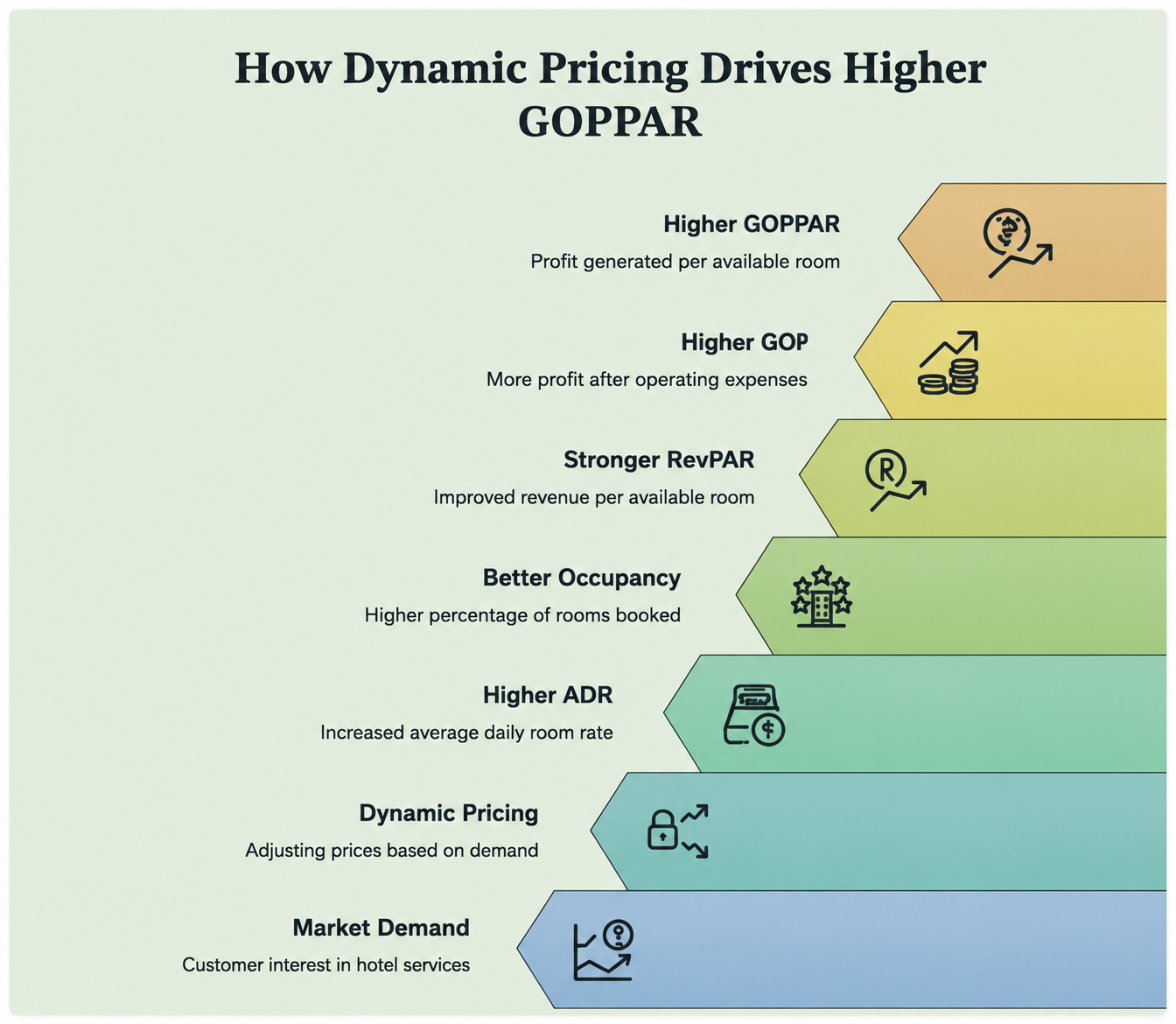
As demand increases and pricing becomes more optimized, hotels can improve revenue performance while generating stronger operating profit per available room.
Why GOPPAR Matters More Than Occupancy
High occupancy may look impressive on reports, but it doesn’t always translate into higher profits. A hotel can fill most of its rooms and still struggle with profitability if room rates are too low or operating costs are too high. This is why many hoteliers consider GOPPAR a more complete measure of business performance.
- High Occupancy Doesn’t Guarantee Profitability: Selling more rooms at heavily discounted rates can increase occupancy while reducing overall profit margins.
- Operating Costs Increase with More Guests: Higher occupancy often leads to increased housekeeping, labor, utilities, amenities, and maintenance costs that can impact profitability.
- Ancillary Revenue Matters: Revenue from restaurants, spas, events, upgrades, and other services can significantly improve GOPPAR, even when occupancy remains unchanged.
- Empty Rooms Still Affect Performance: GOPPAR is calculated using total available rooms, making it a stronger indicator of how effectively a hotel utilizes its inventory.
- It Encourages Better Revenue Decisions: Instead of focusing only on filling rooms, GOPPAR helps hotels balance pricing, occupancy, and costs to maximize profit.
A fully booked hotel isn’t always the most profitable one. In many cases, a hotel with slightly lower occupancy but stronger pricing and cost control will achieve a higher GOPPAR.
Real-World GOPPAR Examples: Budget, Business & Resort Hotels
GOPPAR benchmarks vary widely because every hotel operates with a different revenue mix, cost structure, and guest profile. The examples below show how hotels across different segments typically improve GOPPAR and drive stronger financial performance.
| Hotel Type | Example | Key GOPPAR Driver |
| Budget Hotel | Bengaluru | High occupancy and tight cost control |
| Business Hotel | Delhi | Strong ADR from corporate demand |
| Resort Hotel | Goa | Ancillary revenue from dining, spa, and activities |
| Heritage Hotel | Jaipur | Premium pricing, weddings, and events |
| Urban Hotel | New York or London | Revenue optimization and distribution strategy |
While each property generates profit differently, the most successful hotels focus on balancing room revenue, ancillary income, and operating costs to improve GOPPAR over time.
Why Leading Hotels Use AxisRooms to Monitor GOPPAR and Drive Profitability
Tracking GOPPAR effectively requires more than spreadsheets and manual reports. Hotels need real-time visibility into pricing, distribution, bookings, and revenue performance to make profitable decisions quickly.
AxisRooms helps hotels connect these moving parts through one integrated revenue and distribution ecosystem, making it easier to track performance and improve profitability.
By combining distribution, pricing, and performance insights in one platform, AxisRooms helps hotels move beyond tracking revenue and focus on improving profitability.
Conclusion
In a market where rising costs, shifting demand, and increasing competition can quickly impact margins, revenue alone is no longer enough to measure success. Hotels need visibility into how efficiently they convert revenue into profit, and that’s exactly where GOPPAR delivers value.
By tracking GOPPAR alongside ADR, RevPAR, occupancy, and TRevPAR, hoteliers can make smarter decisions around pricing, distribution, operations, and cost control. More importantly, it helps shift the focus from simply filling rooms to building a more profitable business.
With the right revenue strategy and connected technology, hotels can move beyond chasing occupancy and start optimizing what matters most: sustainable profitability and long-term growth.
Book a free demo today and discover how AxisRooms can help you track performance, optimize revenue, and improve GOPPAR with greater confidence.