
Managing hotel check-out time may seem straightforward, but it plays a critical role in daily hotel operations. A delayed departure can affect housekeeping schedules, room availability, guest arrivals, and overall service efficiency. That’s why hotels follow structured check-out procedures and timelines to keep operations running smoothly.
Understanding hotel check-out time is important not only for guests but also for hoteliers looking to improve operational efficiency and guest satisfaction.
In this guide, we’ll explain what check-out means in a hotel, standard check-out timings, key procedures, late-checkout policies, and best practices for managing departures effectively.
What Does Check-Out Mean in a Hotel?
Hotel check-out is the process through which a guest officially ends their stay, settles any outstanding charges, returns room keys or access credentials if required, and vacates the room before the hotel’s designated departure time.
While it marks the end of the guest journey, it also triggers important operational activities behind the scenes, including room status updates, housekeeping schedules, and room preparation for incoming guests. Understanding the meaning of checkout in hotel operations is essential for maintaining efficiency and guest satisfaction.
What Is the Standard Check-Out Time and Why Do Hotels Set These Hours?
Hotel check-out time is typically between 11 AM and 12 PM worldwide, with 12 PM being the most common standard across mid-scale and upscale hotels. Budget properties often require guests to leave earlier, while luxury hotels may offer flexible or paid late checkout options.
| Hotel Type | Typical Check-Out Time |
| Budget Hotels | 10 AM – 11 AM |
| Mid-Scale Hotels | 11 AM – 12 PM |
| Upscale Hotels | 12 PM |
| Luxury Hotels | 12 PM |
| Resorts | 11 AM – 12 PM |
Hotels set checkout times to allow enough time for room cleaning, inspections, and preparation before new arrivals check in.
Factors That Influence Hotel Check-Out Time:
- Occupancy levels: Hotels with high occupancy often enforce checkout times more strictly.
- Property type: Resorts and leisure hotels may offer greater flexibility than business hotels.
- Seasonal demand: Peak travel periods can reduce late checkout availability.
- Housekeeping capacity: Staffing levels directly affect room turnaround times.
- Technology and automation: PMS-driven room status updates can speed up operations.
- Late checkout requests: Guest demand may influence how flexible hotels can be.
While hotel check-in and check-out times may differ from one property to another, the goal remains the same: ensuring rooms are ready for arriving guests while maintaining operational efficiency.
Because check-out times are closely tied to arrival schedules, it’s useful to understand the standard check-in and check-out window most hotels follow.
What Is the Standard Check-In and Check-Out Time in Hotels?
Most hotels follow a standard check-in time between 2 PM and 3 PM and a standard check-out time between 11 AM and 12 PM. These timings give housekeeping teams enough time to prepare rooms between departing and arriving guests.
However, hotel check-in and check-out times may vary by destination and hotel type; these remain the most common standards across the global hospitality industry.
Hotel Check-Out Rules Every Guest and Hotelier Should Know
Hotel check-out rules help hotels manage room availability, housekeeping schedules, guest expectations, and revenue protection. While policies vary by property, having clear and consistent rules reduces disputes and creates a smoother departure experience for everyone.
Rules For Guests
- Check out on time: Guests should vacate the room before the hotel’s designated check-out time to avoid delays and potential additional charges.
- Request late checkout in advance: Late checkout is subject to availability and should ideally be requested before the property’s cut-off time.
- Review charges before departure: Guests should verify room charges, incidentals, minibar usage, and other expenses before settling the final bill.
- Return room access credentials: Physical keys, key cards, or digital access credentials should be returned or deactivated upon departure.
Rules For Hoteliers
- Late checkout policy: Decide whether late checkout will be complimentary, paid, or offered as a loyalty benefit, and communicate the policy clearly.
- No-show management: Define when a no-show becomes a cancellation and ensure rooms are released and recorded correctly in the PMS.
- Early departure policy: Establish clear rules for guests who leave before their scheduled checkout date, including any applicable charges.
- Overstay handling: If a guest remains beyond checkout time without approval, staff should follow a documented escalation process and apply charges where appropriate.
Publishing check-out policies on your website, OTA listings, booking confirmations, and pre-departure communications helps set expectations and minimizes avoidable disputes.
The Hotel Check-Out Procedure: Step-by-Step SOP for Front Desk Teams
The check-out procedure in hotel operations should be simple, consistent, and easy for staff to follow. A standardized process helps reduce delays, improve guest satisfaction, and release rooms faster for housekeeping.
The following workflow summarizes the standard hotel check-out process before we break down each step in detail.
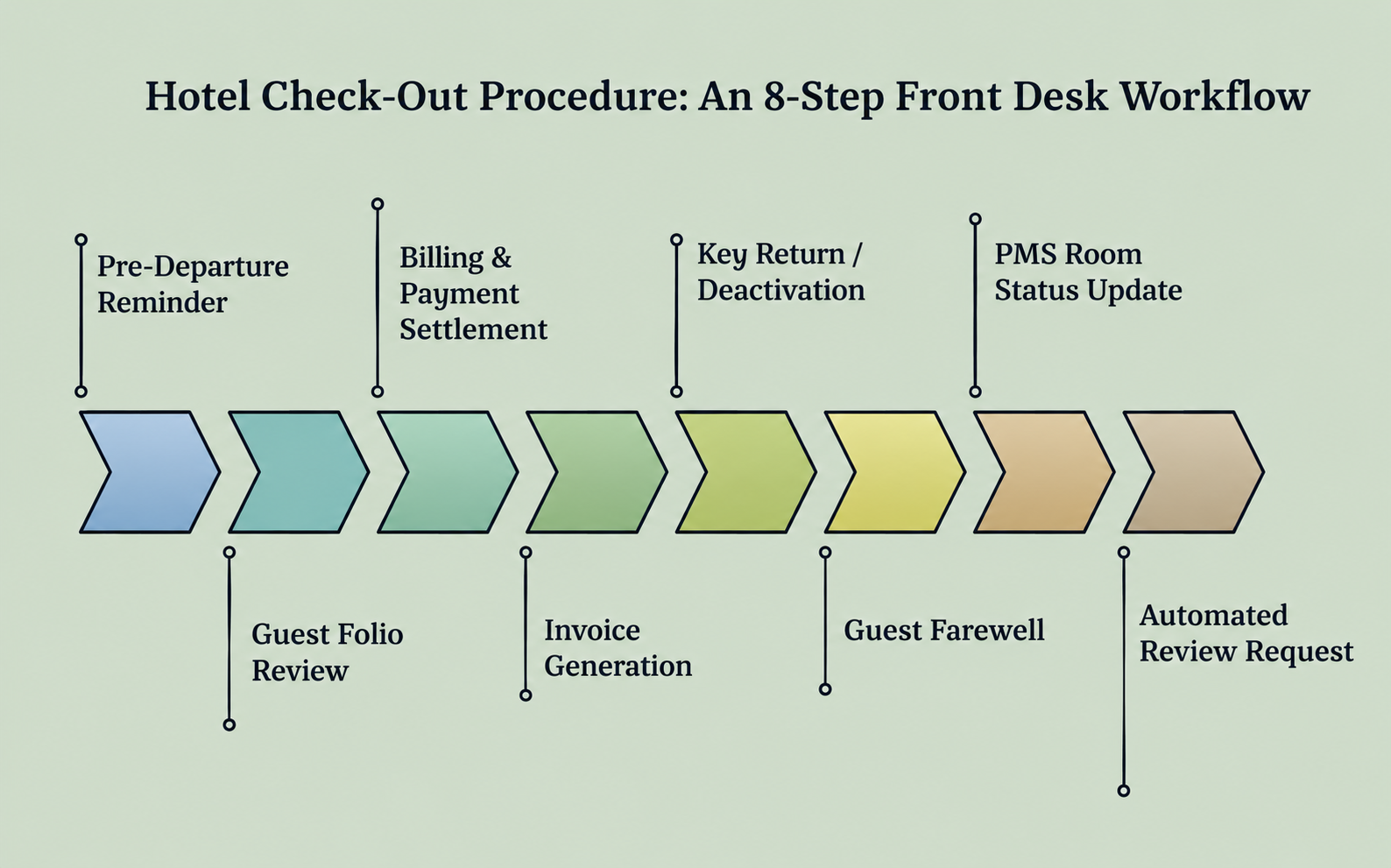
Step 1: Send a Pre-Departure Reminder
Contact guests the night before or on the morning of departure through SMS, email, app notification, or a printed reminder.
Example: Good morning! Your checkout time is 12:00 PM today. If you require a late checkout, please contact the front desk before 10:00 AM, subject to availability.
This helps reduce checkout delays and creates an opportunity to offer late checkout.
Step 2: Deliver and Review the Guest Folio
Provide the guest folio before departure whenever possible. Many hotels now send a digital folio 24 hours before checkout so guests can review charges in advance and resolve billing questions before arriving at the front desk.
Step 3: Complete Billing and Payment Settlement
Verify all room charges, taxes, incidentals, and additional services before processing payment.
For OTA bookings, confirm which charges have already been prepaid and collect any outstanding balances directly at the property.
Step 4: Issue the Invoice
Provide the guest with a final receipt or tax-compliant invoice. Ensure the format meets local tax regulations, whether GST, VAT, HST, or other applicable requirements.
Step 5: Collect or Deactivate Room Access
Retrieve physical keys where applicable and record returns if required.
For key cards or digital keys, deactivate access immediately after checkout confirmation to prevent unauthorized room entry.
Step 6: Deliver a Personalized Farewell
A guest’s final interaction often shapes their lasting impression of the stay. Use the guest’s name whenever possible and end with a warm invitation to return.
Example: We hope you had a wonderful stay, Mr. Sharma. We’d love to welcome you back again soon.
Step 7: Update Room Status in the PMS
Once checkout is complete, update the room status from Occupied to Checked Out / Dirty in the PMS.
This immediately notifies housekeeping that the room is ready for servicing, helping reduce turnaround delays.
Step 8: Send a Post-Stay Review Request
Send an automated review request within 30–60 minutes of departure while the experience is still fresh.
Include a direct review link to Google, Booking.com, Expedia, or the channel through which the guest booked.
Best Practice: Hotels using a modern PMS can automate folio delivery, room status updates, guest messaging, and review requests. Automating these steps reduces front-desk workload, improves accuracy, and helps rooms move from checkout to housekeeping faster.
Why Hotel Check-Out Time Matters for Operations and Revenue
Hotel check-out time affects much more than guest departures. It directly impacts housekeeping efficiency, room availability, guest arrivals, and hotel revenue. When guests check out on time, hotels can maintain smoother operations and deliver a better guest experience.
- Housekeeping Scheduling: A predictable checkout schedule helps housekeeping teams prioritize cleaning and prepare rooms efficiently.
- Faster Room Turnaround: Earlier room availability gives staff enough time to clean, inspect, and prepare rooms for incoming guests.
- Early Check-In Availability: Hotels can accommodate more early check-in requests when rooms are released and serviced on time.
- Occupancy Optimisation: Accurate room availability allows front desk teams to manage arrivals smoothly and reduce guest wait times.
- Revenue Management: Efficient room turnover supports higher occupancy, while late checkout fees can create an additional revenue opportunity. Distribution and inventory management tools like AxisRooms help hotels maintain accurate room availability across booking channels.
Late Check-Out Policy: Turning a Guest Request into a Revenue Opportunity
Late checkout allows guests to extend their stay beyond the standard hotel checkout time, usually for an additional fee or as a loyalty benefit. While guests appreciate the flexibility, hotels can also use late checkout as a simple way to generate incremental revenue without adding inventory.
| Pricing Model | Best For | Typical Pricing |
| Flat Fee | Budget & mid-scale hotels | $15–$60 |
| Hourly Rate | Upscale hotels | Charged per extra hour |
| Loyalty Benefit | Luxury & loyalty programs | Complimentary for eligible members |
Suggested Rate Bands
- Budget hotels: $15–30
- Mid-scale hotels: $25–60
- Upscale hotels: $50–100
- Luxury hotels: Complimentary for top-tier members or $100+ for other guests
Late checkout can become a meaningful revenue stream when managed proactively.
For example, a 100-room hotel operating at 80% occupancy would see roughly 80 checkouts on a busy weekend day. If 15% of departing guests request a late checkout and 70% accept a $40 upgrade fee, the calculation looks like this:
80 checkouts × 15% requests × 70% paid conversion × $40 fee = $336 additional revenue per day
Across 52 weekends, that’s more than $17,500 in annual ancillary revenue from a service many hotels already provide.
The key is making late checkout visible and easy to purchase rather than waiting for guests to ask for it.
Best Practices for Increasing Late Checkout Revenue
- Promote it at check-in: Mention late checkout during arrival so guests know the option exists before departure day.
- Include it in pre-departure messages: Reminder emails, SMS messages, or app notifications can increase awareness and conversions.
- Offer it as a paid add-on: List late checkout as an upsell on your website, booking engine, and OTA listings where supported.
- Train staff to sell proactively: Hotels that present late checkout as a convenience option often achieve higher conversion rates than those that wait for guests to ask.
Example script: “If you think you may need extra time on your departure day, we offer a two-hour late checkout extension for $35, subject to availability.”
Express Check Out and Digital Departures: The Modern Checkout Experience
Express checkout allows guests to settle their bill and complete their departure without waiting at the front desk. As guest expectations evolve and hotels look to reduce checkout-day congestion, digital checkout options are becoming increasingly common across properties of all sizes.
| Express Checkout Method | How It Works |
| Mobile App Checkout | Guests review their folio, pay, and check out through the hotel’s app |
| Email/SMS Folio Link | Guests receive a digital bill and payment link before departure |
| Self-Service Kiosk | Guests complete checkout through an on-property kiosk |
| Key Drop & Card-on-File Billing | Guests leave their keys, and charges are settled automatically |
The biggest advantage of express checkout is operational efficiency. During the peak 11 AM–12 PM checkout window, even a few minutes saved per guest can significantly reduce front desk queues and improve the departure experience.
What Hotels Need to Implement Express Checkout
- A PMS with digital folio capabilities to generate and share guest bills electronically
- An integrated payment gateway for secure online payments and card-on-file billing
- Accurate guest contact information is collected during check-in
- A clearly marked key-drop area for properties offering unattended departures
Ultimately, express checkout is not just a guest convenience; it is a practical way to improve operational efficiency while creating a smoother departure experience.

Manage All Your OTAs from One Place
Request a DemoHotel Check-Out Time in India: City-Wise Guide and GST Billing
While 12 PM remains the most common hotel check-out time in India, timings can vary based on destination type, guest profile, and operational requirements.
| Destination Type | Standard Check-Out | Notes |
| Metro Business Hotels (Mumbai, Delhi, Bengaluru, Hyderabad) | 12:00 PM | Business travelers often prefer later departures |
| Leisure Destinations (Goa, Jaipur, Udaipur) | 10:00–11:00 AM | Tour schedules and transfer timings influence departures |
| Hill Stations (Shimla, Mussoorie, Ooty) | 10:00–11:00 AM | Smaller housekeeping teams and travel logistics |
| Airport Hotels | Flexible / 24-Hour | Day-use and transit stays are common |
| Budget Hotels | 10:00–11:00 AM | Faster room turnover and lean staffing models |
Unlike in many Western markets, where 12 PM is nearly universal, hotel check-out time in India often varies by destination type. Tour itineraries, flight schedules, and operational capacity typically influence these differences.
Beyond departure timings, hotels in India must also ensure that invoices issued at check-out comply with GST regulations, particularly for corporate and business travellers who require accurate tax documentation.
GST Billing Requirements at Check-Out
For many corporate guests, the invoice matters just as much as the stay itself. Missing tax details or incorrect GST calculations can create unnecessary friction after departure.
A compliant hotel invoice should include:
- Hotel GSTIN: The property’s registered GST identification number.
- Guest GSTIN (for corporate bookings): Required when business travelers need a tax-compliant invoice for reimbursement or input tax credit claims.
- Room tariff and applicable GST slab: The room rate and corresponding GST percentage charged on the stay.
- SAC Code 996311: The prescribed Services Accounting Code for hotel accommodation services.
- CGST and SGST breakdown: A clear split of the tax amount charged under Central GST and State GST.
- Itemized ancillary charges and taxes: Separate listing of charges such as food, laundry, airport transfers, or other billable services along with applicable taxes.
Missing GST details can create billing disputes and prevent corporate guests from claiming eligible tax credits, making invoice accuracy especially important at checkout.
How Your Check-Out Experience Impacts OTA Reviews and Revenue
The check-out experience is often the final interaction a guest has with your hotel. While it may only last a few minutes, it can significantly influence guest satisfaction, online reviews, and future revenue performance.
- The Peak-End Rule: Guests tend to remember the most emotional part of their stay and how it ends. A long queue, billing issue, or delayed invoice can overshadow an otherwise positive experience.
- The OTA Ranking Implication: Positive checkout experiences contribute to better reviews, stronger ratings, and improved visibility on OTA platforms.
- The Compounding Effect: Better reviews improve conversion rates, increase bookings, and strengthen pricing power over time.
A smooth check-out process is not just an operational task; it’s one of the simplest ways to strengthen guest satisfaction, improve online reputation, and support long-term revenue growth.
How AxisRooms Turns Better Check-Out Experiences Into More Revenue
A smooth check-out process doesn’t just improve guest satisfaction; it helps hotels increase operational efficiency, generate additional revenue opportunities, and maintain stronger occupancy performance.
AxisRooms helps hotels streamline the guest journey while keeping inventory, distribution, and revenue strategies connected in real time. Its integrated solutions support faster operations, better visibility, and smarter revenue decisions across every stage of the guest stay.
- OTA Integrations: Keep room availability and rates synchronized across channels to prevent inventory discrepancies and maximize bookings.
- PMS Integrations: Connect front-desk operations, room inventory, and guest data for a more seamless departure and room turnover process.
- Payment Gateways: Enable secure, frictionless payment processing for faster billing settlements and reduced checkout delays.
- Channel Manager: Update inventory and rates across multiple distribution channels in real time, helping hotels optimize occupancy and avoid overbookings.
- Revenue Management Services: Support smarter pricing decisions, late checkout monetization, and revenue optimization based on demand trends.
- Web Booking Engine: Drive more direct bookings through a smooth reservation experience while reducing OTA commission dependency.
When check-out operations, distribution, and revenue management work together, every departure becomes an opportunity to improve guest satisfaction and drive greater profitability.
Conclusion
A great hotel check-out process is not just a departure procedure; it is an operational discipline that influences guest satisfaction, online reviews, room availability, and revenue opportunities. From reducing front desk friction to monetizing late checkout requests, small improvements at departure can create measurable business impact.
For hotel teams looking to improve performance, a standardized check-out SOP, a clear late checkout policy, and digital folio delivery are three practical changes that can be implemented quickly and deliver results within weeks.
Ready to streamline guest departures and unlock new revenue opportunities? Book a free demo today with AxisRooms and discover how connected hotel technology can help you deliver smoother check-outs and stronger business performance.