
Starting a hotel business in the US presents a significant opportunity, but it also requires careful planning, substantial investment, and a clear understanding of the country’s regulatory landscape. With the U.S. hotel industry projected to generate around $120 billion in revenue in 2025, according to Statista, the sector continues to offer strong long-term potential for entrepreneurs, investors, and independent hotel owners.
Success, however, depends on far more than securing a property. From funding and licensing to property acquisition, staffing, and hotel technology, every decision plays a role in building a profitable hotel business.
In this guide, we’ll walk you through how to start a hotel business in the US, including startup costs, legal requirements, funding options, business planning, and the essential tools needed to launch and grow a profitable hotel.
What Is a Hotel Business and Why Is It a Good Investment in the US?
A hotel business is an accommodation enterprise that provides paid lodging, guest services, and hospitality experiences to travelers. Depending on its business model, a hotel may generate revenue from room bookings, food and beverage services, events, spa facilities, parking, and other ancillary offerings.
Hotels can operate independently or under a franchise model, ranging from small boutique properties and limited-service hotels to luxury resorts and extended-stay accommodations. Each model serves a different traveler segment and requires its own investment, operational strategy, and revenue approach.
The United States is home to one of the world’s largest and most mature hospitality markets, making it an attractive destination for hotel entrepreneurs and investors. According to Grand View Research, the U.S. hotel market was valued at approximately USD 263.21 billion in 2024 and is projected to grow at a CAGR of 7.1% through 2030, driven by steady leisure and business travel, along with continued investment in tourism infrastructure. This sustained growth creates opportunities for both independent hotels and branded developments.
How to Start a Hotel Business in the USA?
Starting a hotel business in the USA involves much more than purchasing a property. Before welcoming your first guests, you’ll need to secure funding, obtain the necessary licenses, choose the right location, build an operational strategy, and invest in the technology that supports long-term growth.
While every hotel project is different, most follow the same core journey:
- Planning: Validate demand, define your hotel concept, and prepare a detailed business plan.
- Funding: Estimate startup costs and secure financing through SBA loans, commercial lenders, private investors, or other funding sources.
- Licensing: Register your business and obtain the permits, inspections, and approvals required to operate legally.
- Construction or Acquisition: Build a new property, renovate an existing one, or acquire an operational hotel based on your investment strategy.
- Technology: Implement essential systems such as a Property Management System (PMS), Channel Manager, Booking Engine, Revenue Management System (RMS), and payment gateway before opening.
- Launch: Hire and train your team, market your hotel across direct and online channels, and prepare for a successful opening.
While every hotel project follows a different timeline, these stages provide a practical roadmap for launching and growing a successful hotel business.
How Much Does It Cost to Start a Hotel Business in the US?
The cost of opening a hotel in the US varies widely based on your business model and investment strategy. While some limited-service hotels require a significantly lower upfront investment, luxury developments can cost several times more.
In addition to construction or acquisition costs, you’ll need to account for permits, staffing, hotel technology, marketing, and sufficient working capital before opening your doors.
What Factors Determine the Cost of Starting a Hotel in the US?
Your startup budget will largely depend on the type of hotel you plan to develop, where it’s located, how it’s built, and the level of amenities and brand standards you choose. Developers commonly estimate costs on a per-room (or per-key) basis to compare different hotel projects and evaluate investment requirements.
| Hotel Type | Relative Development Cost | Why Costs Vary |
| Limited-Service / Midscale Extended-Stay | Lower | Smaller room inventory, fewer amenities, and lower operating costs make these properties more affordable to develop. |
| Dual-Branded Hotels | Moderate | Combining two hotel brands under one property increases design and operational complexity while serving multiple guest segments. |
| Upscale Extended-Stay / Select-Service | High | Larger rooms, enhanced amenities, and higher brand standards require greater investment. |
| Luxury Hotels | Very High | Premium architecture, luxury finishes, extensive facilities, and personalized guest experiences make these the most capital-intensive hotel developments. |
Note: Per-room (or per-key) estimates are widely used as industry benchmarks. Actual development costs vary based on factors such as land prices, labor costs, construction scope, brand requirements, and local market conditions.
Should You Buy an Existing Hotel or Build a New One?
Building a new hotel offers complete design flexibility and stronger long-term brand control, while purchasing an existing property can reduce development time and accelerate revenue generation. The right option depends on your budget, timeline, and overall business strategy.
| Factor | Build a New Hotel | Buy an Existing Hotel |
| Initial Investment | Higher construction and development costs | Lower upfront cost, depending on the property’s condition |
| Time to Open | 18–36 months or longer | Typically, 6–12 months after acquisition and renovations |
| Design Flexibility | Complete control over layout, branding, and amenities | Limited by the existing structure and infrastructure |
| Renovation Needs | Minimal initially | May require upgrades or modernization |
| Brand Positioning | Easier to create a unique concept or meet franchise standards | Existing reputation can be an advantage or a challenge |
If speed to market and existing cash flow are your priorities, acquiring a hotel may be the better option. If you’re building a unique brand or entering a high-growth market, developing a new property offers greater flexibility despite the higher investment.
Funding Options for Starting a Hotel
Financing is one of the biggest challenges for new hotel owners. Depending on your investment goals, project size, and financial profile, you may rely on a single funding source or combine multiple financing options.
- SBA 7(a) Loans – Suitable for purchasing, renovating, or expanding hotels, offering flexible financing for eligible small businesses.
- SBA 504 Loans – Primarily used to finance commercial real estate and major fixed assets such as hotel properties.
- Commercial Bank Loans – Best suited for borrowers with strong credit histories, collateral, and detailed business plans.
- Angel Investors – Can provide early-stage capital for boutique or independent hotel concepts in exchange for equity.
- Private Equity Firms – Often invest in larger hotel developments, acquisitions, or portfolio expansions with high growth potential.
- Hospitality Investment Groups – Industry-focused investors who provide capital and operational expertise for promising hotel projects.
How Long Does It Take to Start a Hotel in the US?
No two hotel projects follow exactly the same schedule. The overall timeline depends on whether you’re acquiring an existing property, converting another building into a hotel, or constructing a new development from scratch.
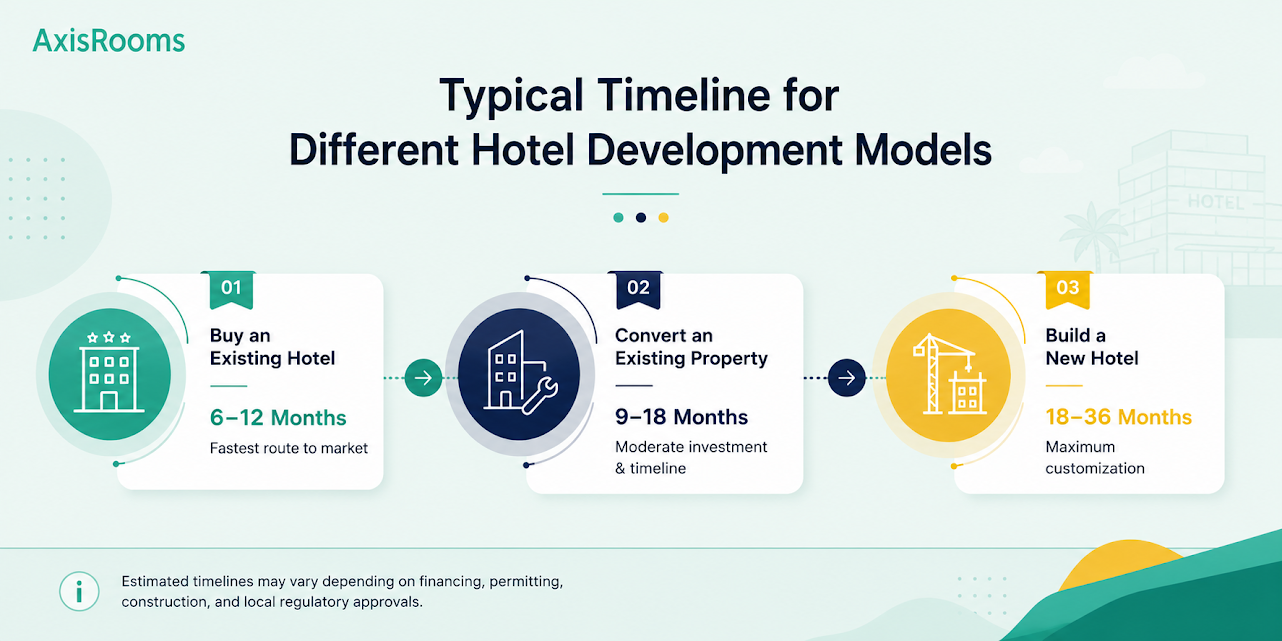
Image:The typical timeline for different hotel development models in the US varies by development approach. Buying an existing hotel may take 6–12 months, converting a property around 9–18 months, while building a new hotel can take 18–36 months.
Which Type of Hotel Business Is Right for You?
The ideal hotel business depends on your investment capacity, target guests, location, and long-term vision. While luxury hotels often receive the most attention, many first-time entrepreneurs find greater success with smaller, limited-service, or boutique properties that offer lower entry costs and simpler operations.
| Hotel Type | Best For | Investment Requirement | Typical Guests |
| Small Hotel | First-time hotel owners | Low | Budget-conscious travelers, local tourists |
| Limited-Service Hotel | Highway locations, suburban markets | Low–Medium | Business and transit travelers |
| Boutique Hotel | Lifestyle destinations and city centers | Medium | Experience-driven leisure travelers |
| Full-Service Hotel | Urban and convention markets | High | Business travelers, conferences, events |
| Luxury Hotel | Premium destinations | Very High | Luxury leisure and international travelers |
| Resort | Beaches, mountains, vacation destinations | Very High | Families, vacationers, groups |
| Extended-Stay Hotel | Corporate hubs and relocation markets | Medium–High | Long-term business travelers and relocating families |
Tip: If you’re entering the hospitality industry for the first time, a small hotel, limited-service hotel, or boutique hotel typically offers a more manageable investment and operational learning curve than a luxury or full-service property.
How to Start a Small Hotel Business
A small hotel is often the most practical choice for first-time hotel entrepreneurs because it requires a lower investment, fewer employees, and simpler day-to-day operations than larger properties.
Focus on these fundamentals:
- Choose a location with consistent year-round demand rather than relying solely on seasonal tourism.
- Keep your room mix and amenities focused on guest needs instead of overinvesting in facilities.
- Build a lean operational team and automate repetitive tasks where possible.
- Invest early in essential hotel technology, including a PMS, Channel Manager, and Booking Engine, to streamline operations from day one.
How to Start a 5-Star Hotel Business
Starting a 5-star hotel requires significantly more capital and planning than other hotel types. Beyond premium construction and interior design, luxury properties must consistently deliver exceptional service, personalized experiences, and world-class amenities.
Key considerations include:
- Select a destination with strong demand for premium travel.
- Develop a distinctive luxury positioning and guest experience.
- Budget for high staffing ratios and continuous employee training.
- Plan for premium facilities such as fine dining, wellness, concierge, and event spaces.
- Use advanced revenue management strategies to maximize profitability throughout the year.
How to Start a Boutique Hotel Business
Boutique hotels continue to gain popularity in the USA as travelers increasingly seek personalized experiences over standardized accommodations. Rather than competing on size, boutique properties stand out through distinctive design, local character, and memorable guest experiences.
Many boutique hotels are developed through adaptive reuse, transforming historic buildings, warehouses, factories, or heritage properties into distinctive hospitality spaces. This approach preserves architectural character while creating memorable guest experiences that modern travelers actively seek.
When planning a boutique hotel:
- Look for properties with architectural or historical appeal.
- Design experiences that reflect the local culture and destination.
- Focus on personalized service rather than extensive amenities.
- Build a strong brand story that differentiates your property.
- Prioritize direct bookings through a compelling website and digital marketing strategy.
What Documents and Licenses Are Required to Start a Hotel Business in the US?
Before welcoming your first guests, you’ll need to register your business and obtain several federal, state, and local approvals. While requirements vary by location, most hotels in the US need the following documents and licenses before they can begin operations.
- Choose a Business Structure (LLC or Corporation): Register your hotel as a legal business entity based on your ownership, tax, and liability requirements.
- Employer Identification Number (EIN): Obtain an EIN from the IRS to pay federal taxes, hire employees, and open a business bank account.
- State Business Registration: Register your business with the appropriate state agency before commencing operations.
- Seller’s Permit or Sales Tax Permit: Apply for a permit if your state requires hotels to collect sales or lodging taxes.
- Certificate of Occupancy (CO): Secure approval from your local authority confirming the property complies with building codes and is safe for occupancy.
- Health Department Permits: Obtain permits if your hotel operates restaurants, bars, pools, spas, or other facilities regulated by local health departments.
- Fire Safety Inspection: Pass inspections covering fire alarms, sprinkler systems, emergency exits, and occupancy requirements.
- Liquor License (If Applicable): Apply through your state’s Alcohol Beverage Control (ABC) authority if you plan to serve alcoholic beverages.
- ADA Compliance: Ensure your property meets the accessibility requirements of the Americans with Disabilities Act (ADA), including accessible guest rooms, entrances, parking, and public spaces.
Because hotel regulations are primarily governed at the state and local levels, licensing requirements can vary depending on where your property is located. Before purchasing or developing a hotel, check with your city or county planning office to confirm zoning requirements, permits, and inspection timelines.
How to Start a Hotel Business Plan: Step-by-Step
A hotel business plan is a strategic roadmap that outlines your hotel concept, target market, financial projections, operational strategy, and growth plan. Whether you’re applying for an SBA loan, pitching investors, or joining a hotel franchise, a well-prepared business plan demonstrates that your project is financially viable and operationally sound.
Essential Steps to Launch a Hotel Business in the USA
-
Conduct Market Research
Start by evaluating the local hospitality market to understand guest demand, competitor performance, and travel trends.
- Analyze occupancy, ADR, and RevPAR using STR/CoStar market data.
- Review local tourism reports and economic development plans.
- Identify your target guests, competitors, and market gaps.
-
Define Your Hotel Concept and Business Model
Before investing in a property, decide what type of hotel you want to operate and who you want to serve.
Your business plan should clearly define your hotel concept, target market, revenue model, funding requirements, and operational strategy. At this stage, you should also determine whether to build a new hotel or acquire an existing property and whether operating as a hotel franchise or an independent hotel best aligns with your investment goals, available capital, and long-term vision.
-
Create Your Hotel Business Plan
Translate your research into a comprehensive business plan that can support financing and guide day-to-day operations.
Include:
- Executive summary
- Target market analysis
- Pricing and revenue strategy
- Marketing and sales plan
- Operational plan
- Financial projections and break-even analysis
-
Secure Funding
Determine how you’ll finance the project based on your investment requirements and business model.
Common funding sources include:
- SBA 7(a) and SBA 504 loans
- Commercial bank financing
- Private investors
- Angel investors
- Hospitality investment groups
-
Register Your Business and Obtain Licenses
Complete all legal and regulatory requirements before beginning operations.
This includes selecting your business structure, obtaining an Employer Identification Number (EIN), completing state registration, and securing all required permits, inspections, and occupancy approvals.
-
Build, Renovate, or Acquire the Property
Whether you’re constructing a new hotel, renovating an existing building, or purchasing an operational property, ensure the project complies with local building codes, zoning regulations, fire safety requirements, and ADA accessibility standards.
-
Hire and Train Your Team
Recruit experienced professionals for front office operations, housekeeping, food and beverage, maintenance, sales, and hotel management.
Develop standard operating procedures (SOPs) and invest in staff training to deliver a consistent guest experience from day one.
-
Implement the Right Hotel Technology
A connected technology stack simplifies operations, improves guest experiences, and supports long-term revenue growth.
Before opening your hotel, implement:
- Property Management System (PMS)
- Channel Manager
- Web Booking Engine
- Revenue Management System (RMS)
- Payment Gateway
- Guest Communication & Reputation Management Tools
-
Market Your Hotel and Launch Operations
Create visibility before opening by building a strong online presence and preparing your distribution strategy.
Focus on:
- Launching a professional hotel website
- Connecting with leading OTAs
- Optimizing for direct bookings
- Building a Google Business Profile
- Developing a pre-opening marketing campaign
- Encouraging early guest reviews after launch
How to Choose the Right Location for Your Hotel Business
Choosing the right location is one of the most important decisions you’ll make when starting a hotel. A great property in the wrong market can struggle to attract guests, while a well-positioned hotel in a high-demand area can achieve stronger occupancy, higher room rates, and better long-term profitability.
According to the U.S. Travel Association’s 2025 Travel Forecast, domestic leisure travel is expected to grow by 1.9%, while business travel is projected to increase by 1.4%. As travel demand continues to evolve, selecting a location based on market data, not assumptions, is more important than ever.
When evaluating potential locations, consider the following factors:
- Airports: Hotels near major airports benefit from consistent demand from business travelers, airline crews, and transit passengers.
- Interstate Highways: Properties located near busy interstate exits often attract road trippers, commercial drivers, and overnight travelers looking for convenient accommodation.
- Downtown Business Districts: Central business districts typically generate year-round demand from corporate travelers, conferences, government offices, and major events.
- National Parks and Tourist Attractions: Hotels near popular attractions can achieve strong occupancy during peak tourism seasons but should also account for seasonal fluctuations.
- Convention and Exhibition Centers: Convention hotels benefit from recurring demand generated by trade shows, conferences, exhibitions, and corporate events.
- Universities and Medical Centers: Colleges, universities, and major hospitals create steady demand from visiting families, faculty, researchers, students, and healthcare professionals throughout the year.
Pro Tip: Don’t choose a location simply because it’s busy. Choose one where demand, competition, and room rates support a profitable business model over the long term.
What Skills Do You Need to Run a Successful Hotel Business?
Launching a hotel is only the beginning. Building a profitable and sustainable hospitality business requires a combination of operational expertise, financial discipline, and a guest-first mindset. Developing these core skills will help you navigate market changes, improve guest satisfaction, and drive long-term growth.
- Leadership: Build a strong workplace culture, motivate your team, and make confident decisions that keep daily operations running smoothly.
- Revenue Management: Understand key performance metrics such as Occupancy, ADR, and RevPAR to optimize pricing, maximize room revenue, and respond to changing market demand.
- Financial Planning: Monitor budgets, operating costs, cash flow, and profitability to ensure your hotel remains financially sustainable.
- Customer Service: Deliver exceptional guest experiences through personalized service, quick issue resolution, and consistent hospitality standards that encourage repeat stays and positive reviews.
- Marketing and Sales: Attract guests through a mix of digital marketing, OTA partnerships, direct booking strategies, social media, and local business collaborations.
- Technology Adoption: Leverage modern hotel technology, including a PMS, Channel Manager, Booking Engine, and Revenue Management System, to automate operations and improve decision-making.
- Team Management: Recruit, train, and retain skilled employees while establishing clear standard operating procedures (SOPs) that ensure consistent service across departments.
Remember: Successful hotels don’t rely on one skill alone. They combine strong leadership, data-driven decision-making, excellent guest service, and the right technology to build a business that grows year after year.
Common Mistakes When Starting a Hotel Business in the US (and How to Avoid Them)
Even well-funded hotel projects can struggle if common planning mistakes aren’t addressed early. Avoiding these pitfalls can save significant time, money, and operational challenges as your business grows.
| Common Mistake | How to Avoid It |
| Underestimating startup costs | Build a realistic budget that includes land, permits, technology, staffing, marketing, and contingency expenses, not just construction costs. |
| Ignoring ADA compliance | Incorporate accessibility requirements into your design and operations from the outset to avoid costly modifications and legal issues. |
| Poor market research | Validate demand using STR/CoStar data, tourism reports, competitor analysis, and local economic trends before investing. |
| Choosing the wrong location | Evaluate year-round demand, accessibility, and competition instead of relying solely on property price or availability. |
| Overinvesting in renovations | Prioritize upgrades that improve guest experience and ROI rather than unnecessary luxury features. |
| Weak staffing plan | Recruit early, define SOPs, and invest in staff training before opening. |
| No direct booking strategy | Launch a professional website with a booking engine and reduce dependency on OTAs over time. |
| Delaying hotel technology adoption | Implement essential systems such as a PMS, Channel Manager, RMS, and payment gateway before launch to streamline operations from day one. |
Identifying these risks before opening your hotel is often far less expensive than correcting them after operations begin.
How Do You Measure the Success of Your Hotel Business?
Opening a hotel is one milestone; running a profitable one is another. Tracking the right performance metrics helps you evaluate revenue, pricing, operational efficiency, and overall business growth. Rather than relying on a single number, successful hotel owners monitor multiple KPIs together to make informed business decisions.
- Occupancy Rate
Measures the percentage of available rooms sold during a specific period. A consistently healthy occupancy rate indicates strong demand and effective inventory utilization.
- Average Daily Rate (ADR)
Shows the average revenue earned from each occupied room. ADR helps you evaluate whether your pricing strategy aligns with market demand and guest expectations.
- Revenue per Available Room (RevPAR)
Combines occupancy and room rates to measure how efficiently your hotel generates room revenue. It is one of the most widely used performance metrics in hotel revenue management.
- Gross Operating Profit per Available Room (GOPPAR)
Measures the operating profit generated by each available room after accounting for operating expenses. It provides a clearer picture of overall profitability than room revenue alone.
- Total Revenue per Available Room (TRevPAR)
Tracks total revenue generated from all departments, including rooms, food and beverage, events, spa services, and other ancillary revenue streams to assess your hotel’s overall financial performance.
- Benchmark Your Performance Against the Market
Tracking your own KPIs is only part of the picture. Benchmarking your Occupancy, ADR, and RevPAR against a competitive set using STR (CoStar) data helps you understand how your hotel performs relative to similar properties in your market.
Pro Tip: Compare your hotel’s performance with properties of a similar size, location, and market segment rather than relying on national averages. Meaningful benchmarking leads to better pricing and revenue decisions.

Manage All Your OTAs from One Place
Request a DemoEssential Hotel Technology for Running a Successful Hotel
Modern hotels rely on more than great service to stay competitive. The right technology helps automate operations, improve guest experiences, increase direct bookings, and make smarter revenue decisions.
Whether you’re opening an independent hotel or joining a franchise, investing in the right software from day one can save time, reduce manual work, and support long-term growth.
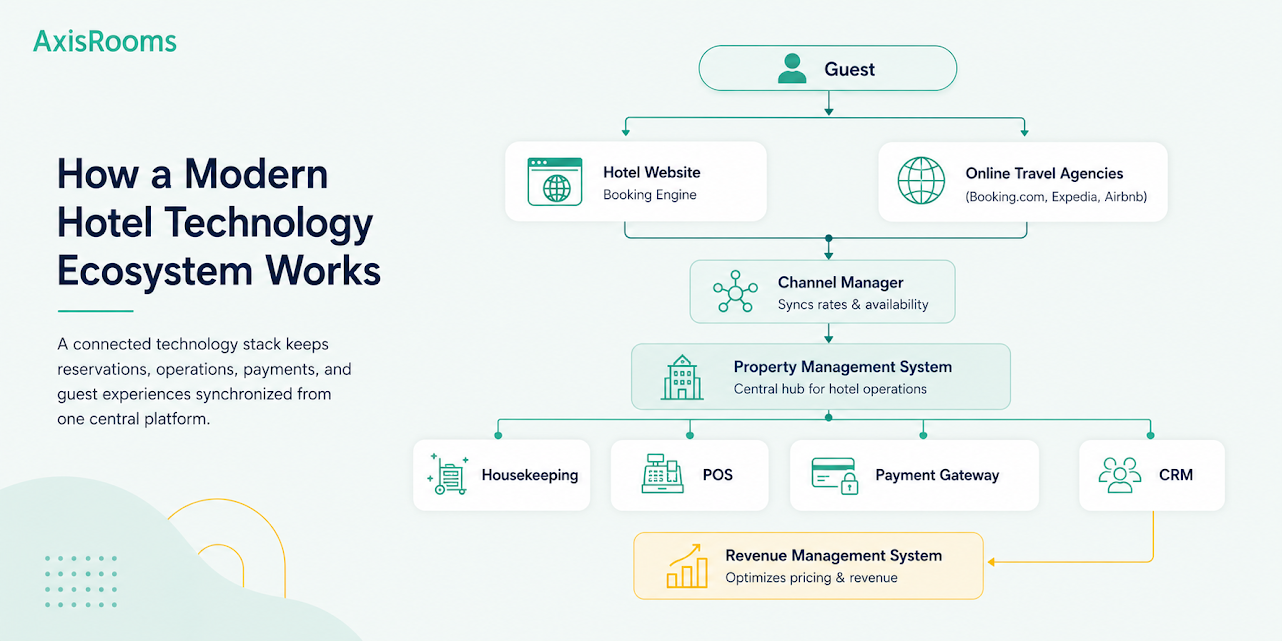
Image:How a modern hotel technology ecosystem connects hotel websites and OTAs with a Channel Manager, PMS, operational tools, CRM, payment systems, and revenue management technology.
Reservation & Distribution Technology
These systems manage reservations, room inventory, and online distribution across multiple booking channels.
- Property Management System (PMS): Centralizes reservations, guest profiles, check-ins, check-outs, housekeeping, billing, and day-to-day hotel operations.
- Central Reservation System (CRS): Manages reservations across your hotel’s website, call center, and distribution channels while maintaining centralized inventory.
- Channel Manager: Synchronizes room rates and availability across OTAs such as Booking.com, Expedia, and Airbnb to prevent overbookings and reduce manual updates.
Revenue Management Technology
Revenue technology helps maximize profitability by optimizing pricing based on demand and market conditions.
- Revenue Management System (RMS): Uses historical trends, competitor pricing, and demand forecasts to recommend optimal room rates and improve RevPAR.
Guest Experience Technology
These tools help hotels build stronger guest relationships before, during, and after every stay.
- Customer Relationship Management (CRM): Stores guest preferences, booking history, and communication records to deliver more personalized experiences.
- Reputation Management Software: Monitors and manages online reviews across Google, TripAdvisor, and OTAs to strengthen your hotel’s online reputation.
- Guest Messaging Platform: Automates confirmations, pre-arrival messages, check-in instructions, and post-stay follow-ups across email, SMS, and messaging apps.
Hotel Operations Technology
Operational tools streamline internal processes, improve efficiency, and simplify day-to-day management.
- Point of Sale (POS): Manages transactions for restaurants, bars, spas, gift shops, and other on-property outlets while integrating with your PMS.
- Payment Gateway: Enables secure online payments for direct bookings, deposits, and guest transactions.
- Housekeeping Software: Helps assign cleaning schedules, track room status in real time, and improve coordination between housekeeping and front office teams.
You don’t need every system on day one. However, a PMS, Channel Manager, Booking Engine, and secure payment gateway form the foundation of a modern hotel technology stack. As your business grows, you can add revenue management, CRM, and guest engagement tools to further improve performance.
AxisRooms: A Modern Hotel Technology Stack for New Hotels
Launching a hotel involves far more than securing funding and opening your doors. As your business grows, managing reservations, distribution, pricing, payments, and guest experiences across multiple systems can quickly become complex. A connected hotel technology stack helps simplify operations, improve efficiency, and create a better experience for both your team and your guests.
Rather than relying on multiple disconnected systems, AxisRooms brings together the essential technologies hotels need to manage distribution, reservations, payments, and revenue from one connected ecosystem.
- 100+ OTA Integrations: Connect your hotel with leading online travel agencies and synchronize rates, inventory, and reservations in real time.
- PMS Integrations: Keep reservations, guest information, and operational data connected for smoother day-to-day hotel management.
- Payment Gateway Integrations: Enable secure online payments and simplify the booking experience for guests across multiple channels.
- Channel Manager: Manage room availability and pricing across OTAs from one centralized dashboard while reducing the risk of overbookings.
- Revenue Management Services: Make more informed pricing decisions using demand trends, booking patterns, and market insights to maximize revenue potential.
- Web Booking Engine: Drive more commission-free direct bookings through your hotel’s website while maintaining real-time inventory and rate parity.
Whether you’re opening your first independent hotel or expanding an existing portfolio, investing in connected hotel technology can help streamline operations, improve visibility, and create a stronger foundation for sustainable growth.
Conclusion
Starting a hotel business in the US requires careful planning, significant investment, and a clear understanding of licensing, funding, operations, and market demand. While the journey can be complex, building a successful hotel ultimately comes down to making informed decisions from choosing the right location and business model to implementing the technology needed to support long-term growth.
With the right strategy and tools in place, you’ll be better positioned to deliver exceptional guest experiences while building a profitable and scalable hospitality business.
Book a free demo today to see how AxisRooms can help simplify hotel operations, optimize distribution, and support your hotel’s growth.