
Starting a hotel business in India is becoming an increasingly attractive opportunity, driven by rising domestic travel, business tourism, and growing demand for quality accommodation across metros and emerging destinations. According to Maximize Market Research, the Indian Hotel Market was valued at USD 32.1 billion in 2023 and is projected to grow at a 9.4% CAGR through 2030, creating strong long-term opportunities for hospitality entrepreneurs.
If you’re wondering how to start a hotel business in India, choosing the right property is only one part of the journey. From estimating investment and securing funding to obtaining licences, meeting compliance requirements, choosing the right business model, and investing in hotel technology, every decision can influence your profitability from day one.
In this guide, we’ll walk you through everything you need to know to start, launch, and grow a successful hotel business in India in 2026.
What Is a Hotel Business?
A hotel business provides paid accommodation along with services such as dining, housekeeping, concierge, and recreational facilities to travellers. Depending on the property’s size and positioning, hotels may cater to business travellers, leisure tourists, families, pilgrims, or long-stay guests.
In India, hotel businesses range from small independent hotels and boutique properties to luxury resorts and branded chains. Although each serves a different market, every hotel business aims to deliver exceptional guest experiences while generating sustainable revenue.
How Do I Start a Hotel Business in India?
If you’re wondering how to start a new hotel business in India, you’ll quickly discover that success requires much more than securing the right property. India’s expanding tourism sector and rising demand for quality accommodation have created significant opportunities, but building a profitable hotel begins with identifying the right market opportunity and delivering an experience that meets evolving traveller expectations.
Whether you’re opening a small independent hotel, developing a luxury property, or planning to build a hotel chain, the principles of building a successful hotel remain the same. A solid launch begins with thorough market research, realistic financial planning, regulatory compliance, and the right technology to support efficient operations and sustainable growth.
How Much Investment Is Needed to Start a Hotel Business in India?
The investment required to start a hotel business in India varies widely depending on factors such as the hotel’s category, location, number of rooms, land ownership, and whether you’re constructing a new property or converting an existing building. While a small independent hotel may require a relatively modest investment, a luxury or branded property demands significantly higher capital.
Understanding the major cost components early helps you prepare a realistic budget, evaluate funding requirements, and avoid unexpected expenses during the setup process.
What Determines the Cost of Starting a Hotel in India?
Several factors influence your overall investment, including the type of hotel, land ownership, room count, construction quality, facilities offered, and the market you plan to serve.
| Hotel Type | Investment Level | Major Cost Drivers |
| Budget Hotel | Low | Smaller room inventory, basic amenities, limited staffing, and simpler interiors. Costs increase if land acquisition or new construction is involved. |
| Mid-scale Hotel | Moderate | Larger room count, restaurant or café, better interiors, additional guest amenities, and higher staffing requirements. |
| Boutique Hotel | Moderate to High | Premium design, customised interiors, unique guest experiences, and higher fit-out costs despite having fewer rooms. |
| Luxury / Five-Star Hotel | High | Premium land, high-end construction, extensive facilities, a larger workforce, and strict brand or HRACC standards. |
Regardless of the hotel category you choose, your total investment will also depend on land acquisition or lease costs, construction or renovation, furniture and fixtures (FF&E), licensing and regulatory approvals, technology, staffing, pre-opening marketing, and working capital.
Funding Options for Hotel Businesses
Securing adequate funding is just as important as estimating your investment. Many hotel projects use a combination of debt, equity, and government-backed schemes to finance construction and operations.
- Bank Loans: Most commercial banks offer loans for hotel construction, renovation, and expansion. A detailed business plan, financial projections, collateral, and repayment capacity are typically required.
- Startup India: Hospitality startups with innovative business models may benefit from Startup India recognition, which provides access to funding opportunities, mentorship, and other government-backed support.
- PMEGP (Prime Minister’s Employment Generation Programme): Eligible first-generation entrepreneurs can explore PMEGP for financial assistance when setting up small hospitality businesses, particularly in rural and semi-urban areas.
- Mudra Loans: Small hotels, guest houses, and homestays may qualify for Mudra loans, making them a suitable option for entrepreneurs with relatively lower funding requirements.
- Private Investors: Boutique hotels and experience-led hospitality ventures often raise capital through angel investors or private equity partners in exchange for equity ownership.
- Franchise Financing: Entrepreneurs planning to operate under an established hotel brand may receive financing support or lender referrals through select franchisors, depending on the brand’s policies.
- NBFCs (Non-Banking Financial Companies): NBFCs can offer quicker loan approvals than traditional banks, although interest rates may be comparatively higher.
- Udyam/MSME Registration: Registering your hotel as an MSME can improve access to government incentives, priority sector lending, and various support schemes for small and medium businesses.
Before approaching any lender or investor, prepare a comprehensive hotel business plan that outlines your target market, investment requirements, revenue projections, operating costs, and growth strategy.
A well-prepared plan not only strengthens funding applications but also serves as the roadmap for building a sustainable hotel business.
How Long Does It Take to Start a Hotel in India?
Launching a hotel involves multiple stages, from business planning and approvals to construction and operational readiness.
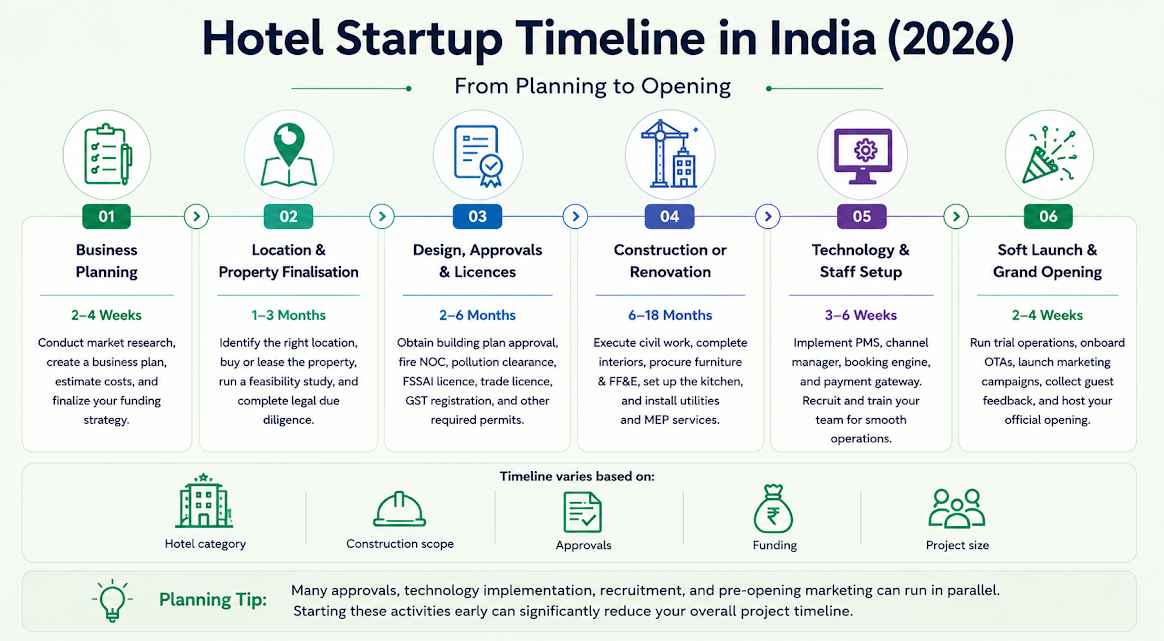
Figure: Indicative hotel startup timeline for a new hotel project in India. Timelines vary based on location, approvals, funding, construction scope, and operational readiness.
Which Type of Hotel Business Is Right for You?
The type of hotel you choose influences your investment, operations, target audience, and long-term growth potential.
According to Mordor Intelligence, mid-scale and upper mid-scale hotels accounted for approximately 38.5% of India’s hotel market in 2025, reflecting strong demand from domestic leisure travellers, SMEs, and corporate travel. However, every hotel category serves a different market and comes with its own investment, operational, and growth considerations.
The table below compares some of the most common hotel business models to help you determine which one best aligns with your objectives.
| Hotel Type | Best Suited For | Key Advantages | Things to Consider |
| Small Hotel | First-time entrepreneurs, family-run businesses, and local investors | Lower operational complexity, faster launch, personalised guest experience | Limited room inventory and fewer revenue streams |
| Mid-scale Hotel | Growing hospitality businesses and independent operators | Strong year-round demand, balanced investment, and appeals to both business and leisure travellers | Higher competition, especially in cities and popular tourist destinations |
| Five-Star Hotel | Established investors, hospitality groups, and luxury developers | Premium positioning, higher ADR potential, wider ancillary revenue opportunities | Significant capital investment, stringent service standards, and specialised staffing |
| Hotel Chain | Businesses planning long-term expansion | Strong brand recognition, standardised operations, economies of scale | Requires proven operating systems, larger management teams, and consistent quality across properties |
Expert Tip: If you’re entering the hospitality industry for the first time, consider launching one well-managed property before expanding into multiple locations or premium segments. Gaining operational experience with your first property creates a stronger foundation for future expansion.
How to Start a Small Hotel
Starting a small hotel is often the most practical option for first-time hospitality entrepreneurs. Whether you’re converting an existing property or developing a new one, small hotels require comparatively lower investment while offering greater operational flexibility.
Focus on these fundamentals:
- Focus on a clearly defined target audience, such as business travellers, tourists, pilgrims, or families.
- Choose a location with consistent year-round demand rather than relying solely on seasonal tourism.
- Keep operating costs under control without compromising guest comfort and service quality.
- Invest in essential hotel technology early to automate reservations, inventory management, and online distribution.
Many successful hotel brands began with a single property before expanding into multiple locations.
How to Start a Five-Star Hotel
A five-star hotel requires considerably more planning than other hotel categories. Beyond substantial investment, you’ll need premium infrastructure, highly trained staff, exceptional guest experiences, and compliance with quality standards expected in the luxury hospitality segment.
Before launching a five-star property, you should:
- Conduct a detailed market feasibility study.
- Secure adequate funding for construction, interiors, and pre-opening expenses.
- Design facilities that meet luxury guest expectations.
- Apply for HRACC star classification after the property becomes operational to strengthen credibility and market positioning.
- Implement a robust technology stack to manage operations, pricing, and multi-channel distribution efficiently.
Luxury hotels compete on experience as much as accommodation, making service consistency and operational excellence critical to long-term success.
How to Start a Hotel Chain
Most successful hotel chains don’t begin with multiple properties; they start by building one successful hotel and then expanding after establishing a proven business model. Scaling from one property to multiple locations requires standardised operations, consistent guest experiences, and the right technology infrastructure.
Before expanding into multiple properties, you should:
- Standardise operating procedures (SOPs) across all departments.
- Build a consistent brand identity and guest experience.
- Invest in technology that supports multi-property management and centralised reporting.
- Recruit experienced leadership teams to oversee operations across locations.
- Expand only after your first property demonstrates consistent occupancy and profitability.
Growing into a hotel chain is a long-term strategy. Prioritising operational consistency and sustainable expansion can help build a stronger, more resilient hospitality brand.
What Documents and Licenses Are Required to Start a Hotel Business in India?
Before opening your hotel, you’ll need to register your business and obtain several licences and approvals from central, state, and local authorities. The exact requirements depend on your hotel’s size, location, facilities, and the services you plan to offer. While some registrations are required for every hotel, others apply only if you operate a restaurant, serve alcohol, or provide additional amenities.
Documents to Keep Ready
Before applying for licences and registrations, keep the following documents readily available:
- Identity and address proof of the owner(s) or directors
- PAN card and Aadhaar card
- Business incorporation or registration documents
- Property ownership documents or a lease agreement
- Approved building plan and occupancy certificate
- Fire safety compliance documents
- Environmental approvals (where applicable)
- Architectural drawings and site plans
Having these documents prepared in advance can help streamline the approval process and minimise delays.
Key Registrations and Licences You’ll Need
- Business Registration: Register your hotel as a sole proprietorship, partnership, LLP, or private limited company to establish its legal identity before commencing operations.
- GST Registration: Obtain GST registration if your business meets the applicable eligibility criteria. This enables tax compliance and allows you to issue GST-compliant invoices.
- Trade Licence: Obtain a trade licence from the local municipal authority to operate your hotel as a commercial establishment within its jurisdiction.
- Fire Safety NOC: Secure a No Objection Certificate (NOC) from the state fire department to certify that your property complies with prescribed fire safety standards.
- FSSAI Licence (If serving food and beverages): Obtain an FSSAI licence if your hotel operates a restaurant, café, room service, or any other food and beverage outlet.
- Pollution Control Board Clearance (Where applicable): Obtain environmental clearance from the respective State Pollution Control Board if your property’s size or operations require it under local regulations.
- Shop and Establishment Registration (As applicable under state laws): Register your hotel under the applicable Shops and Establishments Act if required by your state to comply with employment and workplace regulations.
- Building Completion and Occupancy Certificate: Obtain this certificate from the local authority to confirm that your building complies with approved plans and is safe for occupancy.
- Liquor Licence (If serving alcohol): Apply for the relevant liquor licence from your State Excise Department before serving alcoholic beverages.
- Music Licence (If playing copyrighted music): Obtain the necessary licences from the appropriate copyright authorities if you play copyrighted music in restaurants, bars, banquet halls, or other public areas.
Note: Hotel licensing requirements, application procedures, fees, and timelines vary across states and local authorities. Always verify the latest regulations with the relevant government departments before beginning the approval process.
How to Get HRACC Star Classification for Your Hotel
HRACC (Hotel & Restaurant Approval and Classification Committee) star classification is a voluntary certification issued by the Ministry of Tourism, Government of India. It assesses hotels against defined standards covering infrastructure, guest facilities, service quality, and safety before awarding a star rating.
While HRACC classification is not mandatory to operate a hotel in India, it can strengthen your property’s credibility, improve guest confidence, and enhance your positioning, especially among business travellers, international tourists, and tour operators.
How to Apply for HRACC Star Classification
Once your hotel is operational and all mandatory licences are in place, you can apply for HRACC classification by following these steps:
1. Submit the online application along with the prescribed fee.
2. Upload the required documents and su1pporting information.
3. Undergo a physical inspection by the HRACC evaluation committee.
4. Address any observations, if required.
5. Receive your star classification upon successful evaluation.
Key Things to Know About HRACC
- HRACC evaluates infrastructure, guest facilities, safety standards, hygiene, staff training, and service quality before awarding a star rating.
- Star classification remains valid for a specified period and must be renewed to maintain your certified status.
- HRACC classification and GST are separate requirements. GST on hotel accommodation is based on the applicable room tariff and prevailing tax regulations, not on your hotel’s star rating.
Essential Steps to Launch a Hotel Business
Launching a successful hotel requires careful planning long before you welcome your first guests. Following a structured approach can help minimise delays, control costs, and build a strong foundation for long-term growth.
Step 1. Conduct Market Research
Study your target market, competitors, demand patterns, and preferred guest segments. Understanding local tourism trends and customer expectations will help you position your hotel more effectively.
Step 2. Prepare a Hotel Business Plan
Create a comprehensive business plan covering your target audience, budget, revenue projections, marketing strategy, staffing requirements, and operational roadmap. A well-prepared business plan also improves your chances of securing funding.
Step 3. Finalise Funding
Estimate your startup costs and choose the most suitable funding mix, whether through bank loans, government schemes, private investors, or personal capital. Ensure you have adequate working capital for the initial months of operation.
Step 4. Register Your Business
Choose an appropriate legal structure, register your business, obtain a PAN, complete GST registration where applicable, and fulfil other statutory requirements before commencing operations.
Step 5. Obtain Licences and Regulatory Approvals
Apply for the licences and approvals required to operate your hotel legally, including trade licences, Fire Safety NOCs, FSSAI registration (if applicable), and other state-specific approvals.
Step 6. Acquire or Develop the Property
Purchase, lease, construct, or renovate your property based on your business model. Prioritise guest comfort, operational efficiency, accessibility, and compliance with applicable building regulations.
Step 7. Hire and Train Your Team
Recruit skilled professionals across front office, housekeeping, food and beverage, maintenance, and guest services. Regular training helps maintain service quality and deliver consistent guest experiences.
Step 8. Set Up Your Hotel Technology
Implement essential technology such as a Property Management System (PMS), Channel Manager, Booking Engine, payment gateway, and revenue management tools to streamline operations and maximise revenue from day one.
Step 9. Market Your Hotel
Build a professional website, optimize your Google Business Profile, partner with relevant OTAs, leverage social media, and create pre-opening marketing campaigns to generate bookings before launch.
Step 10. Launch Operations
Conduct a soft launch to test your operations, gather guest feedback, identify gaps, and fine-tune processes before your official opening. A successful launch sets the tone for long-term guest satisfaction and business growth.
How to Choose the Right Location for Your Hotel Business
Choosing the right location is one of the most important decisions you’ll make when starting a hotel business. Even the best-designed property can struggle if it’s located in an area with limited demand or poor accessibility. Before investing in land or signing a lease, evaluate whether the location aligns with your target guests, business goals, and long-term growth plans.
For example, entrepreneurs researching how to start a hotel business in Tamil Nadu may prioritise business hubs such as Chennai and Coimbatore, while those exploring how to start a hotel business in Kerala often evaluate tourism-driven destinations like Kochi, Munnar, Alleppey, or Wayanad, each with different demand patterns and investment considerations.
When evaluating a potential hotel location, consider the following factors:
- Understand Your Target Market: Choose a location based on the guests you want to attract. Business hotels perform well near commercial hubs and airports, while leisure hotels, resorts, and boutique properties benefit from proximity to tourist attractions, beaches, pilgrimage sites, or hill stations.
- Assess Local Demand: Research domestic and international tourism trends, corporate travel, local events, and seasonal demand. Consistent year-round demand generally offers greater revenue stability than highly seasonal destinations.
- Evaluate Accessibility: Guests prefer hotels that are easy to reach. Consider connectivity to airports, railway stations, highways, metro networks, and public transport, along with parking availability.
- Study the Competition: Analyse nearby hotels to understand their room rates, occupancy levels, guest reviews, and positioning. Rather than avoiding competition altogether, identify gaps where your property can offer a stronger value proposition.
- Check Infrastructure and Future Development: Look beyond the present. Upcoming airports, convention centres, industrial parks, metro expansions, or tourism projects can significantly increase a location’s long-term potential.
- Review Local Regulations: Verify zoning regulations, land-use permissions, environmental requirements, and municipal development plans before finalising the property. Resolving regulatory issues early can save considerable time and cost later.
- Estimate Operating Costs: A prime location may attract more guests, but it also comes with higher land prices, rentals, staffing costs, and utility expenses. Evaluate whether the expected demand justifies the overall investment.
- Think About Long-Term Growth: Choose a location that supports future expansion and changing traveller preferences. Areas experiencing steady tourism growth or commercial development often offer better long-term returns than saturated markets.
Note: Don’t evaluate a location based on land price alone. Compare projected occupancy, ADR, RevPAR potential, operating costs, and future demand to understand whether the investment is likely to deliver sustainable returns.
Hotel Startup Checklist: Everything You Need Before Launch
Before welcoming your first guests, take one final step back to ensure every critical task has been completed. Overlooking a licence, delaying technology setup, or skipping staff training can create avoidable operational challenges after launch.
Use the checklist below as a quick readiness assessment before welcoming your first guests.
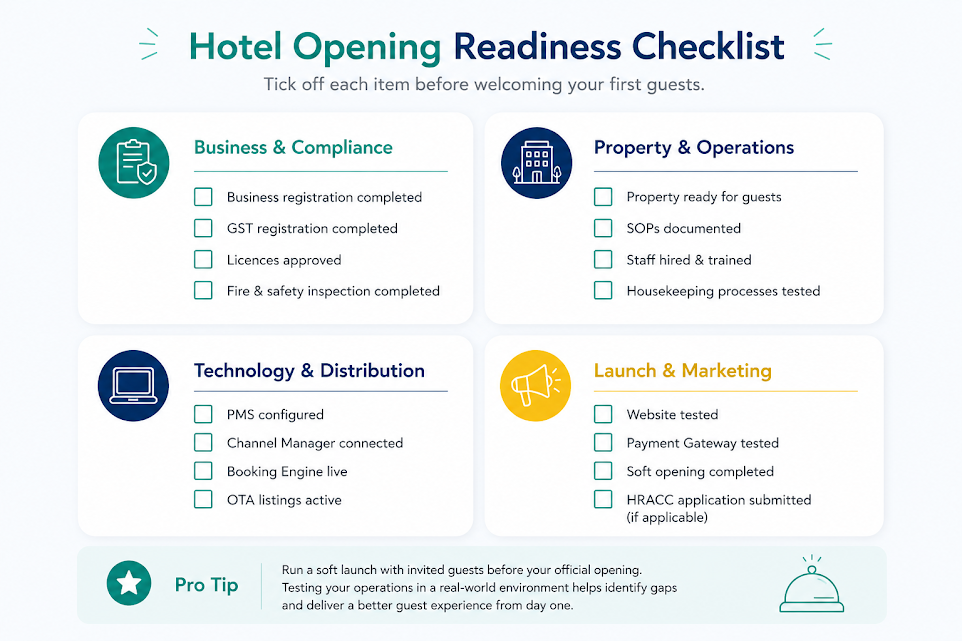
Figure: Hotel Opening Readiness Checklist — A practical pre-launch checklist covering compliance, operations, technology, and marketing before welcoming your first guests.
Completing every item before launch can significantly reduce operational disruptions, improve guest satisfaction, and help your team deliver a consistent experience from day one.
Hotel Technology Every New Hotel Needs
Modern hotels rely on technology to manage reservations, streamline daily operations, improve guest experiences, and maximise revenue. While manual processes may work during the early stages, they quickly become difficult to manage as bookings increase across multiple channels.
Investing in the right technology from the beginning helps reduce operational errors, improve efficiency, and create an effortless experience for both guests and hotel staff.
- Property Management System (PMS): A Property Management System (PMS) serves as the operational hub of your hotel. It centralises reservations, guest profiles, check-ins, check-outs, housekeeping, billing, and front-office operations, helping your team work more efficiently while supporting streamlined front-office operations.
- Channel Manager: A hotel channel manager automatically synchronises your room inventory, rates, and availability across OTAs and other booking channels in real time. This prevents double bookings, eliminates manual updates, and ensures pricing remains consistent everywhere your hotel is listed.
- Booking Engine: A booking engine enables guests to book rooms directly through your hotel’s website. Increasing direct bookings reduces OTA commission costs, improves profitability, and gives you greater control over the guest journey from the very first interaction.
- Revenue Management System (RMS): A revenue management system analyses demand patterns, occupancy trends, seasonality, and market conditions to recommend optimal room rates. Smarter pricing strategies help maximize both occupancy and revenue throughout the year.
- Payment Gateway: A secure payment gateway allows guests to make online payments safely during the booking process. It simplifies transactions, reduces payment failures, and builds trust by offering a smooth and secure payment experience.
Why Integration Matters: Each solution delivers value independently, but the greatest benefits come when they work together as one connected ecosystem.
Manage All Your OTAs from One Place
Request a Demo

What Are the Main Revenue Streams for a Hotel Business in India?
Room bookings are the primary source of income for most hotels, but they’re rarely the only one. Successful hotels generate revenue from multiple guest touchpoints, helping improve profitability, reduce dependence on room sales, and create a more resilient business.
The most common revenue streams include:
- Room Bookings: The largest contributor to hotel revenue. Increasing occupancy, improving Average Daily Rate (ADR), and driving more direct bookings can significantly boost profitability.
- Food & Beverage (F&B): Restaurants, cafés, bars, room service, and catering services generate additional income while enhancing the overall guest experience.
- Events & Banquets: Weddings, conferences, meetings, and social events can become major revenue drivers, particularly for hotels with dedicated event spaces.
- Spa & Wellness Services: Resorts and premium hotels often earn additional revenue through spas, fitness centres, wellness programmes, and recreational experiences.
- Ancillary Services: Airport transfers, laundry, parking, early check-ins, late check-outs, equipment rentals, and curated local experiences may generate smaller individual revenues but collectively contribute meaningfully to overall profitability.
While room bookings remain your primary revenue driver, the most profitable hotels maximize revenue from every guest by combining accommodation with dining, events, wellness services, and other value-added experiences.
Key Hotel KPIs Every Hotel Owner Should Track
Opening your hotel is only the beginning. Tracking the right KPIs helps you measure performance, identify opportunities for improvement, and make better business decisions as your hotel grows.
| KPI | What It Measures | Why It Matters |
| Occupancy Rate | The percentage of available rooms sold during a given period. | Indicates how effectively your hotel is filling available inventory and attracting guests. |
| ADR (Average Daily Rate) | The average revenue earned per occupied room. | Helps evaluate your pricing strategy and average room value. |
| RevPAR (Revenue Per Available Room) | Revenue generated from all available rooms, combining occupancy and ADR. | Provides a clearer picture of overall room revenue performance. |
| GOPPAR (Gross Operating Profit Per Available Room) | Operating profit generated per available room after accounting for expenses. | Measures how efficiently your hotel converts revenue into profit. |
| Guest Reviews & Ratings | Guest satisfaction across review platforms and feedback channels. | Strong reviews improve online reputation, increase bookings, and encourage repeat stays. |
Reviewing these KPIs together provides a more complete picture of your hotel’s performance than relying on a single metric. Regular monitoring helps you make smarter decisions around pricing, marketing, operations, and guest satisfaction.
Common Challenges When Starting a Hotel Business (and How to Overcome Them)
Starting a hotel business is rewarding, but it also comes with financial, operational, and regulatory challenges. Recognising these early allows you to minimise risks and build a stronger foundation for long-term success.
- High Initial Investment: Hotel projects require significant capital for land, construction, interiors, licences, technology, staffing, and working capital. Build a detailed business plan, maintain a contingency budget, and explore multiple funding options before beginning your project.
- Regulatory Approvals and Compliance: Obtaining licences from multiple authorities can delay your launch if applications are incomplete. Prepare a compliance checklist, apply early, and seek professional guidance where necessary.
- Choosing the Right Location: A poor location can limit occupancy and long-term profitability. Evaluate tourism demand, accessibility, competition, infrastructure, and future development before making an investment.
- Recruiting and Retaining Skilled Staff: Finding experienced hospitality professionals can be challenging, particularly in emerging destinations. Invest in structured hiring, regular training, and clear operating procedures to build a reliable team.
- Generating Consistent Bookings: New hotels often struggle to build visibility during their initial months. Combine OTA distribution with direct bookings, digital marketing, and local partnerships to create a steady booking pipeline.
- Managing Revenue and Pricing: Static pricing can reduce occupancy during low-demand periods or leave revenue on the table during peak seasons. Monitor Occupancy, ADR, RevPAR, competitor pricing, and market demand to make informed pricing decisions.
- Managing Operations Efficiently: Handling reservations, payments, inventory, and guest information through disconnected systems increases manual work and operational errors. Investing in an integrated hotel technology ecosystem helps streamline operations and supports long-term growth.
Every hotel faces challenges during its setup journey. Careful planning, disciplined execution, and the right technology can lower risk and support sustainable growth.
How AxisRooms Helps You Start and Grow a Hotel Business
Establishing a hotel is only the first step; running it efficiently is what drives long-term profitability. As bookings increase across multiple channels, managing reservations, pricing, payments, and operations manually becomes increasingly difficult.
AxisRooms brings together the essential hospitality technology needed to simplify hotel operations, improve online distribution, and support sustainable business growth through one connected ecosystem.
- Channel Manager – Synchronise room inventory, rates, and availability across leading OTAs in real time to prevent double bookings and reduce manual updates.
- Web Booking Engine – Enable commission-free direct bookings through your website with real-time availability and secure online payments.
- Revenue Management Services – Optimise room pricing using demand trends and market insights to maximise occupancy and revenue.
- PMS Integrations – Connect your Property Management System with distribution channels to streamline reservations and day-to-day hotel operations.
- 100+ OTA Integrations – Expand your online reach by connecting with leading booking platforms while maintaining accurate inventory and pricing.
- Payment Gateways – Offer guests a secure and simple online payment experience from booking to check-out.
By connecting distribution, operations, pricing, and payments on one platform, AxisRooms helps hotels work more efficiently, increase revenue opportunities, and deliver better guest experiences as they grow.
Conclusion
Starting a hotel business in India is a long-term investment, but with the right planning, it can also be a highly rewarding one. From choosing the right business model and securing licences to adopting modern hotel technology and tracking the right performance metrics, every decision you make before opening your doors influences your hotel’s future growth and profitability.
As India’s hospitality industry continues to expand, hotels that combine operational excellence with smart technology and guest-focused experiences will be best positioned for long-term success. Whether you’re launching your first property or planning to scale your portfolio, building a strong foundation today will help you stay competitive for years to come.
Ready to simplify hotel operations, maximise revenue, and deliver exceptional guest experiences? Book a free demo today and grow your business with confidence.