
Starting a hotel business is an exciting opportunity, but turning it into a profitable venture takes far more than finding the right property. Success depends on choosing the right business model, understanding your market, planning your finances, complying with regulations, and using technology to run operations efficiently.
The opportunity is significant. According to Statista, the global hotel market was expected to generate more than US$450 billion in revenue in 2025, highlighting the continued growth of the hospitality industry worldwide. Whether you’re planning to open a boutique hotel, business hotel, resort, or budget property, understanding how the business works is the first step toward building a sustainable operation.
In this guide, you’ll learn what a hotel business is, how to start one, estimated startup costs, legal requirements, profitability, and the strategies needed to run a successful hotel.
What Is a Hotel Business?
A hotel business is a commercial venture that provides paid accommodation and related services to travelers. Depending on the property, these services may include restaurants, event spaces, spas, concierge assistance, airport transfers, and other guest amenities. The goal is to generate revenue while delivering a comfortable and memorable guest experience.
While room bookings remain the primary source of income, many hotels also earn from food and beverage services, events, wellness facilities, laundry, and other guest offerings.
The type of hotel you operate shapes everything from your target guests to your pricing strategy and services. Hotels come in many forms, each catering to different types of travelers and budgets.
| Hotel Type | Best Suited For |
| Budget Hotels | Price-conscious travelers |
| Business Hotels | Corporate travelers and professionals |
| Boutique Hotels | Guests looking for unique, personalized experiences |
| Resorts | Leisure travelers and families |
| Luxury Hotels | Premium leisure and business guests |
| Serviced Apartments | Long-stay business and leisure travelers |
One common point of confusion is the difference between a hotel business and a business hotel.
A hotel business refers to the business of owning, operating, or managing a hotel to generate revenue. In contrast, a business hotel is a type of hotel designed primarily for corporate travelers, often offering amenities such as meeting rooms, workspaces, and convenient business locations.
Why Start a Hotel Business?
Rising travel demand and evolving guest preferences continue to create new opportunities across the hospitality industry. From boutique hotels and business properties to resorts and homestays, there are opportunities to serve different types of travellers and markets. As tourism continues to recover globally and domestic travel grows in countries like India, the hotel industry remains an attractive space for entrepreneurs and investors.
However, building a successful hotel requires careful planning, consistent service, and the ability to adapt to changing guest expectations. Before investing, it’s important to understand both the opportunities and the challenges.
Who Should Start a Hotel Business?
Starting a hotel business can be a good fit for entrepreneurs, property owners, investors, and hospitality professionals looking to build a long-term business. Whether you’re planning to open a business hotel, a resort, a small boutique hotel, or convert an existing property into accommodation, success depends on choosing the right market, delivering excellent service, and operating efficiently.
How to Start a Hotel Business (Step-by-Step)
Starting a hotel business involves much more than finding the right property. From choosing a profitable concept to setting up technology and launching across booking channels, every decision influences your hotel’s long-term success.
Here’s a step-by-step roadmap to help you get started.
1. Choose Your Hotel Concept
Begin by deciding what type of hotel you want to operate. Your concept determines your target audience, investment requirements, pricing strategy, and day-to-day operations.
For example, a boutique hotel focuses on personalized experiences, while a business hotel caters to corporate travelers with facilities like meeting rooms and high-speed internet. Similarly, a resort targets leisure guests, whereas a budget hotel prioritizes affordability and high occupancy.
Choose a concept that aligns with market demand, your budget, and your long-term business goals.
2. Conduct Market Research
Before investing, understand who your potential guests are and what they’re looking for. Analyze local tourism trends, competitor hotels, occupancy levels, seasonal demand, and average room rates.
For instance, a destination popular for weddings may require banquet facilities, while a business district may benefit more from meeting spaces and express check-in services. Thorough market research helps you identify opportunities, avoid costly mistakes, and build a hotel that stands out.
3. Choose the Right Location
Few decisions influence a hotel’s success as much as its location. Even the best-designed property can struggle if it’s difficult to access or doesn’t match traveler demand.
Consider factors such as:
- Proximity to airports, railway stations, or tourist attractions
- Accessibility and transportation
- Local competition
- Future infrastructure development
- Safety and neighborhood appeal
The right location can improve occupancy, increase room rates, and attract repeat guests.
4. Prepare a Hotel Business Plan
A well-structured hotel business plan acts as your roadmap. It also becomes essential if you’re seeking loans or external investment.
Your business plan should include:
- Business concept and target market
- Market and competitor analysis
- Revenue model
- Marketing and sales strategy
- Operational plan
- Financial projections
- Break-even analysis
A detailed plan helps you make informed decisions and gives lenders confidence in your business.
5. Arrange Funding
Starting a hotel often requires significant capital. Depending on your business model, funding may come from personal savings, bank loans, private investors, business partners, or government schemes that support tourism and hospitality.
Estimate both your initial investment (CAPEX) and ongoing operating expenses (OPEX) before securing funds. This helps avoid cash flow challenges during the early stages of the business.
6. Register Your Business
Choose a suitable legal structure for your hotel, such as a sole proprietorship, partnership, LLP, or private limited company, depending on your ownership model and growth plans.
Business registration is also necessary for opening bank accounts, obtaining licenses, and meeting tax and compliance requirements.
7. Obtain the Required Licenses
Hotels must obtain various approvals before opening, and the requirements may vary by country, state, or local authority.
For hotels in India, these commonly include:
- Business registration
- GST registration
- Trade license
- Fire safety clearance
- FSSAI license (if serving food)
- Pollution and local municipal approvals (where applicable)
Completing these formalities early helps prevent delays before launch.
8. Build or Lease the Property
Once planning is complete, focus on developing a property that aligns with your brand positioning and guest expectations.
Whether you’re constructing a new hotel or leasing an existing building, pay attention to room layouts, guest facilities, accessibility, safety standards, and operational workflows. A well-designed property not only enhances the guest experience but also improves staff efficiency.
9. Set Up the Right Hotel Technology
Technology has become essential for running a modern hotel efficiently. The right tools reduce manual work, improve guest experience, and help maximize revenue from day one.
At a minimum, consider implementing:
- Property Management System (PMS)
- Channel Manager
- Booking Engine
- Revenue Management solution
- Payment Gateway
Together, these systems help automate reservations, manage room availability, distribute inventory across OTAs, process payments, and support smarter pricing decisions.
10. Hire and Train Your Team
Your staff plays a major role in shaping the guest experience. Hire people with the right skills and provide training on customer service, hotel operations, safety procedures, and the technology you’ll use every day.
A knowledgeable and motivated team contributes to better guest satisfaction, stronger reviews, and repeat business.
11. Launch Across Online Booking Channels
Before opening your doors, ensure guests can find and book your hotel online.
List your property on relevant OTAs, optimize your direct booking website, upload accurate room descriptions and images, and maintain consistent pricing across all booking channels. A strong online presence helps generate bookings from day one.
12. Soft Launch and Track Performance
A soft launch allows you to test operations before your official opening. Use this period to identify gaps, gather guest feedback, and fine-tune your processes.
Start monitoring key hotel KPIs such as:
- Occupancy Rate
- Average Daily Rate (ADR)
- Revenue Per Available Room (RevPAR)
- Average Length of Stay (ALOS)
- Guest Review Scores
Tracking these metrics early makes it easier to improve performance and build a stronger foundation for long-term growth.
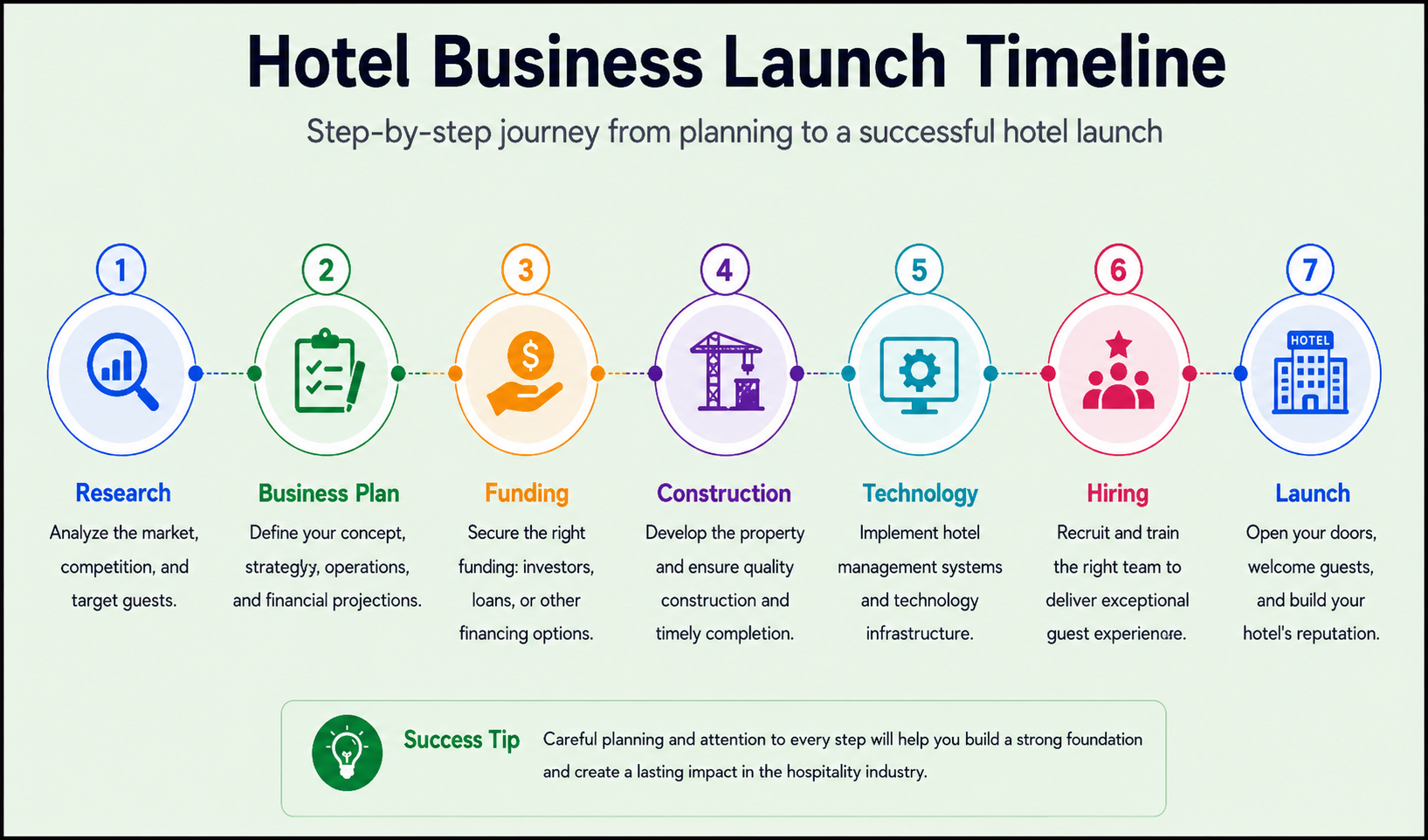
Hotel Business Launch Timeline
A simplified roadmap showing the key stages involved in planning, launching, and operating a successful hotel business.
How Much Does It Cost to Start a Hotel Business?
Starting a hotel business requires significant investment, but there isn’t a fixed cost that applies to every project. Your total investment depends on several factors, including the hotel’s size, location, category, amenities, and whether you’re building a new property or leasing an existing one.
Understanding the major cost components can help you estimate your budget more accurately and avoid unexpected expenses during the planning and launch stages.
- Capital Expenditure (CAPEX): Covers one-time investments such as land, construction or renovation, interiors, furniture, equipment, hotel technology, and licenses.
- Operating Expenditure (OPEX): Includes recurring expenses like staff salaries, utilities, housekeeping, maintenance, marketing, OTA commissions, and software subscriptions.
- Global Cost Considerations: Hotel development costs vary significantly across countries based on land prices, labour costs, regulations, and the type of property being built.
- Additional Startup Expenses: Along with property costs, hotels in India should budget for licenses, GST compliance, technology, pre-opening marketing, and working capital for the first few months of operations.
- Break-even Period: The time required to recover your investment depends on occupancy, Average Daily Rate (ADR), operating costs, financing, and seasonal demand rather than a fixed timeline.
A realistic budget backed by careful planning gives hotel owners a stronger foundation for long-term success and sustainable growth.
Legal Requirements, GST & Business Registration for Hotels in India
Starting a hotel business in India involves more than choosing a location and building the property. Before welcoming guests, you’ll need to complete the required registrations and obtain the necessary licenses to operate legally. While requirements may vary by state, the following are some of the most common formalities for hotels.
- Nature of Business: When registering your business or applying for GST, you’ll need to specify your business activity. Hotels typically fall under the hospitality or accommodation services category, depending on the registration portal and the services offered.
- GST Registration: Hotels that meet the applicable turnover threshold must register for GST and issue GST-compliant invoices. It also supports accurate tax reporting and regulatory compliance.
- Udyam (MSME) Registration: Small and medium-sized hotels may be eligible for Udyam registration, which can provide access to government schemes, financial assistance, and other MSME benefits.
- Company Registration: Choose a business structure that suits your ownership and expansion plans, such as a sole proprietorship, partnership, LLP, or private limited company.
- Trade License: A trade license, issued by the local municipal authority, gives your hotel permission to operate as a commercial establishment within a specific jurisdiction.
- Fire NOC: Hotels must obtain a Fire No Objection Certificate (NOC) to confirm that the property complies with applicable fire safety regulations.
- FSSAI License (if applicable): If your hotel operates a restaurant, café, or serves food and beverages, you’ll generally need an FSSAI license to comply with food safety regulations.
Note: Licensing and compliance requirements may vary based on your hotel’s location, size, and services offered. Always check the latest guidelines issued by your state and local authorities before starting operations.
How Do Hotels Make Money?
Hotels generate revenue from multiple sources, with room bookings contributing the largest share for most properties. However, successful hotels don’t rely on accommodation alone. They diversify their income through additional services and experiences that increase guest spending throughout the stay.
The mix of revenue streams varies depending on the hotel’s location, category, and target audience. For example, a business hotel may earn more from corporate contracts and meeting spaces, while a resort may generate higher revenue from dining, spa services, and recreational activities.
| Revenue Source | How It Generates Revenue |
| Room Revenue | Income from room bookings, including direct reservations, OTAs, travel agents, and corporate bookings. |
| Food & Beverage | Income from restaurants, cafés, bars, room service, and catering. |
| Events & Conferences | Hosting business meetings, conferences, exhibitions, and corporate events. |
| Weddings & Celebrations | Earnings from destination weddings, receptions, banquets, and social gatherings. |
| Spa & Wellness | Earning from spa treatments, massages, fitness centres, and wellness packages. |
| Laundry & Other Guest Services | Charges for laundry, dry cleaning, airport transfers, parking, minibar, and similar services. |
| Local Experiences | Guided tours, adventure activities, cultural experiences, sightseeing, and travel packages offered through the hotel. |
| Corporate Contracts | Long-term agreements with companies for employee stays, project accommodation, or business travel. |
Hotels also increase profitability through dynamic pricing, where room rates are adjusted based on demand, seasonality, occupancy, local events, and competitor pricing. This helps maximize revenue while staying competitive throughout the year.
Is the Hotel Business Profitable?
Yes, the hotel business can be profitable, but profitability depends on much more than filling rooms. Factors such as pricing, occupancy, operating costs, guest demand, and revenue management all play a key role in determining how much profit a hotel generates.
While every property is different, understanding a few key performance metrics can help you measure and improve profitability.
- Gross Profit vs Net Profit: Gross profit is the revenue remaining after direct operating costs, while net profit is the amount left after deducting all business expenses, including salaries, taxes, interest, and overheads. A hotel may generate strong revenue but still have a low net profit if operating costs are too high.
- Profit Margins: Hotel profit margins vary depending on the property’s location, category, occupancy, operating costs, and management efficiency. Rather than aiming for a specific percentage, hotels should focus on increasing revenue while controlling expenses.
- Occupancy Rate: Higher occupancy generally means more rooms are generating revenue. However, filling rooms at heavily discounted rates isn’t always the most profitable strategy.
- Average Daily Rate (ADR): ADR measures the average revenue earned from each occupied room. Increasing ADR through better pricing can often improve profitability without increasing occupancy.
- Revenue Per Available Room (RevPAR): RevPAR combines occupancy and room rates to show how effectively a hotel is generating revenue from its available inventory. It is one of the most widely used performance indicators in the hospitality industry.
- Revenue Management: Successful hotels continuously adjust room rates based on demand, seasonality, booking pace, local events, and market trends. Effective revenue management helps maximize both occupancy and room revenue instead of focusing on just one metric.
The most profitable hotels don’t rely on a single KPI. They monitor occupancy, ADR, RevPAR, and other performance metrics together to make informed pricing and distribution decisions that support long-term growth.
How to Run a Hotel Business Successfully
Opening a hotel is only the beginning. Long-term success depends on consistently delivering great guest experiences, managing revenue effectively, and running efficient day-to-day operations. Here are the key areas every hotel owner should focus on.
- Prioritize the Guest Experience: A memorable guest experience leads to positive reviews, repeat bookings, and word-of-mouth referrals. Focus on clean rooms, responsive service, seamless check-ins, and personalized hospitality.
- Adopt Revenue Management Practices: Don’t rely on fixed room rates throughout the year. Adjust pricing based on demand, seasonality, occupancy, local events, and booking trends to maximize revenue.
- Build a Strong Distribution Strategy: Make your hotel visible across the right booking channels, including OTAs, metasearch platforms, and your own website. Maintaining accurate rates and availability across channels helps capture more bookings.
- Manage Your Online Reputation: Online reviews often influence a guest’s booking decision before they even visit your website. Encourage satisfied guests to leave reviews and respond professionally to both positive and negative feedback.
- Increase Direct Bookings: While OTAs help expand your reach, direct bookings reduce commission costs and strengthen guest relationships. An easy-to-use website and online booking engine can help increase commission-free reservations.
- Invest in Your Team: Well-trained employees deliver better service and improve operational efficiency. Regular training, clear communication, and employee engagement contribute to a better guest experience.
- Create Standard Operating Procedures (SOPs): Documented SOPs ensure consistency across housekeeping, front desk operations, maintenance, food and beverage service, and guest communication. They also simplify staff onboarding and maintain service quality.
- Track the Right KPIs: Monitor key performance indicators such as Occupancy Rate, ADR, RevPAR, ALOS, and guest satisfaction scores. Reviewing these metrics regularly helps identify trends, measure performance, and make informed business decisions.
Running a successful hotel is an ongoing process. Regularly reviewing performance and adapting to changing guest expectations can help your business remain competitive and profitable over time.
Types of Hotel Business Models: Compare Costs, Control & Profitability
Choosing the right hotel business model is one of the biggest decisions you’ll make before starting your hotel. The right model depends on your investment capacity, operational experience, target market, and business goals.
Some entrepreneurs prefer complete control over branding and operations, while others benefit from the recognition and support of an established hotel brand. The comparison below highlights the key differences between the most common hotel business models.
| Hotel Business Model | Typical Investment | Control | Profitability Potential | Ideal For |
| Independent Hotel | Moderate to High | Full control over branding, pricing, and operations | High, but depends on strong management | Entrepreneurs who want complete ownership and flexibility |
| Franchise Hotel | High | Moderate (must follow brand standards) | High, supported by brand recognition and established systems | Investors looking for a proven business model |
| Boutique Hotel | Moderate | High | High if positioned well with a unique guest experience | Owners targeting niche, lifestyle, or luxury travellers |
| Resort | Very High | Full control | High, but often seasonal | Investors in leisure or destination markets |
| Budget Hotel | Low to Moderate | Full control | Moderate to High through higher occupancy and operational efficiency | First-time hotel owners and value-focused markets |
| Serviced Apartment | Moderate | Full control | Stable, with strong long-stay demand | Investors targeting business travellers, relocating professionals, and families |
There’s no single business model that’s best for every investor. Consider your budget, location, operational expertise, and target audience before deciding. As your business grows, the right technology, pricing strategy, and distribution network become just as important as the business model itself.

Manage All Your OTAs from One Place
Request a DemoCommon Mistakes That Can Hurt Your Hotel Business (and How to Avoid Them)
Even well-planned hotel projects can face setbacks because of avoidable mistakes. Recognizing them early can reduce risks, improve operations, and build a stronger business from the start. Recognizing these challenges early can help you reduce risks, improve operations, and build a more profitable business from the start.
- Choosing the Wrong Location: Even excellent service can’t compensate for a poor location. Evaluate factors such as tourist demand, accessibility, local competition, and future growth potential before investing.
- Skipping Proper Business Planning: Launching without a detailed business plan can lead to budgeting issues, operational inefficiencies, and unrealistic revenue expectations. A clear plan should cover finances, marketing, staffing, and long-term growth.
- Using a Weak Pricing Strategy: Keeping room rates fixed throughout the year can result in lost revenue during peak demand and fewer bookings during slower periods. Regularly reviewing market demand and competitor pricing helps maintain a balanced pricing strategy.
- Delaying Technology Adoption: Managing reservations, inventory, and pricing manually becomes increasingly difficult as your hotel grows. Investing in the right hotel technology early can improve efficiency, reduce errors, and save valuable time.
- Relying Too Much on OTAs: Online travel agencies can increase your hotel’s visibility, but depending on them exclusively means paying higher commissions and having less control over guest relationships. Balancing OTA bookings with direct bookings creates a healthier distribution strategy.
- Hiring Too Late or Too Quickly: Your team plays a key role in the guest experience. Hiring in advance and providing proper training helps staff deliver consistent service from day one.
- Ignoring Guest Reviews: Online reviews influence booking decisions and your hotel’s reputation. Responding to guest feedback, resolving concerns promptly, and acting on recurring suggestions can improve both guest satisfaction and future bookings.
Avoiding these common mistakes can save time, reduce costly setbacks, and create a stronger foundation for long-term hotel success.
Technology Every Modern Hotel Business Needs
Running a hotel today involves much more than managing reservations. As your property grows, the right technology can automate daily operations, improve guest experiences, and help maximize revenue. The table below highlights the essential tools that form a modern hotel technology stack.
| Technology | What It Does | Why It Matters |
| Property Management System (PMS) | Manages reservations, check-ins, check-outs, housekeeping, billing, and guest records. | Centralizes day-to-day hotel operations and improves efficiency. |
| Channel Manager | Syncs room rates, availability, and bookings across OTAs and other booking channels in real time. | Prevents overbookings, reduces manual updates, and expands online reach. |
| Booking Engine | Allows guests to book rooms directly through the hotel’s website. | Increases direct bookings and reduces OTA commission costs. |
| Revenue Management System (RMS) | Analyzes demand and recommends or automates pricing decisions. | Helps maximize revenue by optimizing room rates. |
| Payment Gateway | Processes secure online payments during booking and checkout. | Creates a smoother booking experience and simplifies payment collection. |
The most successful hotels don’t rely on standalone tools. Instead, they build an integrated technology stack where reservations, pricing, distribution, payments, and operations work together smoothly. This improves efficiency, reduces manual work, and gives hotel teams better visibility into business performance.
Why AxisRooms Is a Smarter Technology Partner for Growing Hotel Businesses
As your hotel grows, managing reservations, pricing, distribution, payments, and guest information becomes increasingly complex. Connected technology helps simplify these operations while giving your team better visibility into business performance.
AxisRooms brings together the essential technology hotels need to simplify operations, improve distribution, and make smarter revenue decisions all through one connected hospitality platform.
- 100+ OTA Integrations: Connect your hotel with leading OTAs to keep rates, availability, and bookings synchronized in real time, helping expand your online reach while reducing manual updates.
- PMS Integrations: Integrate your Property Management System to centralize reservations, guest information, housekeeping, billing, and daily operations for smoother hotel management.
- Payment Gateways: Offer guests secure online payment options while simplifying payment collection and improving the booking experience.
- Channel Manager: Manage room inventory, pricing, and availability across multiple booking channels from a single dashboard, reducing the risk of overbookings and pricing inconsistencies.
- Revenue Management Services: Make more informed pricing decisions using demand trends, occupancy patterns, and market insights to maximize revenue opportunities.
- Web Booking Engine: Enable guests to book directly through your hotel’s website with real-time rates and availability, helping increase commission-free bookings and strengthen your direct booking strategy.
Whether you’re opening your first hotel or managing multiple properties, having connected systems can reduce operational complexity and give you more time to focus on growing your business and delivering exceptional guest experiences.
Conclusion
Starting a hotel business requires more than a great property or location. Long-term success comes from understanding your market, planning your finances carefully, choosing the right business model, delivering memorable guest experiences, and using technology to run operations efficiently.
Hotels that combine thoughtful planning with the right technology are better equipped to adapt to changing guest expectations, improve operational efficiency, and grow sustainably.
If you’re looking to simplify operations, increase direct bookings, and maximize revenue, AxisRooms provides the tools and expertise to help you build a smarter, more profitable hotel business.
Book a free demo today to simplify hotel operations, increase direct bookings, and maximize revenue.