
The hospitality industry continues to attract entrepreneurs, investors, and business owners looking to tap into the growing demand for travel and accommodation. Yet, hotel ownership and hotel management are often treated as interchangeable, even though they serve very different purposes. Owning a hotel doesn’t necessarily mean managing its day-to-day operations. The ownership structure you choose influences everything from your investment and level of operational control to long-term profitability, risk exposure, and growth potential.
Whether you’re planning to open your first property, invest in a franchise, or expand an existing portfolio, understanding how hotel ownership works is the first step toward making informed business decisions.
In this guide, we’ll explain the different hotel ownership and operating models, compare the roles of owners and managers, explore the responsibilities and challenges involved, and help you choose the right structure for your business.
What Is Hotel Ownership and Management?
Hotel ownership and management are two closely connected but distinct aspects of running a hotel. Hotel ownership refers to the legal and financial control of the property. Owners invest in the business, assume the financial risks, and make strategic decisions that shape its long-term direction.
Hotel management focuses on the hotel’s day-to-day operations, including guest services, staff management, revenue performance, and overall operational efficiency. While some owners manage their own properties, many appoint professional managers or hotel management companies to oversee daily operations.
The two roles are often confused because, in smaller hotels, they may be performed by the same person. As hotels grow or operate under franchise and management agreements, however, ownership and management typically become separate functions.
Hotel Ownership vs Hotel Management: What’s the Difference?
While hotel ownership and hotel management work together, they involve different responsibilities. Owners focus on investing in and growing the business, whereas managers are responsible for operating the property efficiently and delivering a consistent guest experience.
| Hotel Ownership | Hotel Management |
| Invests capital in the hotel | Runs the hotel’s daily operations |
| Owns the property or business assets | Manages hotel staff and departments |
| Bears the financial risks and rewards | Oversees guest experience and service quality |
| Makes long-term strategic and investment decisions | Executes day-to-day operational decisions |
| Focuses on business growth and profitability | Focuses on operational efficiency and performance |
In many hotels, particularly independent properties, the owner may also act as the manager. As businesses expand or enter franchise and management agreements, however, owners often appoint professional managers or specialised hotel management companies to oversee daily operations while they focus on strategy, investment, and business growth.
Why Your Hotel Ownership Structure Matters
Your hotel ownership structure matters because it influences how your business is funded, operated, and positioned for long-term success. The right structure affects everything from decision-making authority and financial returns to expansion opportunities and overall business risk.
Before exploring the different ownership models, it’s important to understand the areas your choice will influence.
- Investment requirements: Different ownership structures require varying levels of upfront capital, ongoing funding, and financial commitment.
- Operational control: Your ownership model determines how much authority you have over daily operations, staffing, pricing, and business decisions.
- Profit sharing: Some models allow you to retain all profits, while others involve sharing revenue through franchise fees, management agreements, or investor partnerships.
- Brand flexibility: The structure you choose can influence your ability to build an independent brand or operate under an established hotel chain.
- Financing opportunities: Lenders and investors often evaluate ownership structures when assessing funding options and long-term financial stability.
- Scalability: The right model can make it easier to expand into multiple properties, attract partners, or enter new markets.
- Risk exposure: Financial, operational, and legal risks vary depending on how ownership and management responsibilities are divided.
Every ownership model offers a different balance of control, investment, and risk. Choosing the right one is a strategic decision that can shape your hotel’s long-term success.
Types of Hotel Ownership and Operating Models
The right hotel ownership model depends on what you want to achieve as an owner. Your investment capacity, preferred level of operational control, long-term business goals, and appetite for risk all play an important role.
While some owners value complete independence, others rely on established brands or professional operators to accelerate growth and simplify operations.
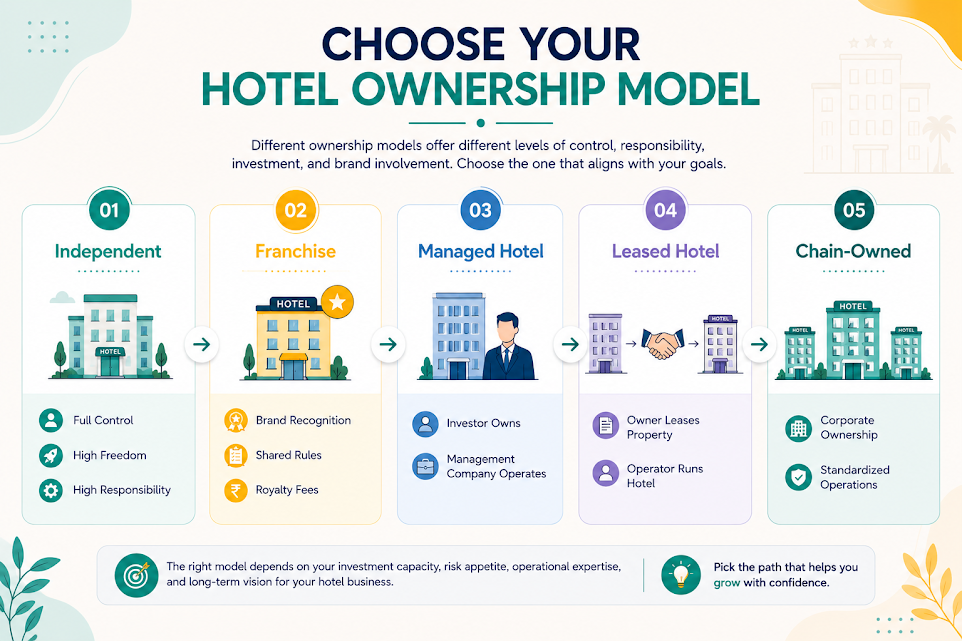
Image: An overview of the five primary hotel ownership models: Independent, Franchise, Managed, Leased, and Chain-Owned, showing how each differs in ownership structure, operational responsibility, brand involvement, and level of control.
Independent Hotel
An independent hotel is owned and operated without being affiliated with a hotel chain or franchise. The owner has complete control over branding, pricing, guest experience, and daily operations, allowing the property to establish its own identity. This model is ideal for boutique hotels, family-run properties, and entrepreneurs who value flexibility and creative freedom.
Key characteristics:
- Complete operational control
- Full branding and marketing freedom
- Keeps all profits after expenses
- Greater responsibility for sales, marketing, and operations
Franchise
A franchise hotel is independently owned but operates under an established hotel brand through a franchise agreement. While the owner manages the property, they gain access to the brand’s reputation, reservation systems, and marketing support in exchange for franchise and royalty fees. This model suits hotels seeking stronger market visibility without giving up ownership.
Key characteristics:
- Access to an established brand
- Franchise fees and ongoing royalties
- Must follow brand standards
- Benefits from wider marketing reach
Managed Hotel
A managed hotel is owned by an investor or property owner, while a professional hotel management company oversees day-to-day operations. The management company takes responsibility for staffing, guest services, and business performance, allowing the owner to focus on the investment rather than daily operations. This model is ideal for investors who prefer a hands-off approach.
Key characteristics:
- Owner provides the investment
- Third-party operator manages the hotel
- Professional operational expertise
- Reduced involvement in daily management
Leased Hotel
A leased hotel is owned by a property owner who leases the hotel to another party responsible for operating the business. The owner earns lease income, while the lessee manages daily operations, staffing, and guest services. This arrangement is commonly chosen by property investors seeking predictable returns with minimal operational involvement.
Key characteristics:
- Property leased to an operator
- Stable lease income for the owner
- Lower operational involvement
- Operator manages business performance
Chain-owned / Chain-affiliated
A chain-owned or chain-affiliated hotel is part of a larger hospitality company that owns or operates multiple properties under the same brand. These hotels follow standardised operating procedures, technology systems, and service standards to deliver a consistent guest experience across locations. This model is commonly adopted by large hospitality groups focused on scale and operational efficiency.
Key characteristics:
- Corporate ownership or affiliation
- Standardized operations and service standards
- Access to large-scale marketing and technology
- Strong purchasing power and operational support
Comparison Table
| Ownership Model | Who Owns the Property? | Who Runs Operations? | Best For | Key Advantage |
| Independent Hotel | Independent owner | Owner | Entrepreneurs seeking full control | Complete flexibility |
| Franchise Hotel | Independent owner | Owner | Hotels wanting brand recognition | Established brand and distribution |
| Managed Hotel | Investor or owner | Third-party management company | Passive owners | Professional operational expertise |
| Leased Hotel | Property owner | Lessee/operator | Property investors | Stable lease income |
| Chain-Owned / Chain-Affiliated | Hotel chain or corporate group | Hotel chain | Large hospitality brands | Standardised operations and economies of scale |
Core Responsibilities of Hotel Owners and Hotel Managers
Although hotel owners and hotel managers work toward the same business goals, their responsibilities differ significantly. Owners focus on the hotel’s long-term success and financial health, while managers oversee the routine operations that keep the property running efficiently.
Hotel Owner Responsibilities
Hotel owners are responsible for the strategic decisions that shape the property’s growth, profitability, and long-term value. Their responsibilities typically include:
- Capital investment: Funding the property’s development, renovations, expansions, and major asset purchases.
- Long-term strategy: Setting business objectives, selecting ownership or operating models, and planning future growth.
- Financial performance: Monitoring budgets, profitability, return on investment (ROI), and overall business performance.
- Compliance: Ensuring the hotel meets legal, financial, tax, licensing, and regulatory requirements.
- Asset management: Protecting and enhancing the value of the hotel through maintenance, upgrades, and investment decisions.
Hotel Manager Responsibilities
Hotel managers are responsible for operating the hotel efficiently while delivering a consistent guest experience. Their day-to-day responsibilities typically include:
- Operations management: Overseeing front office, housekeeping, food and beverage, maintenance, and other daily activities.
- Staff management: Recruiting, training, scheduling, and leading hotel teams to maintain service standards.
- Guest satisfaction: Handling guest feedback, resolving issues, and ensuring a positive stay experience.
- Revenue execution: Implementing pricing strategies, managing inventory, and driving occupancy in line with the owner’s objectives.
- Vendor management: Coordinating with suppliers and service providers to ensure smooth day-to-day operations.
Owners define the hotel’s long-term direction, while managers bring that vision to life through effective day-to-day execution. Sustainable growth and consistent guest satisfaction depend on both roles working together.
Independent Hotel vs Franchise: Which Is Right for You?
Choosing between an independent hotel and a franchise is one of the most important decisions for new hotel owners. Although both models allow you to own the property, they differ in branding, operational freedom, costs, and long-term growth opportunities. The right choice ultimately depends on your experience, investment capacity, and business objectives.
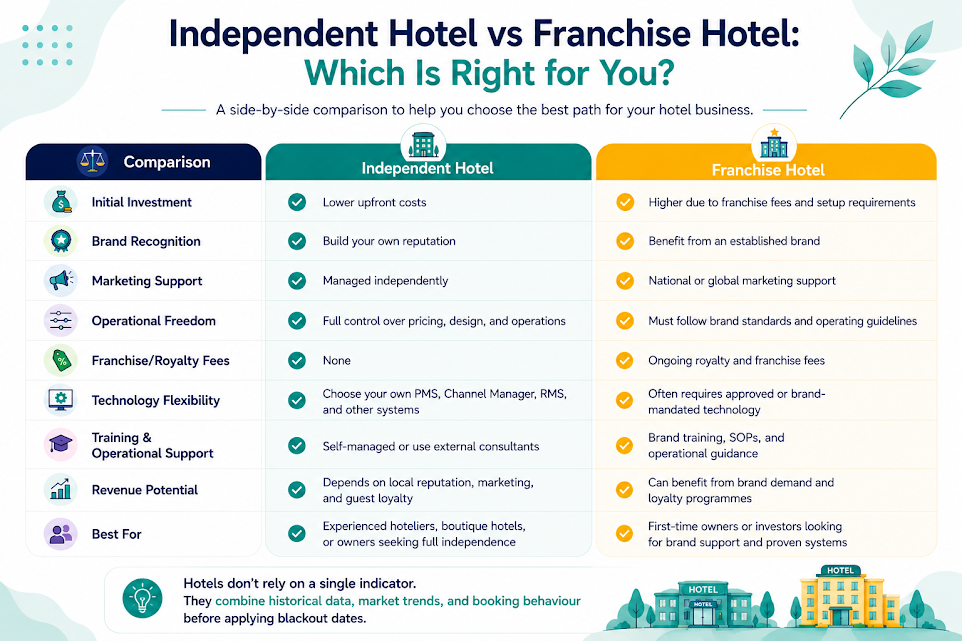
Figure: A side-by-side comparison of independent and franchise hotels across investment requirements, brand recognition, operational freedom, technology flexibility, support, revenue potential, and ideal use cases. The infographic highlights the key trade-offs to help hotel owners choose the model that best aligns with their business goals.
Neither approach is inherently better. Independent hotels provide greater flexibility and creative control, while franchise hotels benefit from established brand recognition, proven operating systems, and wider distribution. The best option depends on how much independence you want, the level of support you need, and your long-term growth strategy.
Legal, Financial, and Ownership Considerations Before Investing in India
Before investing in a hotel, it’s important to look beyond the ownership model itself. The legal structure, financing approach, and contractual agreements you choose can influence taxation, liability, governance, and long-term business flexibility.
-
Choose the Right Legal Entity
Decide whether a sole proprietorship, partnership, LLP, or private limited company best aligns with your ownership goals, funding plans, and risk appetite. The right structure affects taxation, liability, compliance, and future expansion.
-
Plan for Investors and Equity Ownership
If you plan to raise capital or bring in business partners, establish a clear ownership structure from the outset. LLPs and private limited companies generally offer greater flexibility for adding investors and defining equity ownership.
-
Review Franchise Agreements Carefully
Franchise agreements govern brand usage, royalty fees, operating standards, territorial rights, and contract duration. Understanding these terms before signing can help prevent unexpected obligations later.
-
Understand Management Contracts
If a third-party operator will manage the hotel, define responsibilities, performance expectations, fee structures, reporting requirements, and termination clauses through a detailed management agreement.
-
Separate Asset Ownership from Operations
Some investors choose to own the property while outsourcing daily operations to a professional management company. This approach allows owners to focus on long-term asset value while experienced operators manage hotel performance.
-
Plan for Succession and Ownership Transfer
Hotels are long-term investments, making succession planning particularly important for family-owned businesses and partnerships. Clearly defined ownership transfer mechanisms can reduce future disputes and support business continuity.
-
Evaluate Financing Options Early
Consider how the investment will be funded through personal capital, bank loans, institutional finance, or private investors. A well-planned financing strategy should support both the initial investment and future expansion.
How to Choose the Right Hotel Ownership Model
Choosing the right hotel ownership model depends on your financial resources, business objectives, and preferred level of involvement in daily operations. Rather than searching for a one-size-fits-all solution, evaluate each option against your long-term goals and operational capabilities.
1. Budget
Your available capital will determine which ownership models are realistic. Independent hotels generally offer greater flexibility over investment decisions, while franchise and chain-affiliated properties often require higher upfront investments, ongoing royalty fees, and compliance with brand standards.
2. Experience
Running an independent hotel requires expertise in operations, marketing, revenue management, and guest experience. If you’re new to hospitality, a franchise or professionally managed hotel can provide established systems and operational support.
3. Risk Appetite
Each ownership structure comes with a different level of financial and operational risk. Independent ownership offers greater potential rewards but also places full responsibility for performance on the owner. Franchise and management arrangements can reduce certain operational risks while introducing contractual obligations and recurring fees.
4. Desired Level of Control
Think about how involved you want to be in running the business. Owners seeking full control over branding, pricing, and guest experience may prefer an independent hotel, while those looking for a more hands-off investment may benefit from appointing a professional management company.
5. Target Market
Your target guests should influence your ownership decision. Business hotels, luxury resorts, boutique properties, and budget accommodations often benefit from different operating models based on guest expectations and market demand.
6. Brand Goals
If building a distinctive hospitality brand is part of your long-term vision, independent ownership offers maximum creative freedom. If immediate brand recognition and customer trust are more important, partnering with an established franchise may be the stronger choice.
7. Long-Term Expansion Plans
Think beyond your first property. If you plan to grow into a multi-property portfolio, choose an ownership structure that supports expansion, simplifies governance, and can scale as your business evolves.
Hotel Ownership Decision Checklist
Before choosing an ownership model, ask yourself:
- Does this model fit my available investment budget?
- Do I have the operational experience to manage the hotel successfully?
- Am I comfortable with the financial and operational risks involved?
- How much control do I want over daily operations and branding?
- Does this model align with my target guest segment?
- Will it support my long-term brand and business goals?
- Can this ownership structure scale as I expand my portfolio?
The best ownership model is the one that aligns with your financial capacity, operational expertise, and long-term vision, not simply the one that’s most common in the industry.
Is Owning a Hotel Profitable?
Hotel ownership can be highly profitable, but success depends on how effectively the property generates revenue while controlling operating costs. There is no guaranteed return, as performance varies based on location, market demand, pricing strategy, and operational efficiency.
Hotels typically evaluate revenue performance using three key metrics:
- ADR (Average Daily Rate): The average revenue earned per occupied room.
- Occupancy Rate: The percentage of available rooms sold during a given period.
- RevPAR (Revenue Per Available Room): A combined measure of occupancy and room pricing that provides a clearer picture of revenue performance.
Strong revenue, however, doesn’t automatically translate into strong profitability. Hotels must also manage operating expenses, including payroll, utilities, maintenance, marketing, franchise fees (where applicable), technology investments, and debt repayments.
As a result, two hotels with similar occupancy levels can produce very different profits depending on their pricing strategy, cost structure, guest mix, and operational efficiency.
Ownership Challenges That Can Affect Long-Term Hotel Success
Hotel ownership offers significant opportunities for long-term wealth creation, but it also brings strategic challenges that extend well beyond daily operations. Understanding these ownership-level risks can help investors make better decisions and build a more resilient hospitality business.
- Owner vs. operator conflicts: When ownership and management responsibilities are divided, disagreements over budgets, staffing, revenue targets, or capital investments can affect both financial performance and guest experience.
- Franchise compliance requirements: Franchise hotels must consistently meet brand standards, operational guidelines, and quality audit requirements. Failing to comply can result in penalties, reputational damage, or even the loss of the franchise agreement.
- Capital expenditure planning: Hotels require ongoing investment to renovate guest rooms, upgrade facilities, replace equipment, and remain competitive. Delaying major capital improvements can reduce guest satisfaction and asset value over time.
- Expansion and growth decisions: Opening additional properties, entering new markets, or changing ownership structures involves significant financial commitment and operational complexity. Growth should align with long-term business objectives rather than short-term market trends.
- Meeting ROI expectations: Hotel investments often involve multiple stakeholders with different financial goals and investment horizons. Setting realistic return expectations is essential, particularly during periods of market volatility or fluctuating demand.
- Protecting long-term asset value: Beyond generating annual profits, hotel owners must preserve and enhance the property’s long-term value through strategic investments, regular maintenance, and strong market positioning.
- Managing multiple stakeholders: Family-owned hotels, investment partnerships, and institutional ownership structures often involve multiple decision-makers. Clear governance, defined responsibilities, and transparent communication help minimise conflicts and keep the business aligned.
Successful hotel ownership requires balancing operational performance with disciplined investment, effective asset management, and sound strategic decision-making.

Manage All Your OTAs from One Place
Request a DemoChoosing the Right Hotel Technology Based on Your Ownership Model
The right hotel technology strategy depends on how your property is owned and operated. Different ownership models have different priorities, so technology should support your business objectives rather than simply automate daily tasks.
Independent Hotel Owners
Focus on technology that strengthens your brand, increases direct bookings, automates marketing, and supports flexible integrations. The goal is to reduce OTA dependence while building a scalable, guest-centric business.
Franchise Hotel Owners
Prioritise brand-approved technology that meets franchise standards while ensuring smooth operations, accurate reporting, and effortless integration with the franchisor’s systems and processes.
Management Companies
Choose technology that delivers centralised reporting, operational visibility, and financial transparency. Better performance insights help management teams keep owners informed while maintaining consistency across multiple properties.
Multi-Property Investors
Invest in technology with centralised dashboards, portfolio-wide reporting, and scalable integrations. A unified view of performance makes it easier to compare properties, allocate resources, and support future expansion.
Choosing technology that aligns with your ownership model not only simplifies operations but also creates a stronger foundation for sustainable growth as your business evolves.
How AxisRooms Supports Independent Hotels, Franchises, and Managed Properties
Running a hotel successfully requires more than choosing the right ownership model. As operations expand, managing reservations, distribution, pricing, payments, and reporting across multiple systems becomes increasingly complex. Whether you’re an independent owner, a franchise operator, or managing multiple properties, disconnected technology can create inefficiencies that slow growth.
AxisRooms brings these critical operations together through one connected hospitality platform. By integrating distribution, revenue management, and operational tools, hotels can streamline workflows, improve visibility, and make smarter business decisions.
- 100+ OTA Integrations: Connect with leading OTAs to keep rates, availability, and bookings synchronized in real time, reducing manual updates and improving distribution efficiency.
- PMS Integrations: Simply connect your property management system to streamline reservations, front-office operations, reporting, and guest data across your technology ecosystem.
- Payment Gateways: Enable secure online payments, faster transaction processing, and a smoother booking experience for both direct and OTA reservations.
- Channel Manager: Manage inventory and pricing across multiple booking channels from one centralized dashboard while maintaining rate parity and preventing overbookings.
- Revenue Management Services: Make smarter pricing decisions using demand insights, market trends, and revenue optimization strategies tailored to your property’s goals.
- Web Booking Engine: Increase commission-free direct bookings with a fast, mobile-friendly booking experience that integrates perfectly with your hotel’s website.
Whether you’re building an independent brand, operating within a franchise, or managing a growing portfolio, AxisRooms gives you the visibility and control needed to streamline operations, optimise revenue, and scale with confidence.
Conclusion
The way a hotel is owned and managed influences everything from investment decisions to daily operations and long-term growth. There is no single ownership model that suits every property. The right choice depends on your business goals, available resources, and long-term vision.
What remains constant across every ownership structure is the value of connected technology. The right systems improve operational efficiency, increase business visibility, and support better decision-making as your hotel grows.
With a well-defined ownership strategy and a strong technology foundation, hotels are better positioned to scale sustainably and compete in an increasingly dynamic hospitality market.
Book a free demo today to see how AxisRooms can support your hotel’s long-term growth.