
A hotel key card is no longer just a tool for unlocking guest rooms. Today’s systems strengthen security, streamline hotel operations, and even help reduce energy consumption. From contactless RFID and NFC technology to seamless integration with Property Management Systems (PMS), modern hotel key cards have become an essential part of a connected hotel technology ecosystem.
Choosing the right hotel room key card and access system can directly influence operational efficiency, maintenance costs, and guest satisfaction. Whether you manage a boutique hotel, business property, resort, or hotel chain, understanding how different hotel door key card systems work is key to selecting a solution that meets your property’s current needs while supporting future growth.
In this guide, we’ll explain how hotel key cards work, compare the different technologies available, explore their role in hotel security and energy management, and help you choose the right system for your property.
What Is a Hotel Room Key Card?
A hotel room key card is an electronic access card that allows guests to unlock their assigned room and other authorized areas, such as elevators, gyms, parking garages, or executive lounges. Unlike traditional metal keys, hotel key cards are digitally programmed with temporary access permissions that automatically expire when a guest checks out.
Beyond replacing traditional metal keys, hotel key cards have become part of a hotel’s wider technology ecosystem. They can work alongside electronic door locks, Property Management Systems (PMS), elevator access controls, energy-saving switches, and mobile key solutions to automate room access throughout a guest’s stay.
This shift from traditional keys to digital access has transformed more than just how guests enter their rooms. It has enabled hotels to strengthen security, automate access management, reduce maintenance, and introduce contactless technologies such as RFID and NFC.
Why Hotels Use Key Cards Instead of Traditional Keys
Traditional metal keys were difficult to replace, expensive to re-key, and offered little control over guest access. Modern hotel key card systems solve these challenges by providing secure, flexible, and programmable access while integrating with other hotel technologies.
Electronic hotel key cards offer several advantages that benefit both hotel operations and the guest experience.
- Stronger security: Lost or stolen cards can be deactivated instantly without replacing door locks, reducing security risks and replacement costs.
- Faster check-in and check-out: Front desk staff can issue or revoke room access within seconds, helping reduce queues and improve the guest arrival experience.
- Temporary access control: Hotels can assign access based on the guest’s stay, allowing entry only to authorized rooms and facilities for a defined period.
- Lower maintenance costs: Unlike traditional keys, electronic systems eliminate the need to replace locks whenever a key is lost or copied.
- Integration with hotel software: Modern hotel door key card systems can work alongside a PMS, automatically activating room access at check-in and disabling it after checkout to reduce manual intervention.
- Better operational visibility: Many systems maintain access logs that help hotels monitor room entry, improve security, and support maintenance or housekeeping workflows when needed.
- Support for sustainability initiatives: When paired with energy-saving switches, hotel key cards can automatically control room electricity, helping reduce unnecessary energy consumption when guests are away.
Example: A guest checks into a business hotel at 3:00 PM. As soon as the reservation is confirmed in the PMS, the room key card is automatically encoded with the appropriate access permissions. Once the guest checks out, the card is deactivated instantly without requiring staff to replace locks or retrieve physical keys.
How Do Hotel Key Cards Work? (Step-by-Step)
A hotel key card system works by assigning temporary digital access permissions to a guest’s room key card during check-in. When the card is tapped or swiped at the door, the electronic lock verifies the encoded credentials and unlocks the room only if the guest has valid access. Once the stay ends, the card is automatically deactivated, preventing further entry.
Think of a hotel key card as a temporary digital passport; it grants access only during your stay and automatically expires once you check out.
Step 1: The Hotel Encodes the Key Card at Check-In
When a guest checks in, the hotel’s Property Management System (PMS) communicates with the electronic door lock system to encode the hotel room key card with specific access permissions. These typically include:
- Assigned room number
- Check-in and check-out dates
- Access to authorized areas such as elevators, gyms, pools, or executive lounges
Step 2: The Guest Taps or Swipes the Card
The guest uses the key card at their room door. Depending on the technology, the card may be:
- Swiped through a magnetic stripe reader
- Tapped against an RFID or NFC reader
The lock reads the encrypted information stored on the card without requiring an internet connection.
Step 3: The Door Lock Verifies the Card
The electronic lock compares the information stored on the hotel door key card with its own access rules.
If the credentials match and the card is still active, the lock disengages and the door unlocks within seconds. If the card has expired, is damaged, or has been deactivated, access is denied.
Step 4: The Card Is Automatically Deactivated After Checkout
Once the guest checks out, the PMS updates the door lock system to deactivate the card automatically. This ensures the hotel key card can no longer unlock the room, eliminating the need to collect physical keys or replace locks after every stay.
Key takeaway: Every hotel key card follows the same basic lifecycle: it’s programmed during check-in, grants access only to authorized areas throughout the guest’s stay, and is automatically deactivated after checkout. This temporary access model helps hotels improve security while eliminating the need to replace physical keys.
Types of Hotel Key Cards: NFC, RFID, Magnetic Stripe, and Hole Cards
Not all hotel key cards use the same technology. Although every hotel key card performs the same basic function, granting secure room access, the technology behind each one differs in terms of security, durability, convenience, and cost.
Today, RFID hotel key cards have become the industry standard for most hotels, while magnetic stripe cards are still found in many budget properties. NFC technology is driving the next generation of mobile access, and hole cards remain a legacy solution used only in a handful of older properties.
Comparison: Different Types of Hotel Key Cards
| Technology | How It Works | Security | Durability | Cost | Best For |
| Magnetic Stripe | Swipe | Basic | Moderate | Low | Budget hotels & legacy properties |
| RFID | Tap (radio frequency) | High | High | Medium | Most modern hotels |
| NFC | Tap with two-way communication | Very High | Very High | Medium–High | Smart hotels & mobile keys |
| Hole Card | Mechanically punched holes | Low | Moderate | Low | Older legacy systems |
Magnetic Stripe Hotel Key Cards
Hotel magnetic stripe key cards store encrypted information on a magnetic strip located on the back of the card. Guests unlock their room by swiping the card through a compatible door reader.
These cards became popular because they were inexpensive to produce and easy to replace. However, they wear out over time and can become demagnetized if stored near magnets or electronic devices, leading to guest lockouts and replacement costs.
Best suited for: Budget hotels, older properties with legacy lock systems, and hotels looking for a low-cost access solution.
RFID Hotel Key Cards
RFID (Radio Frequency Identification) hotel key cards use radio waves to communicate with the door lock. Instead of swiping, guests simply tap or hold the card close to the reader for instant access.
Because there’s no physical contact between the card and the reader, RFID cards are more durable than magnetic stripe cards and significantly harder to duplicate. Their speed, reliability, and enhanced security have made them the preferred choice for most mid-scale, upscale, and luxury hotels worldwide.
Beyond guest rooms, RFID hotel key cards can also control access to facilities such as elevators, executive lounges, gyms, swimming pools, and parking areas.
Best suited for: Mid-scale hotels, luxury hotels, resorts, and properties seeking stronger security and faster guest access.
NFC Hotel Key Cards
NFC (Near Field Communication) hotel key cards build on RFID technology by enabling two-way communication between the card, smartphone, and door lock.
Many hotels now use NFC technology to support mobile room keys, allowing guests to unlock their rooms using a smartphone or smartwatch instead of a physical card. Depending on the property’s technology ecosystem, NFC can also support cashless payments, loyalty programs, and access to hotel amenities.
As contactless hospitality continues to grow, NFC is becoming an increasingly popular choice for modern hotels investing in digital guest experiences.
Best suited for: Smart hotels, lifestyle properties, luxury brands, and hotels investing in mobile room keys.
Hole Cards
Hole cards are one of the earliest forms of hotel access cards. Instead of storing digital information, they use a unique pattern of punched holes that a mechanical reader recognizes to unlock the door.
Although they played an important role in the evolution of hotel security, hole cards have largely disappeared due to their limited functionality, lower security, and inability to integrate with modern hotel management systems. Today, they’re mainly found in older properties or preserved as part of hospitality history.
Best suited for: Older properties and legacy lock systems that have not yet upgraded to electronic access technology.
What Information Is Actually Stored on a Hotel Key Card?
Despite common misconceptions, a hotel key card does not store your personal or financial information. Most modern hotel key card systems contain only the encrypted access credentials needed to verify whether a guest is authorized to enter a room or designated hotel facilities.
Guest information such as names, payment details, passport numbers, and identification documents is stored securely within the hotel’s Property Management System (PMS), not on the hotel key card itself.
Myth: My hotel key card contains my personal and credit card information.
Reality: Hotel key cards generally store only access-related data. Personal information and payment details remain securely stored in the hotel’s management system.
What Is Stored vs. Not Stored on a Hotel Key Card
| Typically Stored | Not Stored |
| Encoded card ID | Guest name |
| Room access permissions | Credit or debit card details |
| Check-in and check-out validity | Passport or government ID information |
| Access to authorized areas (e.g., gym, pool, lounge) | Home address or contact details |
| Encryption credentials for the door lock | Reservation history or personal preferences |
Even if a hotel room key card is lost, it typically cannot reveal a guest’s personal or financial information. Hotels can simply deactivate the card and issue a new one, making electronic key cards significantly more secure than traditional metal keys.
The Hidden ROI: How Hotel Key Card Switches Reduce Energy Costs
Most guests think of a hotel key card as nothing more than a room key. For hotel operators, however, it can also become a practical energy management tool. When integrated with an energy-saving key card switch, the same card can automatically control electricity inside the guest room, reducing unnecessary power consumption when the room is unoccupied.
For hotels looking to lower operating costs without compromising guest comfort, this small technology upgrade can deliver meaningful long-term savings.
What Is an Energy Saver Hotel Key Card Switch?
An energy saver hotel key card switch is a wall-mounted device, usually installed near the room entrance, that activates electricity only when a valid hotel room key card is inserted.
By linking room access with electricity usage, the switch helps hotels reduce unnecessary energy consumption in unoccupied rooms without affecting guest comfort.
Think of it as a master power switch that activates the room only when it’s occupied.
How Does a Hotel Key Card Turn On Room Electricity?
A hotel key card energy-saving switch works by recognizing a valid room key card and completing an electrical circuit. Once activated, it supplies power to selected systems such as lighting, air conditioning, and designated electrical outlets.
When the guest removes the card, a built-in timer keeps the power on for a short period before disconnecting non-essential circuits. This gives guests enough time to leave the room comfortably while helping hotels avoid wasting electricity in unoccupied rooms.
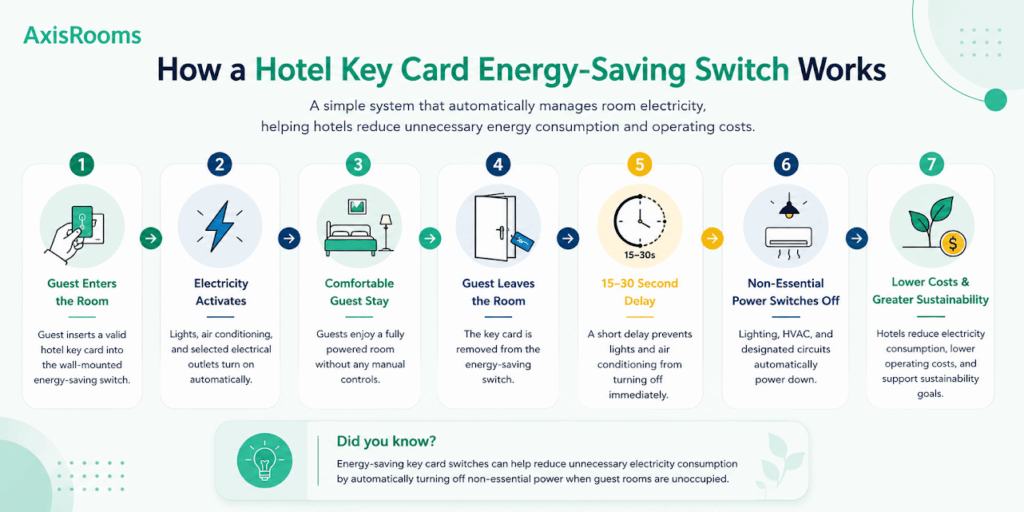
Image: The hotel key card energy-saving switch automatically powers designated room circuits when a guest inserts their key card and turns off non-essential electricity shortly after they leave, helping hotels reduce energy consumption, lower operating costs, and improve sustainability.
Why Hotels Are Adopting Energy-Saving Key Card Systems
More hotels are adopting energy-saving key card systems because they reduce operating costs while supporting more sustainable and efficient day-to-day operations.
Key advantages include:
- Lower electricity consumption by automatically switching off non-essential power when rooms are unoccupied.
- Reduced operating costs, especially in hotels with high occupancy and year-round operations.
- Less wear on HVAC systems, lighting, and electrical equipment, extending their lifespan.
- Improved sustainability by reducing unnecessary energy usage and supporting environmental initiatives.
- Automatic energy management without requiring staff intervention or relying on guests to switch off appliances.
- A better guest experience, as rooms are fully powered when occupied, while maintaining efficient energy use behind the scenes.
Hotel Key Card Systems and PMS Integration: Why Connectivity Matters
A hotel key card system becomes significantly more valuable when it’s connected to a Property Management System (PMS). Instead of managing room access manually, hotels can automate guest entry throughout the entire stay.
A typical integrated hotel key card system includes:
- Property Management System (PMS): Manages reservations, room assignments, and guest check-ins.
- Card Encoder: Programs the hotel key card with room access permissions.
- Electronic Door Locks: Verify the card and unlock authorized rooms.
- Door Lock Software: Synchronizes guest access between the PMS and the lock system.
When these systems work together, hotels can automatically activate room access during check-in, instantly deactivate cards after checkout, update guest permissions in real time, and reduce manual work at the front desk. The result is a more secure, efficient, and enjoyable guest experience.
Many hotels integrate their PMS with electronic lock solutions from providers such as ASSA ABLOY (VingCard), Onity, Salto, and Godrej Locking Solutions, depending on their property size, location, and operational requirements.
Common Hotel Key Card Problems (and How Hotels Solve Them)
Hotel key cards are designed to be reliable, but like any technology, they can occasionally fail. Most issues are easy to resolve and don’t require replacing the entire lock system. Understanding the most common problems can help hotel staff troubleshoot quickly and minimize guest inconvenience.
1. The Hotel Key Card Stops Working
One of the most common complaints is that a hotel room key card suddenly stops unlocking the door. This usually happens because the card has expired, was incorrectly encoded, or the guest’s reservation details have changed.
Solution: Re-encode the key card at the front desk or verify that the reservation and room assignment are correct in the PMS.
2. The Key Card Won’t Read at the Door
If the door reader doesn’t recognize the card, the issue could be dirt on the reader, a damaged card, or a temporary communication error between the lock and the card.
Solution: Clean the card, try again, or issue a replacement card. If the problem persists, inspect the electronic door lock for maintenance.
3. Guests Think Their Phone Demagnetized the Card
Many travelers believe that keeping a magnetic stripe hotel key card next to a smartphone causes it to stop working. While strong magnets can affect magnetic stripe cards, modern smartphones are unlikely to demagnetize them under normal use. RFID and NFC hotel key cards aren’t affected by magnetism.
Solution: Encourage guests to keep magnetic stripe cards away from strong magnetic sources. Upgrading to RFID or NFC cards further reduces this issue.
4. The Card Stops Working After Checkout
Many guests assume they can continue accessing their room for a short period after checking out, especially if they’ve left behind luggage or need to return briefly. However, modern hotel key card systems are designed to automatically expire once the stay ends, preventing unauthorized access.
Solution: Modern hotel key card systems automatically deactivate cards at checkout through the PMS, preventing unauthorized room access and improving security.
5. Lost or Stolen Hotel Key Cards
Misplaced hotel key cards are common, particularly in large resorts, convention hotels, and properties where guests frequently move between rooms, restaurants, pools, and other facilities. Unlike traditional metal keys, a lost key card doesn’t usually require replacing the door lock.
Solution: Hotels can instantly deactivate the lost card and issue a new one without changing the door lock, minimizing security risks and guest disruption.
Branded & Custom Hotel Key Cards: A Small Detail That Strengthens Your Brand
A hotel key card is one of the few branded items every guest carries throughout their stay. Beyond providing room access, a well-designed custom hotel key card can reinforce your brand identity, promote hotel services, and create additional marketing opportunities at virtually no extra effort.
Hotels often use branded key cards to:
- Showcase their logo and visual identity for a more professional guest experience.
- Promote restaurants, spas, or premium amenities to encourage on-property spending.
- Add QR codes linking to digital menus, hotel directories, Wi-Fi details, or guest feedback forms.
- Highlight loyalty programs or future booking offers to increase repeat stays.
- Partner with local businesses by offering discounts for nearby attractions, cafés, or transport services.
- Choose premium materials or finishes, such as matte, recycled, wooden, or metallic cards, to reflect the hotel’s positioning.
A thoughtfully designed key card can continue promoting your brand long after the guest has checked in, turning a simple access card into a subtle yet effective marketing touchpoint.
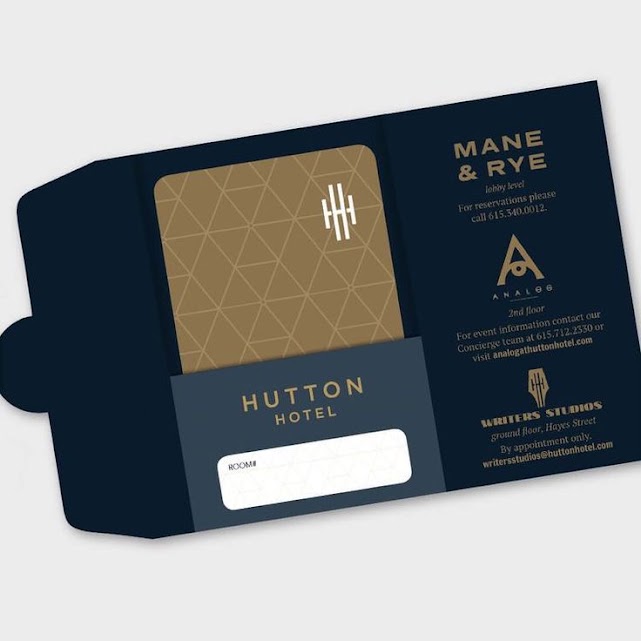
Image: Example of a branded hotel key card and a matching key card holder. Beyond reinforcing your hotel’s visual identity, a customized key card holder can display practical guest information such as room numbers, concierge contacts, and promotional messages for on-property amenities.
How to Choose the Right Key Card System for Your Hotel
Choosing the right hotel key card system isn’t just about selecting the latest technology. The ideal solution should match your property’s size, security needs, budget, and long-term operational goals.
Use the checklist below to evaluate different systems before making an investment.
| Consideration | What to Look For |
| Hotel Size | Small hotels may only need a basic RFID system, while larger properties often benefit from cloud-based access control with centralized management. |
| Budget | Consider both the upfront hardware cost and ongoing maintenance, software licensing, and card replacement expenses. |
| Security Requirements | Look for encrypted RFID or NFC technology with time-based access permissions and audit logs for better guest security. |
| PMS Compatibility | Ensure the system integrates flawlessly with your Property Management System to automate key card activation, deactivation, and room assignments. |
| Mobile Key Readiness | If you’re planning to offer smartphone room access in the future, choose a solution that supports mobile keys or can be upgraded easily. |
| Vendor Support | Evaluate installation assistance, staff training, software updates, and after-sales support, especially for multi-property operations. |
| Energy-Saving Integration | Check whether the system supports energy-saving key card switches to help reduce electricity consumption and operating costs. |
| Scalability | Select a platform that can grow with your business, whether you’re adding more rooms, properties, or advanced guest access features. |
Before You Make a Decision
Before selecting a hotel key card system, ask yourself these questions:
- Does it support the type of key card you want to use (RFID, NFC, or magnetic stripe)?
- Can it integrate with your existing PMS and electronic door locks?
- Will it support mobile keys and other future technology upgrades?
- Does the vendor provide reliable implementation and technical support?
- Can the system scale as your hotel grows?
Choosing a solution based on your future operational needs, not just today’s budget, can save significant time, upgrade costs, and integration challenges down the road.

Manage All Your OTAs from One Place
Request a DemoHotel Key Card vs Mobile Key: Which Is the Future?
Mobile room keys are gaining popularity, but hotel key cards aren’t disappearing anytime soon. Instead, many hotels are adopting a hybrid approach that offers guests the choice between a traditional hotel key card and a smartphone-based mobile key.
The right solution depends on your property’s size, guest demographics, technology budget, and long-term digital strategy.
| Feature | Hotel Key Cards | Mobile Keys |
| Access Method | Physical RFID, NFC, or magnetic stripe card | Smartphone app or digital wallet |
| Guest Convenience | Simple and familiar for all guests | Contactless access without carrying a physical card |
| Hardware Investment | Lower initial investment | Requires compatible smart locks and a mobile access platform |
| Replacement | Easy and inexpensive to replace if lost | No physical replacement required |
| Security | Secure with encrypted RFID or NFC technology | Advanced encryption with remote credential management |
| Adoption | Widely used across hotels of all sizes | Growing rapidly, especially in upscale and tech-forward hotels |
| Best Suited For | Budget, mid-scale, independent hotels, and properties serving diverse guest segments | Luxury hotels, lifestyle brands, and properties focused on digital guest experiences |
The Future Is Choice, Not Replacement
While mobile keys continue to gain traction, hotel key cards remain the industry standard because they’re affordable, reliable, and familiar to guests of all ages. At the same time, many travelers increasingly expect contactless, smartphone-based experiences, especially in premium hotels.
As a result, many modern hotels now offer both options. Guests can use a traditional hotel key card if they prefer, or unlock their room with a mobile key through the hotel’s app or digital wallet. This hybrid approach provides greater flexibility, improves guest satisfaction, and allows hotels to adopt new technology at their own pace rather than replacing existing systems overnight.
How AxisRooms Connects Your Hotel Technology Ecosystem
A hotel key card system is just one component of a modern hotel’s technology ecosystem. To operate efficiently, hotels also rely on connected platforms that manage reservations, pricing, distribution, payments, and day-to-day operations.
AxisRooms brings these critical hotel technologies together through one integrated platform, helping hotels streamline operations, improve revenue management, and deliver a smooth guest experience.
Here’s how AxisRooms supports modern hotel operations:
- Channel Manager: Manage rates, inventory, restrictions, and availability across all connected booking channels from a single dashboard.
- PMS Integrations: Connect your Property Management System with other hotel technologies to streamline reservations, guest information, and operational workflows.
- 100+ OTA Integrations: Connect with leading OTAs, metasearch platforms, and regional booking channels worldwide, expanding your property’s online visibility.
- Revenue Management Services: Optimize pricing using demand trends, occupancy patterns, and booking pace to maximize revenue.
- Web Booking Engine: Drive commission-free direct bookings through your hotel’s website with real-time availability and secure online reservations.
- Payment Gateways: Simplify online payments with secure, integrated payment processing that supports a quicker booking and checkout experience.
When connected technologies work together, hotels spend less time managing disconnected systems and more time delivering exceptional guest experiences. While hotel key cards control who can access a room, an integrated technology ecosystem helps hotels manage reservations, distribution, pricing, payments, and daily operations from one centralized platform.
Conclusion
Hotel key cards have evolved from simple room access tools into an essential part of the modern hotel technology ecosystem. Today, they play an important role in improving hotel security, streamlining operations, enhancing the guest experience, and even reducing energy costs through integrated access systems.
As hotels continue to modernize, choosing a key card solution that integrates smoothly with your broader hotel technology ecosystem can deliver greater long-term value. The right combination of access control, property management, distribution, and revenue tools creates a more efficient operation and a better guest experience from check-in to checkout.
Book a free demo today to discover how AxisRooms can help you connect your hotel technology ecosystem, simplify operations, and support long-term business growth.