
Sri Lanka’s growing tourism demand is creating new opportunities for guest houses, boutique hotels, resorts, and independent properties. For entrepreneurs and hotel investors, the opportunity is clear, but building a profitable hotel business requires the right concept, location, financial plan, and distribution strategy from the start.
The market momentum supports this growth. According to Reuters, Sri Lanka welcomed a record 2.36 million tourists in 2025. However, more tourists do not automatically mean steady occupancy or higher revenue for every hotel. New properties still need to understand registration requirements, control startup costs, plan for seasonal demand, and compete for bookings across direct and online channels.
In this guide, we’ll explain how to start a hotel business in Sri Lanka, from costs and registration to business planning, marketing, and hotel technology.
Is Starting a Hotel Business in Sri Lanka a Good Idea in 2026?
Yes, starting a hotel business in Sri Lanka can be a strong opportunity in 2026, provided the property is built around the right location and guest demand.
According to Mordor Intelligence, Sri Lanka’s hospitality market is expected to grow from USD 2.84 billion in 2026 to USD 4.08 billion by 2031. This expansion creates room for guest houses, boutique stays, independent hotels, and resorts, but success still depends on choosing a concept that fits the market.
A business hotel in Colombo and a boutique villa on the south coast serve very different travelers. Before investing, understand who you want to attract, when they travel, and the type of stay they seek.
Which Type of Hotel Business Should You Start in Sri Lanka?
The right hotel business depends on your investment capacity, location, target guests, and the operational complexity you can manage. Comparing these factors early can help you choose a hotel model that is realistic to launch and sustain.
-
Guest House
A guest house is a practical option for first-time hospitality entrepreneurs who want to start with a smaller property and simpler operations. It can work well in destinations where travelers value affordable rooms, convenient locations, and local experiences.
However, lower room rates leave less room for pricing mistakes. Occupancy, operating costs, and visibility across booking channels require careful management.
-
Boutique Hotel or Boutique Villa
Boutique hotels and villas focus on distinctive design, personalized service, and experience-led stays. They are often better suited to leisure destinations and travelers willing to pay more for privacy, character, or a strong sense of place.
This model can support higher room rates, but expectations rise with the price. The property, service, photography, reviews, and online positioning must consistently justify the premium.
-
Small Independent Hotel
For entrepreneurs exploring how to start a small hotel business in Sri Lanka, an independent hotel offers room to build a distinct brand without the scale of a large resort or chain property.
The model works best when room count, staffing, and guest services reflect realistic demand. As bookings increase, owners also require stronger systems for reservations, pricing, housekeeping, and online distribution.
-
Resort
A resort is built around the complete stay experience rather than accommodation alone. Dining, wellness, activities, beach access, nature, or other on-property experiences often influence why guests book and how long they stay.
Resorts generally involve higher investment and more complex operations. They also require a clear plan for seasonality, ancillary revenue, staffing, and demand during quieter periods.
-
Classified Tourist Hotel
A classified tourist hotel operates within Sri Lanka’s formal hotel classification framework and must meet the standards applicable to its category. This route may suit investors developing a structured hotel operation with defined facilities, services, and market positioning.
Consider the intended classification early, as property design and operating requirements can influence the project before opening.
Hotel Business Types in Sri Lanka: Quick Comparison
| Property Type | Best Suited For | Typical Location or Demand | Operational Complexity |
| Guest House | First-time owners and smaller investors | Cultural destinations, transit locations, budget, and independent travelers | Low to moderate |
| Boutique Hotel or Villa | Experience-led and premium concepts | South coast, heritage areas, scenic and leisure destinations | Moderate |
| Small Independent Hotel | Owners planning a scalable, standalone property | Cities and mixed-demand destinations | Moderate to high |
| Resort | Larger investors and destination-led stays | Beach, nature, wellness, and leisure destinations | High |
| Classified Tourist Hotel | Structured hotel projects targeting defined service standards | Business and established tourism markets | High |
The best option is not necessarily the property with the most rooms or the highest room rate. Choose a model that reflects destination demand and the investment and operational complexity you can sustain.
How to Choose a Name for Your Hotel Business
A good hotel business name should be memorable, easy to find online, and aligned with the experience you want guests to expect. The right name can signal luxury, relaxation, adventure, or affordability before a traveler even views your rooms.
When choosing a hotel name:
- Match the guest experience: Choose words that reflect your property concept and target travelers.
- Keep it simple: Avoid names that are difficult to spell, pronounce, or remember.
- Consider the destination: A meaningful connection to the location, landscape, or local character can make the name more distinctive.
- Check online availability: Search for similar hotel names and confirm that a suitable website domain and social media handles are available.
- Test it before committing: Ask potential guests or people within your target market what the name suggests to them.
Your hotel name should set the right expectation, not simply sound creative. A boutique villa, city hotel, and surf-focused guest house serve different travelers, so the name should reinforce that positioning.
How Much Does It Cost to Start a Hotel Business in Sri Lanka?
The cost of starting a hotel business in Sri Lanka varies significantly by location, property size, hotel category, and whether you build, buy, lease, or renovate an existing property. A small guest house may require a relatively lean setup, while a boutique hotel or resort can involve substantial development and operating capital.
Rather than relying on one average startup figure, calculate costs around the property you plan to open and the standards it must meet.
What Are the Main Costs of Starting a Hotel?
Hotel startup costs go beyond buying land or constructing rooms. Your initial budget may need to cover:
- Property and development: Land, lease deposits, construction, renovations, architecture, and landscaping.
- Furniture, fixtures, and equipment: Beds, room furniture, kitchen equipment, linen, lighting, and guest amenities.
- Registration and approvals: Business registration, tourism licensing, professional fees, and property-related approvals.
- Pre-opening staff costs: Recruitment, training, salaries, and uniforms before the hotel starts generating steady revenue.
- Marketing and distribution: Website development, photography, OTA setup, branding, and launch campaigns.
- Hotel technology: PMS connectivity, a channel manager, booking engine, payment systems, and revenue tools.
- Working capital: Cash reserves for utilities, payroll, maintenance, supplies, and other expenses during the early operating period.
Do not build your budget around opening day alone. Sri Lanka’s accommodation sector remains labour-intensive, with salaries and wages representing the largest operating cost category in a recent SLTDA assessment. New hotel owners need sufficient working capital to cover the period between opening and stable demand.
How Startup Costs Vary by Hotel Type
The type of property you open can change both the initial investment and the ongoing cost structure.
| Hotel Type | Major Cost Drivers | Typical Cost Complexity |
| Guest house | Property conversion, basic room setup, licences, and essential technology | Lower |
| Boutique hotel or villa | Design, premium interiors, landscaping, and guest experiences | Moderate to high |
| Small independent hotel | More rooms, staffing, operating systems, and F&B facilities | Moderate to high |
| Resort | Land, amenities, landscaping, activities, and larger teams | High |
| Classified tourist hotel | Property standards, facilities, equipment, and service requirements | High |
A smaller property is not automatically inexpensive, especially if the concept depends on premium interiors or a high-cost location. Likewise, a larger hotel may gain some operating efficiencies but requires more capital before opening.
How Can You Fund a Hotel Project in Sri Lanka?
Hotel projects may be funded through owner capital, business partners, bank financing, or private investors. The right funding mix depends on the size of the property, development timeline, and how much debt the hotel can realistically service after opening.
Larger tourism investments may also explore investor facilitation through the Board of Investment of Sri Lanka (BOI), which supports hospitality and tourism investment opportunities.
Before borrowing, test your financial plan against lower occupancy, seasonal demand, construction delays, and slower-than-expected revenue growth. A hotel may attract guests and still face cash-flow pressure if its debt and operating costs are too high.
How to Choose the Right Location for Your Hotel in Sri Lanka
The right hotel location is one where your property concept matches a clear source of travel demand. A busy tourism destination may offer more potential guests, but higher competition and property costs can make it harder for a new hotel to stand out.
Sri Lanka is also highly seasonal. SLTDA’s 2025 tourism review shows clear seasonal patterns in international arrivals, which means hotel owners need to understand when their target guests travel and how demand changes throughout the year.
Before choosing a location, assess:
- Guest demand: Identify whether the area attracts leisure, business, wellness, surf, cultural, wildlife, or domestic travelers.
- Seasonality: Estimate how demand and room rates may change between peak and quieter months.
- Existing competition: Compare nearby hotels by room rates, reviews, facilities, and market positioning.
- Accessibility: Consider airport transfers, road and rail connectivity, and access to the experiences guests are travelling for.
- Operating conditions: Check utilities, staffing availability, supplier access, and the practical cost of running the property.
- Future potential: Look beyond current footfall and assess planned tourism development and changes in the destination.
For example, a city hotel in Colombo may rely on a different demand mix from a surf-focused stay on the south coast or an experience-led property near a wildlife or cultural destination. Base your location decision on the guests you plan to serve, not simply where tourism appears busiest.
Hotel Business Registration and Licensing in Sri Lanka
Starting a hotel business in Sri Lanka requires business registration and the tourism approvals applicable to your accommodation category. The Sri Lanka Tourism Development Authority (SLTDA) provides category-specific guidance and an online tourism business licensing service for accommodation providers.
As requirements vary by property type, identify your accommodation category before preparing the application.
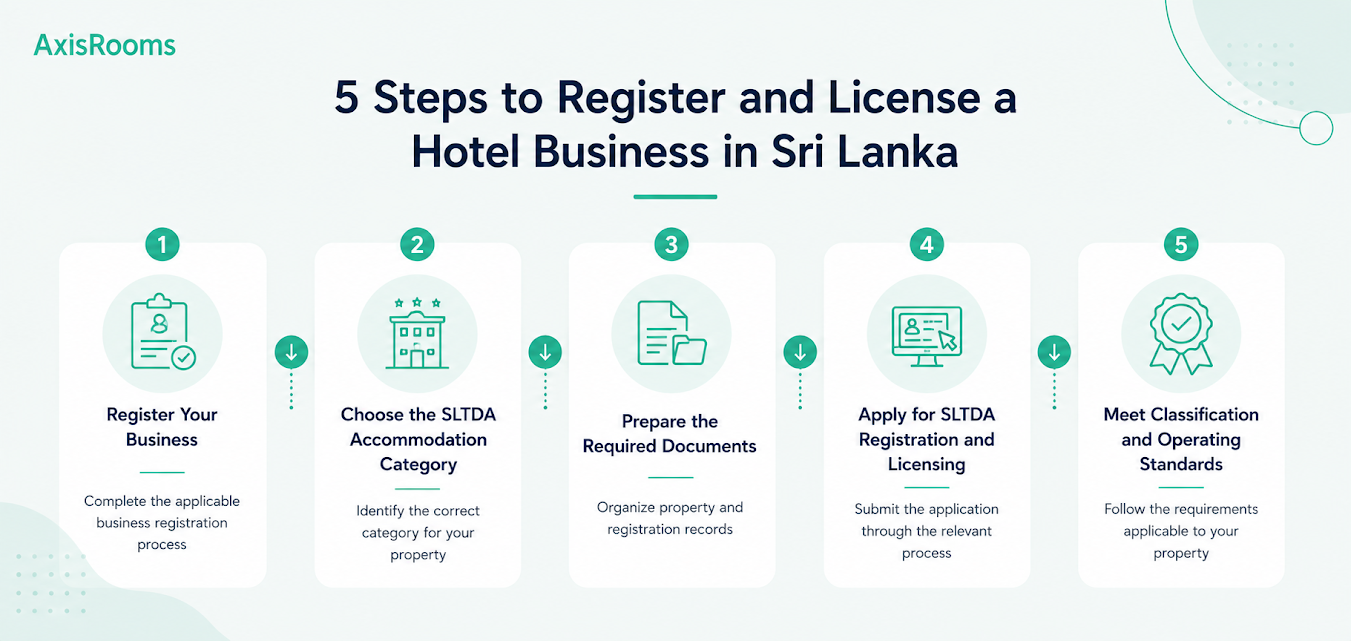
Image: These five steps to register and license a hotel business in Sri Lanka include business registration, selecting the appropriate SLTDA category, preparing necessary documents, applying for the required licenses, and adhering to applicable operating standards.
Step 1: Register Your Business
Start by establishing the legal business that will own or operate the hotel. Depending on its structure, this may involve registration through the Registrar of Companies and completion of relevant tax and local administrative requirements.
Keep the business name, ownership information, and property details consistent across applications. Discrepancies can create unnecessary delays during document review.
Step 2: Choose the Correct SLTDA Accommodation Category
The SLTDA separates tourist accommodation into categories including tourist hotels, classified hotels, guest houses, boutique hotels and villas, and other accommodation types.
Select the category that reflects how your property will actually operate. Do not choose one simply because it sounds more marketable; room count, facilities, design, and operating standards may determine the applicable requirements.
Review the latest SLTDA guidelines for your category before completing major construction or renovation work.
Step 3: Prepare Property and Registration Documents
Document requirements vary by accommodation category and application process. For tourist hotels, the SLTDA’s published registration process requires applicants to submit supporting records through its online system.
These may include business registration records, approved building plans, proof of ownership or lease documents, local authority approvals, environmental clearances, insurance, and other category-specific records.
Follow the current SLTDA checklist for your property type rather than relying on a generic hotel registration document list.
Step 4: Apply for SLTDA Registration and Licensing
Hotel operators can use the SLTDA Online Tourism Business Licensing Service to submit relevant registration and licensing applications.
The process may involve online document submission, review, payment, and property inspection. For tourist hotels, the SLTDA’s published process also outlines document verification and inspection before registration is completed.
Tourism licences must be renewed as required. SLTDA’s online licensing service states that formal registration is subject to annual licence renewal under the Tourism Act.
Step 5: Understand Classification and Operating Standards
Registration and hotel classification are not the same. Properties seeking classified hotel status must meet the applicable standards and inspection requirements for their category.
SLTDA also publishes development standards covering areas such as infrastructure and tourist accommodation design. Review these during project planning rather than waiting until the hotel is ready to open.
Planning for compliance early can reduce the risk of expensive property changes later.
When Does BOI Approval or Investor Facilitation Apply?
Board of Investment of Sri Lanka (BOI) involvement is more relevant to qualifying investment projects, particularly larger or foreign-funded tourism developments. BOI’s current tourism investment materials identify high-end hotels, resorts, experiences, and wellness tourism among its investment focus areas.
For a small, independently funded guest house or hotel, the standard business and tourism registration route may be more relevant. Larger investors should assess BOI eligibility and project facilitation early, especially when the investment structure, investor visas, or development process requires additional support.
Note: Always confirm the latest requirements with the relevant government authority or a qualified local adviser before committing significant capital to a hotel project.
How to Start a Hotel Business Plan for Sri Lanka
A hotel business plan is a practical roadmap that explains how your property will attract guests, generate revenue, manage costs, and grow. It can also help investors and lenders assess whether the hotel concept is financially viable.
For a hotel in Sri Lanka, the plan should reflect local demand, seasonality, accommodation requirements, and the realities of operating the property, not just broad tourism growth.
What Should Your Hotel Business Plan Include?
A strong hotel business plan should cover:
1. Executive summary: Briefly explain the hotel concept, location, target guests, investment requirements, and business goals.
2. Hotel concept and positioning: Define the property type, room inventory, facilities, guest experience, and what will make the hotel different from nearby competitors.
3.Market and demand analysis: Study target travelers, tourism seasonality, source markets, local demand drivers, and competing properties.
4. Marketing and distribution strategy: Explain how guests will discover and book the hotel through OTAs, your website, direct bookings, travel partners, and other channels.
5. Staffing and operations plan: Estimate the team required for front office, housekeeping, food and beverage, maintenance, and management based on the size of the property.
6. Startup and operating costs: Include development or renovation costs, licences, salaries, utilities, commissions, supplies, maintenance, marketing, and hotel technology.
7. Pricing and revenue strategy: Outline expected room rates, seasonal pricing, occupancy assumptions, and opportunities to generate revenue beyond room bookings.
8. Financial projections: Forecast revenue, operating expenses, cash flow, and the time the hotel may need to reach break-even.
9. Risks and contingency planning: Consider low-season demand, construction delays, cost increases, staffing gaps, and slower-than-expected booking growth.
Avoid building the plan around peak-season occupancy or the highest room rates in your destination. Use realistic assumptions and test how the business performs when demand is lower than expected.
Sample Business Plan Structure for a Hotel in Sri Lanka
Use this sample hotel business plan structure to organize your idea into a clear roadmap. Each section should be based on your own property, destination, guest segment, and financial assumptions rather than copied from another hotel.
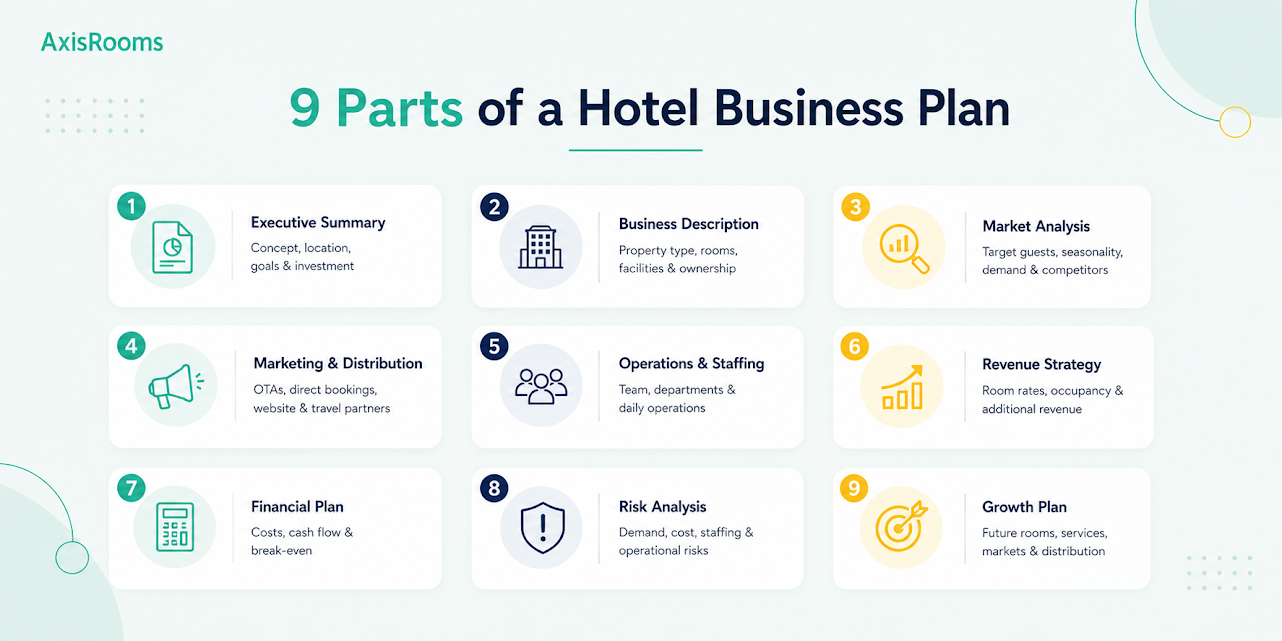
Image: A complete hotel business plan covers nine core areas, from the executive summary and property concept to market analysis, distribution, staffing, revenue, finances, risks, and future growth. Together, they help you test whether the hotel is commercially and operationally realistic before investing.
How to Start a Small Hotel Business in Sri Lanka
Starting a small hotel business in Sri Lanka is often about doing fewer things well. With fewer rooms and a leaner team, the priority should be controlling costs, targeting a clear guest segment, and building a simple booking process that can grow with the property.
Start with the essentials:
- Keep the concept focused: Give travelers a clear reason to choose your property instead of trying to serve every guest type.
- Plan staffing around real needs: Cross-functional roles may work for a small team, but service quality and workload still need to remain manageable.
- Protect working capital: Keep enough cash available for salaries, utilities, maintenance, and low-demand periods after opening.
- Build online visibility early: List the hotel on relevant booking channels and create a direct booking presence.
- Manage rates and inventory consistently: Even a small hotel can lose revenue through outdated prices or manual availability errors.
A small property does not need the operating complexity of a large resort. It does, however, need clear control over costs, bookings, and pricing from the beginning.

Manage All Your OTAs from One Place
Request a DemoHow to Promote a New Hotel Business in Sri Lanka
Promoting a new hotel business in Sri Lanka requires putting your property on the channels your target guests use to research and book their trips. The goal is not to appear everywhere. It is to build a balanced channel mix that gives the hotel visibility while creating more opportunities for direct bookings.
Start with these core distribution channels:
1. Build your Google and direct booking presence: Create a complete Google Business Profile with accurate contact details, professional photos, and location information. Your hotel website should clearly explain the rooms and experience, and a booking engine should let guests check live availability and reserve directly.
2. List of relevant OTAs: Booking.com and Agoda can give a new property wider online visibility. However, your OTA strategy should also reflect your target source markets. SLTDA’s 2025 data identifies India, the UK, Russia, Germany, and China among Sri Lanka’s important visitor markets, making it useful to track where your own guests search and book rather than choosing channels based only on global popularity.
3. Build social proof early: Encourage genuine guest reviews and respond to feedback professionally. For a new hotel without an established reputation, recent reviews, accurate photography, and consistent property information can give travelers more confidence to book.
4. Create content around the destination: Travelers often research the experience before choosing a hotel. Publish useful content about nearby attractions, transport, activities, weather, and itineraries that match the type of guest you want to attract.
5. Develop travel trade relationships: Local travel agents and destination management companies (DMCs) can be valuable for properties targeting tours, groups, and specific inbound markets. Choose partners based on the guests and destinations they actually sell.
6. Review your channel mix regularly: Compare booking volume, commission costs, room rates, cancellations, and revenue from each channel. A channel that delivers many reservations may not always produce the most profitable bookings.
As OTA and direct channels grow, updating rates and room availability separately can quickly become difficult. A hotel channel manager such as AxisRooms can synchronize inventory and pricing across connected booking channels, reducing manual updates and overbooking risks.
The strongest promotion strategy is not the one with the most channels. It is the one that reaches the right guests while giving the hotel greater control over where its bookings come from.
7 Mistakes That Make New Hotels in Sri Lanka Harder to Grow
Opening a hotel is only the first milestone. Many new properties struggle to grow because early decisions around demand, pricing, distribution, and operations become harder to fix once bookings increase.
Here are seven mistakes to avoid:
1. Building the Hotel Around Peak-Season Demand
Strong months can make occupancy and room rates look more promising than they are across the full year. If your financial plan depends on peak demand continuing, quieter periods can quickly put pressure on cash flow.
Avoid it: Forecast occupancy, rates, and operating costs across different seasons before committing to major expenses.
2. Trying to Attract Every Type of Guest
A hotel designed equally for backpackers, families, luxury travelers, and business guests often ends up with unclear positioning. That makes pricing, marketing, and the guest experience harder to align.
Avoid it: Define your primary guest segment and build the rooms, services, and booking strategy around their needs.
3. Choosing the Wrong Accommodation Category Too Late
SLTDA requirements vary across accommodation categories. Waiting until the property is nearly complete to review the relevant standards can create compliance issues or costly changes.
Avoid it: Confirm the applicable accommodation category and current requirements during the planning stage.
4. Depending Too Heavily on One Booking Channel
One OTA may generate early bookings, but overdependence leaves the hotel exposed to commission costs, changing demand, and limited control over guest acquisition.
Avoid it: Build a balanced mix of relevant OTAs, direct bookings, and travel partners based on your target markets.
5. Using the Same Room Rate Throughout the Year
Sri Lanka’s hotel demand can shift with seasonality, booking pace, source markets, and destination-specific travel patterns. Fixed pricing can leave rooms overpriced in softer periods and underpriced when demand rises.
Avoid it: Review rates regularly and adjust pricing based on demand, occupancy, and booking trends.
6. Underestimating Working Capital After Opening
A full hotel does not become profitable on its first day. Salaries, utilities, supplies, maintenance, commissions, and marketing expenses continue while demand is still developing.
Avoid it: Maintain enough working capital to support the property through its early months and lower-demand periods.
7. Managing Growing Bookings With Manual Processes
Spreadsheets and separate OTA logins may work when booking volume is low. As more channels and reservations are added, manual rate and inventory updates increase the risk of errors and overbookings.
Avoid it: Set up connected hotel technology before manual processes become an operational bottleneck.
A new hotel does not need to get every decision perfect from day one. However, the earlier you build clear controls around demand, cash flow, pricing, and distribution, the easier it becomes to grow without constantly fixing avoidable operational problems.
Which KPIs Should a New Hotel in Sri Lanka Track?
A new hotel in Sri Lanka should track KPIs that show how well it is filling rooms, pricing inventory, attracting bookings, and managing guest demand. Occupancy alone is not enough to measure whether the hotel is performing profitably.
Start with these core hotel KPIs:
| KPI | What It Measures | Why a New Hotel Should Track It |
| Occupancy Rate | Percentage of available rooms sold | Shows how effectively the hotel is filling its room inventory |
| ADR (Average Daily Rate) | Average room revenue earned per occupied room | Indicates whether room pricing is generating enough value |
| RevPAR (Revenue per Available Room) | Room revenue generated across all available rooms | Balances occupancy and pricing to show room revenue performance |
| ALOS (Average Length of Stay) | Average number of nights per booking | Reveals stay patterns and opportunities to attract longer bookings |
| Booking Window | Time between reservation and arrival | Helps plan pricing and availability around early and last-minute demand |
| Direct Booking Share | Percentage of reservations booked directly | Shows how much demand the hotel generates without relying on third-party channels |
| Channel Mix | Contribution of OTAs, direct bookings, agents, and other sources | Identifies which booking sources generate demand and revenue |
| Cancellation Rate | Percentage of bookings cancelled | Highlights revenue risk and changes in booking behaviour |
These KPIs are most useful when reviewed together and over time. For example, high occupancy may look positive, but if ADR is too low or most bookings come through high-cost channels, the hotel may still struggle to generate healthy returns.
For a new property, compare performance by season, guest segment, and booking channel rather than relying on one annual average. This makes it easier to identify where demand originates, which guests stay longer, and when pricing may need to change.
What Hotel Technology Does a New Hotel Need?
A new hotel needs technology to manage room distribution, reservations, direct bookings, pricing, and payments accurately. Setting up the right systems before opening can reduce manual work and prevent disconnected processes from becoming difficult to correct later.
The exact hotel technology stack will depend on the size of your property, but these are the core systems to consider.
Channel Manager
A hotel channel manager keeps rates and room availability synchronized across connected booking channels. When a room is booked on one OTA, inventory is updated across the other connected channels in real time.
For a new Sri Lankan hotel selling through multiple OTAs, this reduces manual updates and lowers the risk of overbookings or inconsistent availability.
Property Management System Integrations
Your property management system (PMS) supports the daily operation of the hotel, including reservations, guest records, check-ins, housekeeping, and other front-office workflows.
More importantly, consider how the PMS connects with your distribution systems. Integrated technology creates a smoother flow of booking and inventory data instead of requiring staff to update separate platforms manually.
Booking Engine
A hotel booking engine lets travelers check real-time availability and reserve rooms directly through your hotel website.
This gives your direct booking strategy an actual conversion path. A good-looking website alone cannot generate direct reservations efficiently if guests still need to call, email, or wait for availability confirmation.
Revenue Management
Revenue management helps a new hotel make better pricing decisions based on demand, occupancy, booking pace, and seasonality.
This is particularly important when demand changes across travel periods. Instead of maintaining one fixed room rate, hotels can adjust prices as market conditions and booking patterns change.
OTA Integrations
OTA integrations connect your hotel with the online booking platforms that matter to your target markets. The right connections can expand visibility and make it easier to distribute room inventory across relevant channels.
However, more OTA connections are not automatically better. Choose channels based on your guest segments and source markets, then monitor which ones actually generate valuable bookings.
Online Payment Infrastructure
Online payment infrastructure gives guests a secure way to complete payments during the booking journey. It can also reduce manual payment follow-ups and make direct reservations easier to confirm.
Before opening, assess which payment methods suit domestic and international guests and whether the setup connects smoothly with your booking workflow.
These systems are more effective when they operate as a connected hotel technology stack rather than isolated tools. When distribution, reservations, pricing, direct bookings, and payments share information, teams spend less time correcting manual errors and gain stronger operational control.
How AxisRooms Helps New Hotels Build a Smarter Distribution and Revenue Strategy
For a new hotel, opening the doors is only the beginning. The next challenge is reaching the right travelers, keeping inventory accurate, and responding to changes in demand with better pricing decisions.
AxisRooms brings distribution and revenue tools into a connected hospitality ecosystem, giving new hotels a stronger foundation to manage bookings and grow.
- 100+ OTA Integrations: Connect your hotel with relevant online travel agencies and expand visibility across the channels your target guests use.
- PMS Integrations: Create a smoother flow of reservation and inventory data between property operations and distribution systems.
- Payment Gateways: Support secure online transactions and make the booking journey easier to complete.
- Channel Manager: Update room rates and availability across connected channels from one place, reducing manual work and overbooking risks.
- Revenue Management Services: Use demand trends, booking pace, and market insights to make more informed pricing decisions.
- Web Booking Engine: Turn your hotel website into a direct sales channel with real-time availability and a simpler reservation experience.
Rather than adding a separate system whenever a new challenge appears, hotels can establish a more connected distribution setup early. This gives teams greater control over where rooms are sold, how inventory is managed, and how pricing responds as demand changes.
Conclusion
Starting a hotel business in Sri Lanka takes more than finding a promising property and opening rooms to guests. Long-term growth requires a clear understanding of the market, realistic cost planning, the right registrations, and deliberate pricing and distribution decisions.
You do not need the biggest property or the most booking channels to compete. A focused hotel concept, disciplined planning, and systems that can keep pace with the business create a stronger foundation for growth.
If managing rates, availability, and bookings across different channels is becoming complicated, schedule a free demo today to see how a connected setup can simplify your hotel operations.