
Whether it’s a dispute over a late checkout, confusion about visitor access, or disagreements over cancellation charges, many guest complaints stem from one common issue: unclear expectations. As hotels welcome guests from diverse backgrounds and booking channels, having well-defined hotel rules and regulations is essential to ensuring smooth operations, protecting staff and property, and delivering a consistent guest experience.
Clear rules do more than maintain order; they reduce misunderstandings, support compliance, strengthen operations, and help guests know what to expect before and during their stay. For hotels, they also serve as a practical framework for handling everyday situations fairly and professionally.
In this guide, we’ll explain what hotel rules and regulations are, why they matter, how to create them, the essential policies every property should have, provide a free template, and cover important regulations for hotels in India.
What Are Hotel Rules and Regulations?
Hotel rules and regulations are the guidelines that define how a hotel operates and what is expected from everyone on the property. They help establish clear standards for guest behaviour, staff responsibilities, safety, security, and day-to-day operations while ensuring compliance with applicable laws and industry requirements.
Although the terms are often used together, “rules” generally refer to expected behaviour, while “regulations” also include legal and operational requirements that hotels must follow. Together, they create a structured framework that supports consistent service, protects the interests of both guests and the property, and reduces the likelihood of misunderstandings or disputes.
Whether it’s a boutique hotel, business hotel, resort, or vacation rental, documented rules create a safer and more predictable experience for everyone on the property. They reduce confusion, support day-to-day operations, and create a safer, more consistent experience for guests and staff alike.
Why Are Hotel Rules and Regulations Important?
Well-defined hotel rules are important because they create clear expectations for everyone on the property, helping hotels operate safely, consistently, and professionally. Well-documented policies reduce uncertainty, guide staff in handling common situations, and ensure guests understand their responsibilities before and during their stay.
Here’s why every hotel should document its rules and regulations.
- Protect guest safety: Clear guidelines for emergencies, restricted areas, occupancy limits, and security procedures help create a safer environment for guests and staff.
- Reduce disputes: Written policies on issues like check-in, payments, cancellations, and visitor access minimize misunderstandings and make it easier to resolve conflicts fairly.
- Ensure legal compliance: Hotels must comply with applicable laws, local regulations, and licensing requirements. Documented policies support compliance while reducing operational and legal risks.
- Improve staff consistency: Standardized rules give employees a clear framework for handling guest requests and enforcing policies, resulting in more consistent service across departments.
- Protect hotel property: Rules around smoking, room occupancy, damages, and prohibited activities help safeguard hotel assets and reduce unnecessary maintenance and replacement costs.
- Enhance the guest experience: When expectations are communicated clearly, guests know what to expect, leading to smoother stays and greater confidence in the property’s professionalism.
- Reduce negative reviews: Many poor reviews stem from unmet expectations rather than poor service. Clearly communicated rules help prevent avoidable complaints and improve overall guest satisfaction.
Ultimately, clear rules support safer operations, fairer decision-making, and a more predictable guest experience.
What’s the Difference Between Hotel Rules and Hotel Policies
Hotel rules and hotel policies are closely related, but they serve different purposes. Hotel rules define what guests, visitors, and employees are expected to do while on the property, whereas hotel policies outline how the hotel manages its operations, services, and business decisions.
In simple terms, rules focus on behaviour, while policies focus on procedures. Both work together to create a safe, uniform, and well-managed guest experience.
| Aspect | Hotel Rules | Hotel Policies |
| Purpose | Define acceptable behaviour and guest expectations. | Define how the hotel operates and makes decisions. |
| Focus | Guests, visitors, and staff conduct. | Reservations, payments, operations, and service standards. |
| Who follows them? | Primarily guests and visitors (with some staff rules). | Primarily hotel staff, though they also affect guests. |
| Examples | Quiet hours, no-smoking rules, occupancy limits, visitor restrictions. | Cancellation policy, refund policy, payment terms, check-in and check-out procedures. |
| If not followed | May result in warnings, penalties, or removal from the property. | Determines how the hotel responds, such as charging cancellation fees or denying late check-out requests. |
For example, a hotel’s visitor rule may state that only registered guests are allowed in rooms after a certain time. The corresponding visitor policy explains how visitors must register, the documents required, and the process staff should follow before granting access.
How to Create Hotel Rules and Regulations
Creating hotel rules and regulations starts with understanding your property’s operational needs, legal obligations, and the expectations of your guests. The goal is to establish clear, practical guidelines that are easy for guests to understand and simple for staff to enforce consistently.
Rather than copying another property’s rulebook, develop rules that reflect your hotel’s size, location, guest profile, and services.
1. Understand Legal and Regulatory Requirements
Begin by identifying the laws and regulations that apply to your property. Local licensing requirements, fire safety standards, health regulations, GST compliance, and tourism guidelines may all influence the rules your hotel needs to communicate.
2. Identify Guest Expectations
Consider the situations that most commonly lead to guest questions or disputes. Reviewing guest feedback, staff observations, and operational challenges can help identify where clearer expectations are needed.
3. Keep the Language Simple
Write rules in plain, easy-to-understand language. Guests should be able to read and understand each rule quickly, regardless of where they booked or their familiarity with your property.
4. Avoid Ambiguous Wording
Rules should leave little room for interpretation. Instead of using vague terms like “reasonable” or “when necessary,” specify exactly what is expected whenever possible. Clear wording makes policies easier to follow and enforce consistently.
5. Train Employees
Staff should understand not only what each rule says but also how to communicate it professionally and apply it consistently. Regular training reduces misunderstandings and ensures guests receive the same information from every department.
6. Display Rules Across Guest Touchpoints
Make your rules easy to find before, during, and after a booking. They can be shared on your website, booking confirmations, check-in documents, in-room materials, and digital guest communications so expectations are clear throughout the guest’s journey.
7. Review and Update Them Regularly
Hotel operations, regulations, and guest expectations evolve over time. Review your rules periodically to ensure they remain accurate, relevant, and aligned with current legal requirements and business practices.
Essential Hotel Rules and Regulations Every Property Should Have
While every property has unique operating requirements, most hotels rely on a common set of rules covering guests, rooms, visitors, payments, safety, and employee conduct. Well-defined rules reduce misunderstandings, support smooth daily operations, enhance safety, and deliver a consistent guest experience.
Hotel Rules and Regulations for Guests
Hotel rules and regulations for guests define the standards guests are expected to follow throughout their stay. They help hotels maintain order, protect property, and ensure a safe and comfortable experience for everyone.
- Check-in and check-out: Guests must adhere to the hotel’s designated check-in and check-out timings unless an early arrival or late departure has been approved in advance.
- Valid government-issued ID: Every guest should present a valid government-issued identity document during check-in to comply with local regulations and verify the reservation.
- Visitor policy: Visitors may only enter guest rooms according to the hotel’s visitor policy and may be required to register at the front desk.
- Payment requirements: Room charges, deposits, and incidental expenses must be settled according to the agreed payment terms before or during checkout.
- Cancellation policy: Guests should review the hotel’s cancellation terms before confirming their booking, as refund eligibility may vary by rate plan.
- Lost and found: Items left behind are handled according to the hotel’s lost and found procedure. Unclaimed belongings are typically stored for a limited period.
- Illegal activities: Any illegal, hazardous, or disruptive activity is strictly prohibited and may result in immediate eviction or notification of local authorities.
- Respect for staff and other guests: Guests are expected to behave respectfully and avoid actions that disturb other occupants or interfere with hotel operations.
- Property damage: Guests may be held financially responsible for any intentional or negligent damage caused to hotel property.
- Quiet hours: Noise should be kept to a minimum during designated quiet hours to ensure a peaceful environment for all guests.
Hotel Room Rules and Regulations
Hotel room rules and regulations outline how guests should use their rooms responsibly to protect hotel property, maintain hygiene, and ensure everyone’s safety.
- Smoking policy: Smoking should only be permitted in designated smoking areas or rooms. Violations may attract cleaning or penalty charges.
- Maximum occupancy: The number of occupants must not exceed the room’s approved capacity unless additional arrangements have been made.
- Pet policy: Guests should follow the hotel’s pet policy regarding permitted animals, additional charges, and designated pet-friendly rooms.
- Noise levels: Loud music, parties, or excessive noise inside guest rooms should be avoided, especially during late hours.
- Minibar usage: Items consumed from the minibar will be charged according to the hotel’s pricing policy unless otherwise specified.
- Room damage: Guests are expected to use hotel furnishings and amenities responsibly and report any accidental damage immediately.
- Electrical appliances: Personal appliances that may pose safety risks, such as hot plates or electric cookers, should not be used unless permitted by the hotel.
- Housekeeping access: Guests should cooperate with housekeeping schedules or use privacy indicators when they do not wish to be disturbed.
- Fire safety: Tampering with smoke detectors, fire alarms, or emergency equipment is strictly prohibited.
Hotel Visitor Rules
Hotel visitor rules help maintain security while ensuring a safe environment for registered guests and hotel staff.
- Visitor timings: Visitors should only enter guest rooms during the hotel’s approved visiting hours.
- Overnight visitors: Overnight stays by unregistered visitors are generally not permitted unless approved by the hotel and additional registration requirements are completed.
- Visitor registration: All visitors may be required to register at the reception before entering guest areas.
- Identity verification: Visitors should present a valid government-issued ID when requested for security purposes.
- Restricted access: Visitors are only permitted in authorized areas and must comply with all hotel security guidelines.
Hotel Payment & Cancellation Rules
Clear payment and cancellation rules reduce billing disputes and help both guests and hotels understand their financial responsibilities.
- Advance deposits: Certain bookings may require partial or full payment before arrival to confirm the reservation.
- Refund policy: Refunds are processed according to the hotel’s cancellation terms and the booking channel used.
- Cancellation window: Guests should cancel within the specified timeframe to avoid cancellation charges.
- Early departure: Guests checking out before their scheduled departure date may be subject to early departure fees, depending on the booking terms.
- No-show policy: Reservations may be cancelled and applicable charges applied if guests fail to arrive without prior notice.
Hotel Safety & Emergency Rules
Safety rules prepare guests and staff to respond quickly during emergencies while minimizing risks within the property.
- Fire exits: Guests should familiarize themselves with the nearest emergency exits immediately after check-in.
- Emergency contacts: Important emergency numbers and front desk contact details should be easily accessible in every room.
- Medical emergencies: Any medical emergency should be reported to hotel staff immediately so appropriate assistance can be arranged.
- Disaster procedures: Guests should follow staff instructions during emergencies such as fires, earthquakes, floods, or other evacuation situations.
- CCTV surveillance: Public areas may be monitored through CCTV to enhance guest safety and property security.
- Restricted areas: Access to operational zones, maintenance rooms, kitchens, and staff-only areas is prohibited without authorization.
Hotel Rules and Regulations for Employees
Hotel rules and regulations for employees establish professional standards that support smooth operations, guest satisfaction, and legal compliance.
- Attendance and punctuality: Employees are expected to report for duty on time and follow assigned work schedules.
- Grooming and appearance: Staff should maintain professional grooming standards and wear clean, designated uniforms while on duty.
- Guest privacy: Personal guest information must remain confidential and should only be accessed for legitimate operational purposes.
- Confidentiality: Business information, financial records, and operational data should never be disclosed without authorization.
- Uniform compliance: Employees should wear the prescribed uniform and identification badge throughout their shift unless instructed otherwise.
- Incident reporting: Safety concerns, guest complaints, accidents, and operational issues should be reported promptly through established procedures.
- Hygiene standards: Employees must follow all hygiene and sanitation protocols to maintain a safe and healthy environment.
- Professional conduct: Staff should treat guests and colleagues with courtesy, respect, and professionalism at all times.
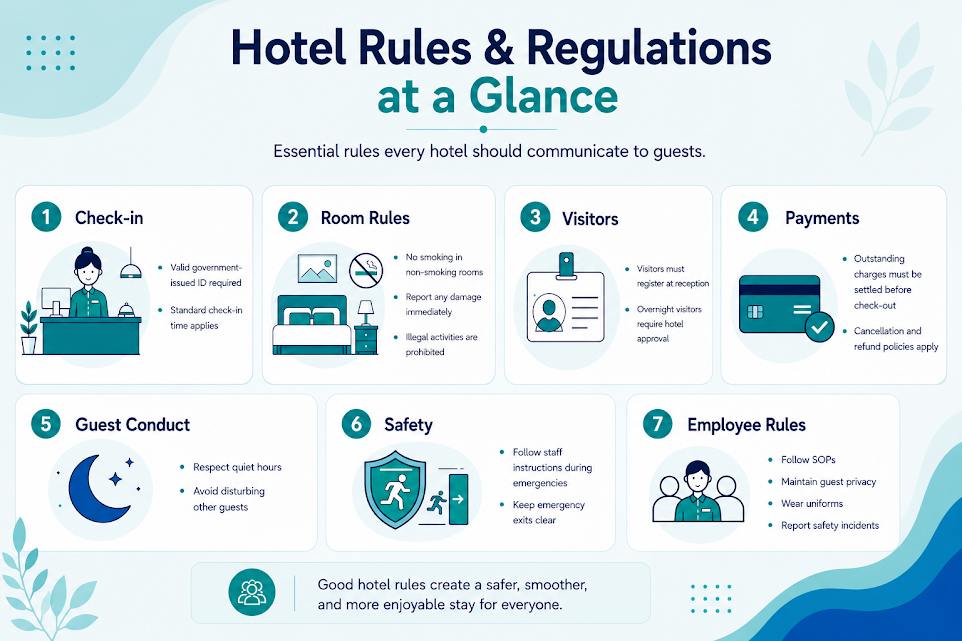
Figure: This infographic provides a quick overview of the core areas covered in most hotel rulebooks: check-in, room usage, visitors, payments, guest conduct, employee rules, and safety. While the exact terms may differ from one property to another, these categories form the foundation of clear and effective hotel rules and regulations.
Hotel Rules and Regulations for Guests in India
While many hotel rules such as check-in timings, payment policies, and guest conduct are common across the world, hotels in India must also comply with specific legal and regulatory requirements. These obligations help verify guest identities, maintain security records, and meet reporting requirements set by central and state authorities.
The exact rules may vary depending on your property’s location and guest profile. However, every hotel should understand the following requirements when creating or updating its guest policies.
| Requirement | What It Means | Best Practice for Hotels |
| Valid government-issued ID | Verify the identity of every guest during check-in using an accepted government-issued photo ID, such as an Aadhaar Card, Passport, Driving Licence, or Voter ID. | Clearly communicate accepted ID requirements during booking and at check-in to avoid delays. |
| Foreign guest registration | Hotels accommodating foreign nationals must complete the required Form C submission and comply with applicable FRRO reporting requirements. | Train front desk staff on documentation requirements and maintain accurate records. |
| Guest register | Hotels are generally required to maintain guest registration records containing essential check-in details. | Keep guest records accurate, secure, and readily available if requested by authorities. |
| Right of admission | Hotels may refuse accommodation under lawful circumstances, provided decisions comply with applicable laws and are not discriminatory. | Define admission policies clearly and apply them consistently to all guests. |
| State-specific regulations | Some states or local authorities may require additional measures, such as CCTV coverage, police verification, or other security protocols. | Review local regulations periodically and update internal procedures whenever requirements change. |
Note: Hospitality regulations may change over time and can differ across states and union territories. Hotels should periodically review applicable central, state, and local government requirements and seek professional legal advice where necessary before updating their guest policies.
Common Mistakes Hotels Make When Creating Rules
Creating clear hotel rules is only part of the process. How those rules are written, communicated, and enforced has a direct impact on guest satisfaction and day-to-day operations. Even well-written hotel rules can fail if they’re difficult to understand, inconsistently applied, or never updated.
Here are some of the most common mistakes hotels make and how to avoid them:
1. Copying Another Hotel’s Rules
Every property operates differently. Copying another hotel’s rules without considering your location, guest profile, facilities, or legal obligations can create policies that are confusing, impractical, or difficult to enforce.
2. Using Confusing or Overly Technical Language
Guests should be able to understand your policies without needing clarification. Avoid legal jargon, long paragraphs, or vague wording. Clear, simple language reduces misunderstandings and helps guests know what to expect before and during their stay.
3. Failing to Update Policies Regularly
Guest expectations, technology, and local regulations evolve over time. Rules that haven’t been reviewed for years may no longer reflect current operations or legal requirements. Schedule periodic reviews to keep your policies accurate and relevant.
4. Hiding Important Terms and Conditions
Extra charges, cancellation terms, visitor restrictions, or security deposit requirements should never come as a surprise. Display important conditions prominently during booking, check-in, and on your website to build trust and reduce disputes.
5. Not Training Staff on Hotel Policies
Well-written rules are ineffective if employees don’t understand them. Front desk, housekeeping, security, and guest service teams should know your policies well enough to explain and apply them confidently.
6. Enforcing Rules Inconsistently
Allowing one guest to break a rule while enforcing it for another creates frustration and damages credibility. Consistent application of policies helps maintain fairness, improves guest confidence, and reduces conflicts between staff and guests.
A good set of hotel rules doesn’t just exist on paper; it is clearly communicated, consistently enforced, and reviewed regularly to reflect changing guest expectations and operational needs.
Manage All Your OTAs from One Place
Request a Demo

How to Communicate and Enforce Hotel Rules and Regulations Effectively
Guests are far more likely to follow policies when they encounter them at multiple touchpoints throughout their journey, not just at check-in. Consistent communication reduces misunderstandings, minimizes disputes, and creates a smoother guest experience from booking to check-out.
The following touchpoints are the most effective places to communicate hotel rules:
| Guest Touchpoint | What to Communicate | Why It Matters |
| Hotel website | Key policies such as check-in and check-out times, cancellation terms, visitor rules, pet policy, and smoking policy. | Sets clear expectations before guests make a booking. |
| Booking engine | Important booking conditions, payment terms, and cancellation policies. | Ensures guests review essential terms before confirming their reservation. |
| Booking confirmation email | A summary of the most important policies, along with arrival instructions and contact information. | Reinforces expectations and reduces pre-arrival questions. |
| Reception desk | Display key guest rules, emergency information, and property policies in a visible location. | Provides a final reminder during check-in and supports front desk conversations. |
| Guest directory | Include detailed property rules, available services, emergency procedures, and facility guidelines. | Gives guests an easy reference throughout their stay. |
| QR code in the room | Link guests to a digital version of your hotel rules, FAQs, and service information. | Makes policies easily accessible without relying on printed materials. |
| Digital guest guide | Offer comprehensive information on hotel policies, amenities, local recommendations, and service requests. | Creates a more convenient, self-service guest experience while reducing repetitive staff queries. |
Communicating hotel rules across multiple guest touchpoints is only half the job. Regular staff training, documented SOPs, and consistent enforcement ensure every guest receives the same information and experience.
How AxisRooms Helps Hotels Manage Guest Policies More Efficiently
Even the best-written hotel policies lose their value if guests receive inconsistent information across booking channels and on-property touchpoints. As hotels manage bookings from multiple channels and interact with guests before, during, and after their stay, disconnected systems can lead to inconsistent information and avoidable disputes.
AxisRooms helps hotels maintain consistency by connecting distribution, reservations, and booking channels. With synchronized availability and direct booking, hotels can communicate policies effectively, reduce errors, and enhance the guest experience from booking to check-out.
- 100+ OTA Integrations: Keep booking details, cancellation terms, and availability synchronized across multiple online travel agencies, reducing discrepancies between booking channels.
- Web Booking Engine: Display important booking conditions, payment terms, and cancellation policies during the direct booking process, helping guests understand key information before confirming their reservation.
- PMS Integrations: Connect guest reservations, front desk operations, and property workflows so staff have access to accurate booking and guest information throughout the stay.
- Channel Manager: Centralize inventory and rate updates across distribution channels, helping maintain consistent booking information across every platform.
- Payment Gateways: Support secure online payments while enabling guests to review payment terms and booking conditions before completing their reservation.
- Revenue Management Services: Optimize pricing and distribution strategies without compromising rate parity or the policies communicated across booking channels.
Connected hotel technology makes it easier to communicate policies consistently, reduce disputes, and deliver a smoother guest experience.
Conclusion
Effective hotel rules aren’t about restricting guests; they’re about creating a smoother experience for everyone. When expectations are communicated clearly and applied fairly, hotels can reduce disputes, strengthen guest trust, and operate with greater confidence.
As your hotel grows, maintaining that consistency becomes just as important as creating the rules themselves. With the right processes and connected technology, you can reduce misunderstandings, strengthen guest trust, and keep operations running smoothly.
Book a free demo today to discover how AxisRooms can help simplify hotel operations and deliver a more consistent guest experience.