
As hotels continue to diversify their online distribution, OTA management has become essential for maximizing bookings, maintaining rate consistency, and reducing operational complexity. Listing your property across multiple online travel agencies (OTAs) such as Booking.com, Agoda, MakeMyTrip, and Expedia can significantly increase visibility, but manually managing rates, inventory, reservations, and availability across multiple platforms often leads to errors, overbookings, and lost revenue.
This challenge is only expected to grow as the online travel market expands. According to Grand View Research, the global online travel agencies market was valued at USD 663.7 billion in 2025 and is projected to grow from USD 718.9 billion in 2026 to USD 1,316.8 billion by 2033. As hotels increasingly rely on OTAs to drive bookings, adopting an effective OTA management strategy is becoming essential for maintaining operational efficiency and maximizing revenue.
In this guide, we’ll explore what OTA management is, core components, why it matters, and how hotels can use the right technology and best practices to manage online distribution more effectively.
What Is OTA Management?
OTA management is the process of managing a hotel’s presence, inventory, pricing, reservations, and performance across multiple online travel agencies (OTAs). It ensures room availability, rates, and booking information remain accurate and synchronized across every connected booking channel.
For hotels, OTA management goes beyond listing rooms on platforms like Booking.com, Agoda, MakeMyTrip and Expedia. It involves maintaining consistent pricing, updating availability, managing reservations, monitoring booking performance, and ensuring guests receive a smooth booking experience across every OTA.
The term OTA hotel management is often used to describe the broader process of managing a hotel’s online distribution and bookings across multiple OTAs. As hotels expand their online presence, effective OTA management becomes essential for maintaining efficient operations, reducing manual errors, and supporting sustainable business growth.
Why OTA Management Matters
OTA management is important because it enables hotels to manage multiple online travel agencies efficiently while maximizing visibility, bookings, and revenue. As hotels expand their distribution across platforms like Cleartrip, Agoda, Goibibo, and Yatra, maintaining accurate rates, inventory, and reservations becomes increasingly challenging. A well-planned OTA management strategy helps hotels stay competitive while streamlining day-to-day operations.
Some of the biggest benefits of effective OTA management include:
- Greater online visibility: Reach more travelers by maintaining an active presence across multiple OTAs.
- Wider distribution: Expand your hotel’s reach across domestic and international booking channels without managing each platform separately.
- Higher revenue opportunities: Capture more bookings while reducing revenue loss caused by pricing inconsistencies and inventory errors.
- Improved occupancy: Keep room availability updated in real time to maximize occupancy throughout the year.
- Sustainable business growth: Build a scalable distribution strategy that supports long-term growth as your hotel connects with more booking channels.
Effective OTA management is built on three interconnected components that work together to simplify hotel distribution and improve overall business performance.
The Three Core Components of OTA Management
Although OTA management is often associated with managing online bookings, it encompasses much more than updating room availability across different platforms. Hotels need to balance distribution, day-to-day operations, and pricing strategies simultaneously to deliver a pleasant experience for both guests and staff.
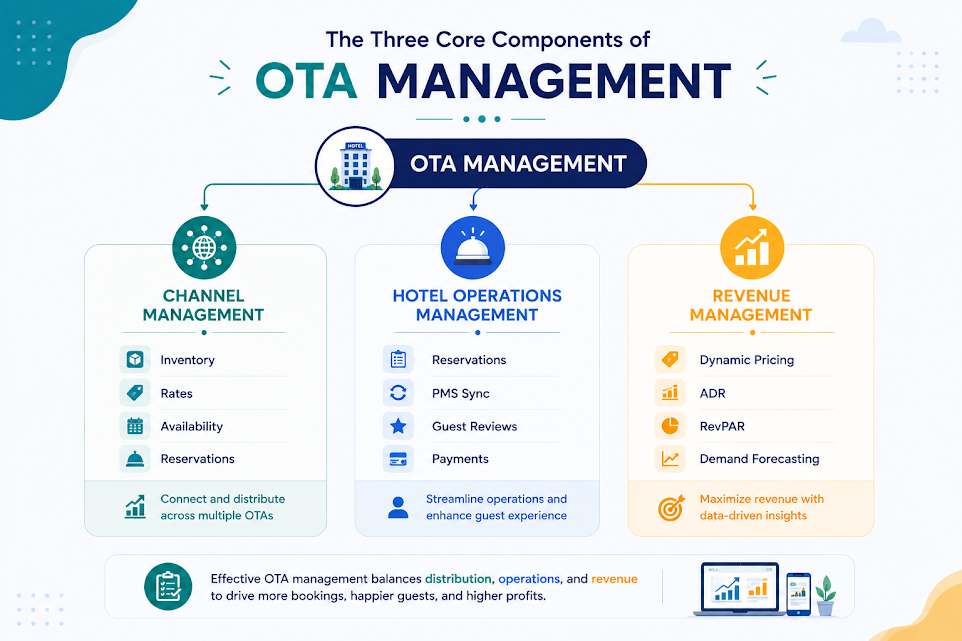
Image: This infographic highlights the three core components of OTA management: channel management, hotel operations management, and revenue management, and shows how they work together to streamline hotel distribution, operations, and revenue growth.
The three core components of OTA management are:
1. OTA Channel Management
OTA channel management focuses on distributing inventory across multiple online travel agencies while keeping room availability, rates, and reservations synchronized in real time. It ensures every connected booking channel displays accurate information and helps hotels eliminate manual updates and overbookings.
2. OTA Hotel Operations Management
Every OTA booking impacts day-to-day hotel operations. This includes managing reservations, synchronizing bookings with the PMS, maintaining accurate property content, responding to guest reviews, handling payments, and ensuring operational teams have the information they need to deliver a smooth guest experience.
3. OTA Revenue Management
OTA revenue management focuses on maximizing profitability by optimizing room rates, occupancy, ADR, RevPAR, and pricing strategies across different booking channels. By combining accurate distribution with data-driven pricing, hotels can respond to market demand more effectively and improve overall revenue performance.
Together, these three components create a connected OTA management strategy that enables hotels to streamline operations, improve distribution, and maximize revenue.
What Is an OTA Channel Manager?
An OTA channel manager is a software solution that enables hotels to manage room inventory, rates, and reservations across multiple online travel agencies (OTAs) from a single platform. Instead of updating availability manually on each OTA, hotels can make one change in the channel manager, which is then automatically synchronized across every connected booking channel in real time.
For hotels working with platforms like Cleartrip, Ixigo, MakeMyTrip, and Goibibo, a channel manager eliminates repetitive manual updates and significantly reduces the risk of overbookings, pricing inconsistencies, and reservation errors. It also saves valuable time, allowing hotel teams to focus on guest experience rather than managing multiple OTA extranets.
As hotels build a stronger OTA management strategy, it becomes important to understand how each core technology fits into the workflow. A channel manager handles OTA distribution, a PMS manages hotel operations, and a booking engine drives direct bookings. Knowing the difference helps hotels reduce duplicate work, avoid overbookings, and choose the right tools for both online distribution and day-to-day operations.
OTA Channel Manager vs PMS vs Booking Engine: What’s the Difference?
Although these hotel technologies work together, each serves a different purpose. Understanding the difference between a channel manager, Property Management System (PMS), and booking engine helps hotels build an efficient technology ecosystem while avoiding duplicate processes and manual work.
| Tool | Primary Purpose | Best For |
| OTA Channel Manager | Synchronizes room rates, inventory, and reservations across multiple OTAs in real time. | Managing online distribution and preventing overbookings. |
| Property Management System (PMS) | Manages front desk operations, reservations, housekeeping, billing, guest profiles, and daily hotel operations. | Runs day-to-day hotel operations from a centralized system. |
| Booking Engine | Enables guests to book rooms directly through the hotel’s website without paying OTA commissions. | Increasing direct bookings and reducing dependency on third-party channels. |
How Does an OTA Channel Manager Work?
An OTA channel manager acts as a central hub between your hotel, connected OTAs, and your Property Management System (PMS). It automatically synchronizes rates, inventory, and reservations in real time, ensuring every booking channel displays accurate availability while eliminating manual updates.
Here’s how the process works:
Step 1: The Hotel Updates Rates and Inventory
The hotel updates room rates, availability, restrictions, or promotions once through the channel manager instead of logging into multiple OTA extranets.
Step 2: The Channel Manager Distributes Updates
The channel manager instantly pushes the latest information to all connected OTAs, including Booking.com, Agoda, MakeMyTrip, Expedia, Goibibo, and other booking platforms.
Step 3: A Guest Makes a Reservation
A traveler books a room through one of the connected OTAs using the updated rates and real-time availability displayed on the platform.
Step 4: Availability Is Updated Automatically
As soon as the booking is confirmed, the channel manager automatically reduces inventory across every connected OTA, preventing double bookings and maintaining rate parity.
Step 5: The Reservation Syncs with the PMS
The confirmed reservation, guest details, and booking information are instantly transferred to the hotel’s Property Management System (PMS), allowing front desk teams to manage check-ins, housekeeping, and guest services without manual data entry.
This real-time workflow enables hotels to manage multiple OTAs efficiently while maintaining accurate inventory, consistent pricing, and seamless hotel operations.
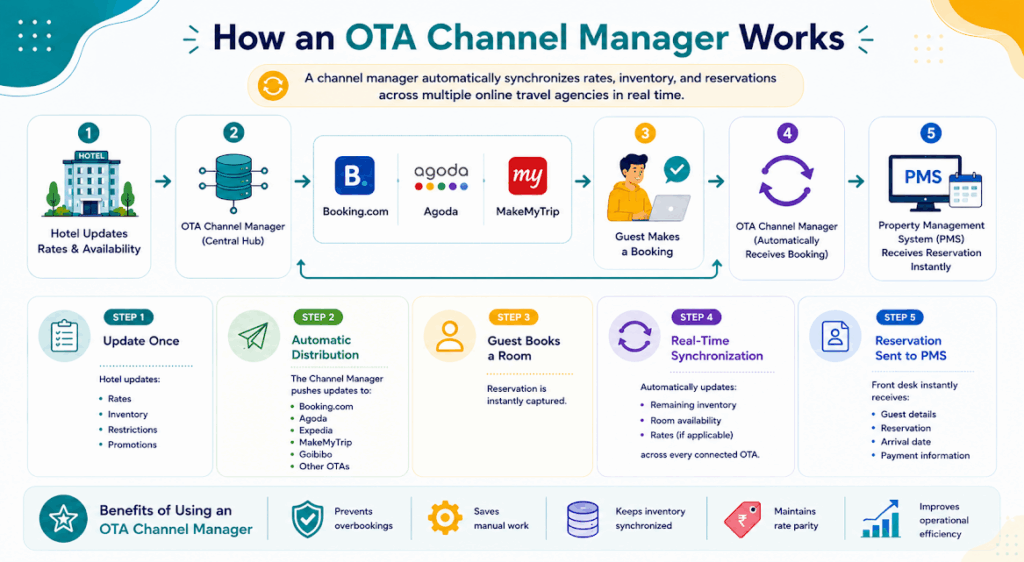
Image: This infographic explains how an OTA channel manager automatically synchronizes rates, inventory, and reservations across multiple online travel agencies and the PMS in real time, helping hotels prevent overbookings and improve operations.
How OTA Channel Manager APIs Enable Real-Time Hotel Distribution
Real-time synchronization is possible because most modern channel managers use Application Programming Interfaces (APIs) to exchange information between hotels and online travel agencies.
Unlike manual updates or older XML-based integrations that require scheduled data transfers, APIs enable two-way communication between connected systems. Whenever a hotel updates room availability or pricing, or a guest completes a reservation, the information is exchanged almost instantly across every integrated platform.
The benefits of API-based OTA connectivity include:
- Real-time inventory updates: Prevents rooms from being oversold across multiple OTAs.
- Two-way synchronization: Automatically updates reservations, cancellations, rates, and availability between the PMS, channel manager, and OTAs.
- Improved operational efficiency: Eliminates repetitive manual updates and reduces the risk of human error.
- Faster distribution: New rates, restrictions, and promotions are published across connected channels within seconds.
- Greater scalability: Hotels can connect with multiple OTAs without increasing operational complexity.
As hotels expand their online distribution, API connectivity has become the foundation of modern OTA management, enabling faster updates, better inventory control, and a more reliable booking experience. Hotels should also evaluate whether their OTA management platform offers extensive integrations with OTA, PMS, GDS, and payment gateways to build a connected technology ecosystem.
Why OTA Ranking System Matters
An OTA ranking system is the search algorithm used by online travel agencies such as Booking.com, Agoda, Expedia, and MakeMyTrip to determine the order in which hotels appear in search results. It evaluates a combination of pricing, availability, guest experience, booking performance, and listing quality to identify the most relevant and reliable properties for travelers.
For hotels, appearing on an OTA is only the first step; where your property ranks often determines how many bookings you receive. Higher-ranked hotels enjoy greater visibility, attract more clicks, and typically generate more reservations than properties that appear further down the search results.
While every OTA uses its own ranking algorithm, several factors consistently influence a hotel’s visibility:
- Competitive pricing: Hotels offering attractive, competitive, and consistent room rates are more likely to rank higher in search results.
- Guest reviews and ratings: Positive reviews and high review scores build trust with travelers while signaling quality to OTA algorithms.
- Low cancellation rates: Consistently honoring bookings demonstrates reliability and improves your property’s performance metrics.
- Fast response times: Prompt responses to guest inquiries and reviews show that your hotel is actively managed.
- Accurate availability: Real-time inventory updates reduce booking errors and overbookings, improving both guest experience and OTA trust.
- High-quality property content: Complete descriptions, professional images, updated amenities, and accurate policies encourage more bookings and higher engagement.
- Strong booking conversion: Hotels that consistently convert listing views into confirmed bookings are often rewarded with greater visibility.
Effective OTA management supports many of these ranking factors by keeping property information accurate, maintaining rate parity, synchronizing availability in real time, and enabling faster responses to changing market conditions. As a result, hotels can improve their OTA rankings, increase visibility, and drive more bookings across multiple distribution channels.
How OTA Management Supports Hotel Operations
Managing multiple OTAs isn’t just about increasing online bookings; it also plays a critical role in simplifying day-to-day hotel operations. Every reservation received through an OTA affects room availability, front desk workflows, guest communication, and payment processing.
Without an efficient OTA management strategy, hotel teams often spend hours manually updating bookings, increasing the risk of errors and overbookings.
An effective OTA management system supports hotel operations by:
- Synchronizing reservations: Automatically updates bookings across OTAs and the Property Management System (PMS), reducing manual data entry.
- Keeping inventory accurate: Ensures room availability is updated in real time to prevent double bookings.
- Supporting front desk teams: Provides staff with instant access to confirmed reservations and guest information.
- Simplifying payment management: Helps streamline booking records and payment reconciliation across multiple sales channels.
- Improving guest communication: Keeps reservation details consistent, reducing booking errors and enabling smoother guest experiences.
- Reducing manual work: Automates repetitive distribution tasks, allowing hotel teams to focus more on operations and guest service.
As hotels continue to expand their online distribution, integrating OTA management with the right hotel technology becomes essential for maintaining operational efficiency at scale.
Real-World Example: How Rainwood Hotel Simplified OTA Management
Rainwood Hotels partnered with AxisRooms in 2018 to implement the AxisRooms Channel Manager, integrating it with its Property Management System (PMS) to centralize OTA management and automate real-time rate, inventory, and reservation updates across multiple booking platforms.
The results demonstrated the impact of efficient OTA management. Rainwood Hotel recorded a 50% increase in OTA sales and a 55% increase in overall OTA room revenue, while also eliminating overbookings and improving inventory accuracy across its connected distribution channels.
Essential Features of OTA Hotel Management Software
Not all OTA hotel management software offers the same capabilities. While some solutions focus only on updating inventory across booking channels, more comprehensive platforms combine distribution, hotel operations, and revenue optimization into a single ecosystem.
When evaluating OTA hotel management software, look for features such as:
| Feature | Why It Matters |
| Real-Time Synchronization | Instantly updates rates, inventory, and reservations across all connected OTAs to prevent overbookings. |
| Multi-OTA Integrations | Connects with leading OTAs like Booking.com, Agoda, Goibibo, Cleartrip, and Ixigo from one dashboard. |
| Built-in Channel Manager | Automates online distribution while eliminating repetitive manual updates. |
| PMS Integrations | Keeps reservations, guest details, and room availability synchronized with your Property Management System. |
| Revenue Management Capabilities | Supports dynamic pricing, demand forecasting, and occupancy optimization to maximize revenue. |
| Web Booking Engine | Enables guests to book directly through your website, reducing OTA commission costs. |
| Payment Gateway Integration | Simplifies secure online payments and streamlines payment reconciliation. |
| Reporting and Analytics | Tracks booking performance, occupancy, revenue, and channel-wise performance with actionable insights. |
| Mobile Accessibility | Allows hotel teams to manage inventory and reservations from anywhere. |
| API Integrations | Connects effortlessly with third-party hotel technologies for real-time data exchange and automation. |
Choosing software with these capabilities enables hotels to manage distribution more efficiently while creating a connected technology ecosystem that supports long-term growth.
How OTA Management Improves Hotel Revenue
Effective OTA management is about more than keeping room availability updated; it also plays a key role in improving hotel revenue. By maintaining accurate rates, distributing inventory efficiently, and responding quickly to changes in demand, hotels can maximize occupancy while protecting profitability across every booking channel.
Some of the biggest ways OTA management supports hotel revenue include:
- Dynamic pricing: Update room rates across all connected OTAs in real time based on demand, seasonality, competitor pricing, and occupancy trends.
- Occupancy optimization: Distribute inventory efficiently to reduce unsold rooms and maximize bookings throughout the year.
- Rate parity: Maintain consistent pricing across OTAs to build guest trust, avoid pricing conflicts, and comply with OTA agreements.
- Improved ADR (Average Daily Rate): Adjust pricing strategically to increase the average revenue earned from each occupied room.
- Higher RevPAR (Revenue per Available Room): Combine optimized occupancy and pricing to maximize revenue generated from available inventory.
- Demand forecasting: Use booking trends and market data to anticipate demand and make proactive pricing and inventory decisions.
- Smarter distribution strategy: Allocate inventory across the right booking channels to balance OTA bookings with direct reservations and improve overall profitability.
When combined with the right channel manager and revenue management strategy, effective OTA management enables hotels to increase revenue while maintaining operational efficiency and better control over their online distribution.
KPIs to Measure OTA Management Success
Monitoring the right performance metrics helps hotels evaluate whether their OTA management strategy is delivering the desired business outcomes. While every property tracks different goals, the following KPIs provide a strong starting point for measuring distribution performance and revenue growth.
| KPI | Why It Matters |
| Occupancy Rate | Measures how effectively available rooms are being sold over a given period. |
| ADR (Average Daily Rate) | Tracks the average revenue earned from each occupied room. |
| RevPAR (Revenue per Available Room) | Evaluates overall revenue performance by combining occupancy and room rates. |
| OTA Conversion Rate | Measures how effectively OTA listings convert visitors into confirmed bookings. |
| Booking Source Mix | Shows the balance between OTA bookings and direct bookings, helping reduce overdependence on a single channel. |
| Cancellation Rate | Identifies booking quality and highlights trends that may affect occupancy and revenue. |
| Direct Booking Ratio | Measures the percentage of commission-free direct bookings compared to OTA bookings. |
| OTA Ranking | Indicates your property’s visibility and competitiveness across online travel agencies. |
Regularly monitoring these KPIs allows hotels to identify opportunities for improvement, refine their distribution strategy, and make more informed revenue management decisions.
Common OTA Management Mistakes Hotels Make
Even with the right technology, poor OTA management practices can lead to missed bookings, lower visibility, and revenue loss. Avoiding these common mistakes can help hotels improve distribution efficiency and maximize their OTA performance.
1. Updating OTAs Manually
Many hotels still log in to individual OTA extranets to update room rates and availability. While this may be manageable with one or two booking platforms, it becomes increasingly difficult as distribution expands. Delayed updates can result in overbookings, inaccurate inventory, and unnecessary administrative work.
Best practice: Use a channel manager to automatically synchronize rates, inventory, and reservations across every connected OTA in real time.
2. Failing to Maintain Rate Parity
Displaying different room rates across OTAs can confuse potential guests and reduce trust in your pricing. It may also impact your relationship with OTA partners and encourage guests to book through whichever platform offers the lowest rate, rather than your preferred distribution channel.
Best practice: Maintain consistent pricing across OTAs while using dynamic pricing strategies to adjust rates based on demand and occupancy.
3. Neglecting OTA Listings
An incomplete hotel profile, outdated photos, missing amenities, or inaccurate room descriptions can reduce your property’s visibility and booking conversion rate. Since travelers often compare multiple listings before making a decision, outdated content can place your hotel at a disadvantage.
Best practice: Regularly update property descriptions, images, amenities, policies, and room details to keep your listings accurate, engaging, and competitive.
4. Ignoring Guest Reviews
Guest reviews significantly influence booking decisions and OTA rankings. Hotels that fail to monitor feedback or respond to reviews may appear less trustworthy, affecting both their online reputation and future bookings.
Best practice: Respond to guest reviews promptly, address concerns professionally, and use feedback to continuously improve the guest experience.
5. Using Static Pricing Throughout the Year
Applying the same room rates regardless of seasonality, local events, or market demand often results in missed revenue opportunities. Hotels may either underprice rooms during peak demand or struggle to attract bookings during quieter periods.
Best practice: Adopt a revenue management strategy that adjusts pricing dynamically based on occupancy, booking pace, competitor rates, and market demand.
6. Relying on Too Few Distribution Channels
Depending heavily on one or two OTAs limits your hotel’s market reach and increases business risk if booking patterns change. It can also reduce your ability to attract different traveler segments across domestic and international markets.
Best practice: Diversify your distribution strategy by connecting with multiple OTAs while continuing to strengthen direct bookings through your hotel’s website.
Avoiding these common mistakes helps hotels build a more efficient OTA management strategy, improve their visibility across booking platforms, and create a stronger foundation for sustainable revenue growth.
Best OTA Management Software
Choosing the right OTA management software enhances your hotel’s online distribution, reservations, and revenue handling. While most platforms provide channel management, the best solutions integrate easily with your PMS, booking engine, revenue management tools, payment gateways, and other hotel technologies.
Below are some of the leading OTA management software and channel managers used by hotels worldwide.
1. AxisRooms
AxisRooms is a comprehensive hotel distribution and revenue management platform designed to help hotels manage their OTA presence from a single dashboard. Beyond channel management, it offers a connected ecosystem of hotel technology solutions that streamline operations, automate online distribution, and maximize revenue across multiple booking channels.
Key Features
- Real-time OTA Channel Manager
- 100+ OTA Integrations
- PMS Integrations
- Revenue Management Services
- Web Booking Engine
- Payment Gateway Integrations
- Centralized Reporting & Analytics
Best For: Independent hotels, hotel chains, resorts, and hospitality groups looking for an all-in-one OTA management platform.
2. SiteMinder
SiteMinder is one of the most widely used hotel commerce platforms, helping properties connect with hundreds of online travel agencies while managing inventory, rates, and reservations in real time. Its broad integration network makes it a popular choice for hotels with an international distribution strategy.
Key Features
- Channel Manager
- Global OTA Network
- PMS Integrations
- Booking Engine
- Dynamic Revenue Tools
- Reporting Dashboard
Best For: Mid-sized to large hotels with extensive international OTA distribution.
3. RateGain
RateGain combines channel distribution, rate intelligence, and revenue optimization into a single platform. It focuses on helping hotels improve pricing decisions, manage distribution efficiently, and respond to changing market demand through data-driven insights.
Key Features
- Channel Management
- Rate Intelligence
- Revenue Optimization
- Market Insights
- PMS Integrations
- Analytics Dashboard
Best For: Revenue-focused hotels seeking advanced pricing intelligence and market analytics.
4. Cloudbeds
Cloudbeds is a hospitality management platform that integrates channel management, PMS functionality, booking engine capabilities, and guest management into a unified solution. Its cloud-based architecture makes it particularly attractive for growing hospitality businesses.
Key Features
- Channel Manager
- Property Management System
- Booking Engine
- Guest Management
- Payment Processing
- Reporting & Analytics
Best For: Hotels looking for an all-in-one hospitality management platform.
5. STAAH
STAAH offers cloud-based channel management solutions that help hotels distribute inventory across multiple OTAs while maintaining accurate rates and availability. It also provides booking engine capabilities and reporting tools for independent hotels.
Key Features
- Channel Manager
- Booking Engine
- PMS Integrations
- OTA Connectivity
- Rate Management
- Business Reports
Best For: Independent hotels and boutique properties seeking reliable OTA distribution.
6. HotelRunner
HotelRunner is a cloud-based hospitality platform that enables hotels to manage online distribution, direct bookings, and digital marketing from a centralized dashboard. Its extensive connectivity supports hotels expanding their online presence across multiple booking channels.
Key Features
- Channel Manager
- Booking Engine
- OTA Integrations
- Payment Solutions
- Website Management
- Reporting Tools
Best For: Hotels looking to strengthen both OTA distribution and direct booking capabilities.
7. Little Hotelier
Little Hotelier is designed specifically for small hotels, guesthouses, inns, and bed & breakfasts. It combines channel management, reservation management, and front desk operations into an easy-to-use platform tailored for smaller properties.
Key Features
- Channel Manager
- Front Desk Management
- Booking Engine
- Guest Management
- Payment Processing
- Mobile App
Best For: Small hotels, guesthouses, B&Bs, and independent accommodation providers.
How to Choose the Right OTA Management Software
With numerous OTA management solutions available, choosing the right platform goes beyond comparing features or pricing. The ideal software should align with your hotel’s size, distribution strategy, operational requirements, and long-term growth plans while simplifying day-to-day OTA management.
When evaluating OTA management software, consider the following factors:
- OTA integrations: Ensure the platform connects with the OTAs that are most important for your hotel, including Booking.com, Agoda, Ixigo, Expedia, and other regional or global booking channels.
- PMS compatibility: Choose software that integrates smoothly with your Property Management System to synchronize reservations, guest information, and room availability automatically.
- Real-time synchronization: Look for software that updates rates, inventory, and reservations instantly across all connected OTAs to prevent overbookings and pricing discrepancies.
- Revenue management capabilities: Platforms with dynamic pricing, demand forecasting, and reporting tools can help optimize occupancy and maximize revenue.
- Ease of use: A user-friendly interface reduces the learning curve and enables hotel teams to manage distribution more efficiently.
- Scalability: Select software that can support your hotel’s future growth, whether you’re expanding room inventory, adding properties, or connecting with additional OTAs.
- Customer support: Reliable onboarding, training, and responsive technical support are essential for minimizing downtime and resolving issues quickly.
The right OTA management software should not only automate online distribution but also integrate seamlessly with your hotel’s technology ecosystem, enabling you to manage bookings, operations, and revenue from a single platform.
OTA Management in India: Best Practices for Hotels
Managing OTAs in India requires a slightly different approach than in many global markets. Indian travelers rely heavily on mobile bookings, compare prices across multiple platforms, and often make travel decisions around festivals, long weekends, and seasonal demand. At the same time, hotels need to balance domestic OTAs with international booking platforms to maximize occupancy throughout the year.
Here are some best practices for hotels managing OTAs in India:
- Prioritize key domestic OTAs: Platforms like MakeMyTrip and Goibibo dominate the domestic travel market and should form the foundation of your distribution strategy.
- Leverage global OTAs for inbound demand: Booking.com and Agoda play a significant role in attracting international travelers, particularly for leisure destinations and business hubs.
- Maintain the right OTA mix: Avoid relying on a single booking platform. A balanced mix of domestic and international OTAs reduces dependency and expands market reach.
- Understand GST implications: OTA commissions are subject to GST, making accurate invoicing, reconciliation, and tax compliance an important part of hotel operations.
- Optimize for mobile bookings: Since a large share of hotel bookings in India are made on smartphones, ensure your listings include high-quality images, accurate information, and competitive pricing.
- Adjust pricing for seasonal demand: Revise room rates during festivals, holidays, local events, and peak travel seasons to maximize occupancy and revenue.
- Monitor regional booking trends: Traveler preferences vary across destinations, so regularly review OTA performance and adjust your distribution strategy based on local demand.
Adopting these practices enables hotels to build a stronger OTA strategy while responding more effectively to the unique dynamics of the Indian hospitality market.
Hotel OTA Management Checklist
A successful OTA management strategy requires consistent monitoring rather than one-time setup. Use this checklist to ensure your hotel is following the essential best practices for efficient OTA management.
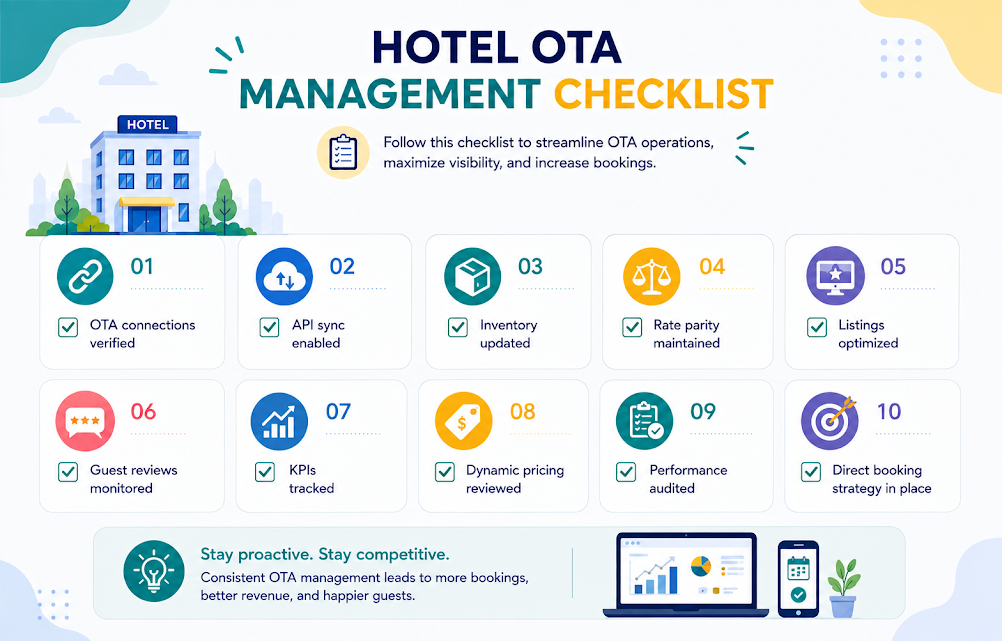
Image: This checklist summarizes the essential best practices for effective OTA management, from maintaining rate parity and inventory synchronization to tracking performance and optimizing distribution across booking channels.
Manage All Your OTAs from One Place
Request a Demo

How AxisRooms Simplifies OTA Management
Managing multiple OTAs manually can quickly become overwhelming as your hotel expands its online distribution. From keeping room availability and rates synchronized to maintaining rate parity and monitoring performance across different booking platforms, manual processes often consume valuable time and increase the risk of operational errors.
AxisRooms brings every aspect of OTA management together through a connected hotel technology ecosystem. Instead of relying on multiple disconnected tools, hotels can manage online distribution, operations, and revenue from a single platform.
Some of the ways AxisRooms simplifies OTA management include:
- 100+ OTA Integrations: Connect with leading domestic and international OTAs through a single centralized platform.
- Channel Manager: Automatically synchronize rates, inventory, and reservations across multiple booking channels in real time.
- PMS Integrations: Ensure reservation details flow efficiently into your Property Management System, reducing manual data entry and operational errors.
- Revenue Management Services: Optimize pricing strategies using market insights, occupancy trends, and demand forecasting.
- Web Booking Engine: Increase commission-free direct bookings through your hotel’s website while maintaining pricing consistency.
- Payment Gateway Integrations: Simplify secure online payments and booking reconciliation across different booking channels.
By combining distribution, hotel operations, and revenue management into one integrated platform, AxisRooms enables hotels to improve operational efficiency, reduce manual work, and maximize revenue while delivering a streamlined booking experience.
Conclusion
As online travel agencies continue to play a larger role in hotel distribution, effective OTA management has become essential for maintaining visibility, enhancing operational performance, and increasing revenue. From managing rates and inventory to optimizing pricing and monitoring performance, every aspect of OTA management contributes to a more efficient and profitable hotel operation.
Investing in the right OTA management strategy and supporting it with integrated technology allows hotels to streamline daily operations, strengthen their online presence, and deliver a better booking experience for guests.
Book a free demo with AxisRooms today to simplify your hotel’s OTA management.