
The rise of online travel booking has created opportunities for entrepreneurs to build travel businesses without relying entirely on physical offices or traditional agent networks. But knowing how to start an online travel agency in India involves more than launching a website. A successful OTA needs a clear target market, a viable business model, reliable travel inventory, booking technology, secure payments, supplier partnerships, and a strategy for attracting and retaining customers.
For new entrepreneurs, the challenge is knowing where to begin and which parts of the business need to be built in-house versus supported by technology partners. A well-planned approach can make it easier to launch, manage bookings efficiently, and scale as demand grows.
In this guide, we’ll explain how to start an online travel agency in India, choose the right business model, build the required technology, estimate costs, and develop a practical growth strategy.
What Is an Online Travel Agency? Meaning, Definition and How It Works
An online travel agency (OTA) is a digital platform that allows travelers to search, compare, and book travel products such as hotels, flights, activities, transfers, and packages online. Unlike a traditional travel agency, an OTA connects travelers with travel suppliers through a digital platform and facilitates bookings through a website or mobile application.
An online travel agency refers to the digital business or platform that facilitates travel bookings, while an online travel agent generally refers to a person who uses online systems to arrange travel for customers.
At its simplest, an OTA acts as an intermediary between the traveler and the travel supplier. It brings together travel inventory, presents available options, facilitates bookings and payments, and supports reservations after booking.
OTAs can focus on different products or audiences, including accommodation, flights, tours and activities, holiday packages, corporate travel, or niche segments such as luxury and pilgrimage travel. They may also operate as B2C platforms serving travelers directly, B2B platforms serving travel businesses, or B2B2C platforms that enable intermediaries to serve end customers.
How Does an Online Travel Agency Business Work?
An online travel agency business works by connecting travelers with travel suppliers through a digital platform that brings together search, inventory, booking, payment, and customer support. While the customer sees a simple search-and-book journey, several processes work behind the scenes to complete and manage each reservation.
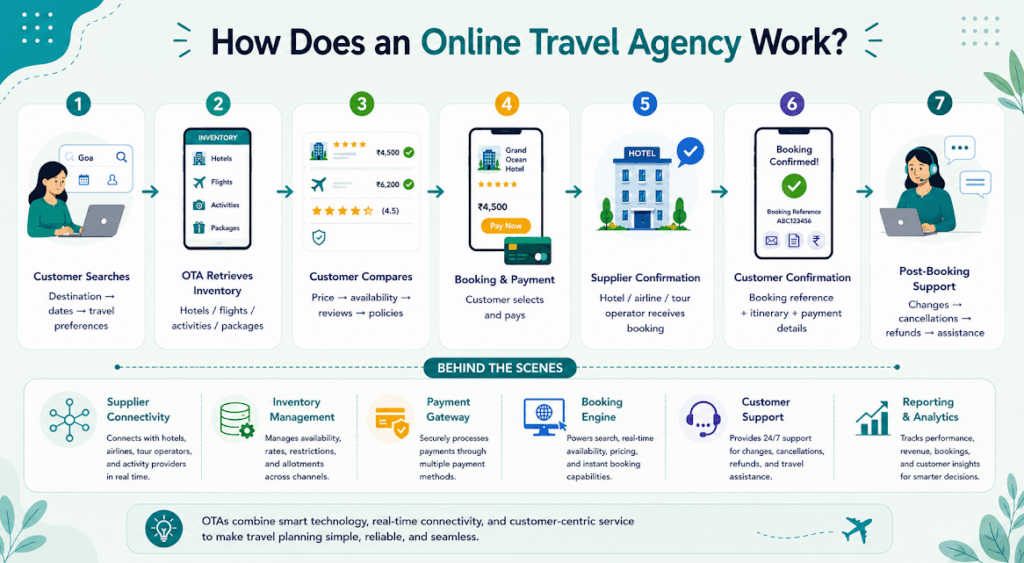
Image: The process typically starts when a customer searches for a travel product such as a hotel, flight, activity, or package. The OTA retrieves relevant inventory and displays available options for the traveler to compare based on price, availability, reviews, and booking conditions. Once the customer completes the booking and payment, the reservation is sent to the relevant supplier, and a confirmation is issued.
The relationship continues after booking. OTAs may handle cancellations, modifications, refunds, customer queries, and other post-booking requirements. Supplier connectivity, inventory management, payment processing, booking technology, and reporting work together behind the scenes to keep the process running smoothly.
This makes an OTA more than a travel website: it acts as the digital link between customer demand and travel supply.
Online Travel Agency Business Model: How Does an OTA Make Money?
An online travel agency business model defines how an OTA generates revenue from travel bookings and services. Common revenue streams include commissions, markups, service fees, advertising, subscriptions, or a combination of these models.
1. Commission Model
The OTA earns a percentage of each booking from the travel supplier. The supplier typically fulfils the reservation, while the OTA focuses on bringing the customer and facilitating the booking.
Best for: New OTAs and supplier-partnered travel platforms.
2. Merchant or Markup Model
The OTA accesses inventory at a net or wholesale rate and sells it to customers at a higher price. The difference between the supplier rate and selling price becomes the OTA’s gross margin, giving the business greater control over pricing.
Best for: OTAs with established supplier relationships and greater control over inventory and pricing.
3. Advertising Model
Travel suppliers pay the OTA for increased visibility through sponsored listings, featured placements, promotions, or other advertising opportunities. This model becomes more valuable as the OTA attracts a large and relevant audience.
Best for: High-traffic OTAs and established travel marketplaces.
4. Service or Convenience Fees
The OTA charges customers an additional fee for facilitating a booking or providing services such as premium support, itinerary assistance, or customised travel planning. These fees can supplement booking-related revenue rather than replace it.
Best for: Niche and specialized travel businesses.
5. Subscription or Membership Model
Customers, suppliers, or business partners pay a recurring fee in exchange for access to exclusive rates, services, inventory, or other benefits. This can create a more predictable revenue stream than relying entirely on individual bookings.
Best for: Niche, membership-based, and B2B travel platforms.
6. Hybrid Model
A hybrid OTA combines multiple revenue streams based on its customers, inventory, and market position. For example, an OTA may earn commissions from hotel bookings while also generating revenue through service fees, advertising, or package markups.
Best for: Growing and established OTAs.
OTA Business Models at a Glance
| Business Model | How It Works | Best For |
| Commission | Earn a percentage of each booking | New OTAs |
| Merchant/Markup | Buy or access inventory at a net rate and sell at a higher price | Established OTAs |
| Advertising | Suppliers pay for visibility | High-traffic OTAs |
| Service Fees | Customers pay an additional fee | Niche travel businesses |
| Subscription | Recurring payment for access or benefits | B2B and membership platforms |
| Hybrid | Combines multiple revenue streams | Growing OTAs |
For a new online travel agency, the commission model can be a relatively straightforward starting point because revenue is linked to successful bookings. As the business grows, additional revenue streams can be introduced based on its customers, suppliers, inventory, and market position.
How to Start an Online Travel Agency in India
To start an online travel agency in India, you need to define your market, choose a viable business model, secure travel inventory, set up the business, and build the technology and processes needed to handle bookings. The exact requirements depend on the products you plan to sell and the customers you want to serve.
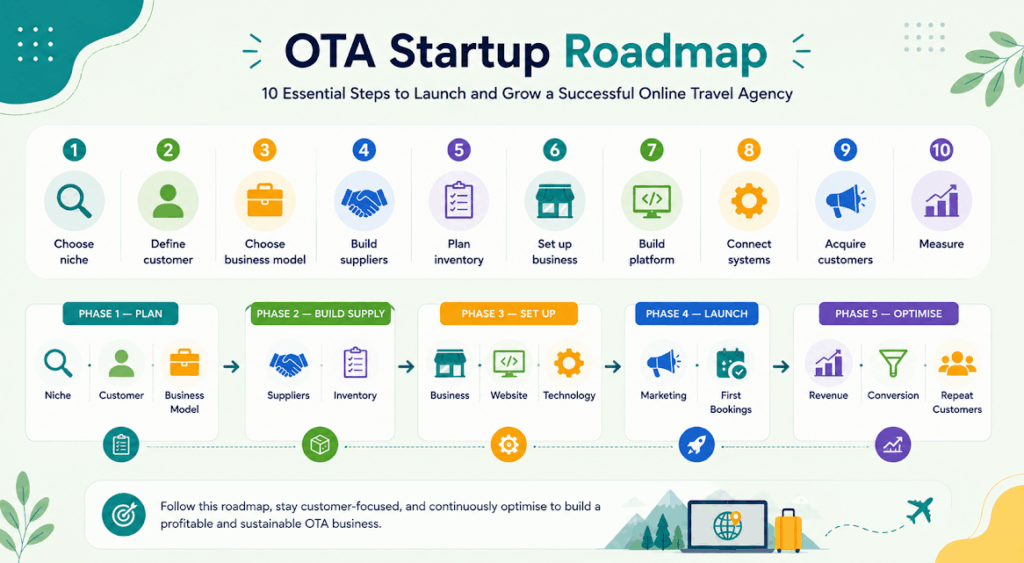
Image: A roadmap outlining 10 key steps to start an online travel agency: choose a niche, define target customers, select a business model, build supplier relationships, plan inventory, set up the business, develop the OTA platform, connect booking and payment systems, acquire customers, and measure performance. The steps are organised into five phases: Plan, Build Supply, Set Up, Launch, and Optimise.
The roadmap above provides an overview of the process. Here’s what each step involves when setting up an online travel agency in India:
1. Choose Your OTA Niche: Focus on a specific travel segment rather than trying to compete across every category. Options include accommodation, flights, holiday packages, tours and activities, pilgrimage, luxury, corporate, honeymoon, adventure, or boutique travel.
2. Define Your Target Customer: Identify who you want to serve and understand their travel preferences, booking behaviour, spending patterns, and key pain points. This will shape your product, pricing, and marketing strategy.
3. Choose Your Business Model: Decide whether you will earn through commissions, markups, service fees, advertising, subscriptions, or a combination of revenue streams.
4. Build Your Supplier Network: Identify the hotels, airlines, tour operators, wholesalers, aggregators, or other suppliers that can provide the inventory your customers need. Evaluate their rates, availability, booking terms, and reliability.
5. Decide How You Will Manage Inventory: Determine whether you will use direct supplier contracts, aggregators, APIs, GDS connections, or a combination. The priority is maintaining accurate availability, pricing, and booking conditions.
6. Set Up the Business: Complete the appropriate business registration, tax, banking, contractual, and other applicable compliance requirements for your OTA.
7. Build Your OTA Platform: Create a website or booking platform where customers can search, compare, book, pay, and manage their reservations.
8. Connect Booking, Inventory, and Payment Systems: Integrate the systems required to retrieve travel inventory, process reservations and payments, send confirmations, and manage bookings.
9. Launch Your Customer Acquisition Strategy: Choose the channels most relevant to your target audience, such as SEO, paid search, content, social media, partnerships, email, affiliates, or referrals. A focused niche can make customer acquisition more manageable for a new OTA.
10. Measure and Optimise: Track bookings, conversion rate, average booking value, customer acquisition cost, cancellations, repeat bookings, revenue, and supplier performance. Use these insights to refine your products, pricing, marketing, and operations.
Starting an OTA is ultimately about aligning customer demand, travel supply, technology, and revenue strategy. Once these foundations are in place, the business can expand based on actual booking and customer data.
What Do You Need to Start an Online Travel Agency?
Starting an online travel agency requires more than a website. You need the right business setup, travel inventory, technology, and operational processes to turn customer searches into completed and supported bookings.
- Business setup: Business registration, PAN, business bank account, GST requirements where applicable, relevant industry registrations or accreditations, and agreements with travel suppliers.
- Travel inventory: Reliable access to hotels, flights, activities, packages, or other travel products through direct supplier contracts, aggregators, APIs, GDSs, or a combination of these.
- Technology: An OTA website, booking engine, travel inventory connectivity, payment gateway, inventory management, customer support tools, and analytics.
- Operations: Booking management, supplier coordination, customer service, cancellation and refund handling, financial reconciliation, and processes for resolving booking issues.
- Marketing and customer acquisition: A plan for SEO, paid advertising, content, partnerships, social media, email, or other channels relevant to your target audience.
The exact requirements will depend on the type and scale of OTA you plan to build. A niche accommodation platform, for example, may need a very different setup from a B2B travel marketplace offering flights, hotels, and holiday packages.
How to Create an Online Travel Agency Business Plan
An online travel agency business plan explains how you will build, operate, finance, and grow the business. While the business model defines how the OTA makes money, the business plan brings together the market, customers, products, suppliers, technology, operations, finances, and growth strategy.
A practical OTA business plan should cover:
1. Executive summary: A brief overview of the OTA, its target market, value proposition, business model, and growth objectives.
2. Market opportunity: Define the travel market you plan to enter, the customer demand you want to address, and the opportunity for your business.
3. Target audience and niche: Identify your ideal customers and the specific travel segment you intend to serve.
4. Product offering: Outline the hotels, flights, packages, activities, transfers, or other travel products you plan to sell.
5. Competitive analysis: Identify competing OTAs and explain how your business will differentiate itself.
6. Revenue and supplier strategy: Document how the OTA will earn revenue and how you will source and manage travel inventory.
7. Technology and operations: Define the website, booking technology, integrations, payment systems, customer support, and operational processes required to run the OTA.
8. Marketing strategy: Explain how you will attract customers through SEO, paid advertising, content, partnerships, social media, email, or other relevant channels.
9. Financial plan: Estimate startup costs, recurring expenses, expected revenue, cash-flow requirements, and the assumptions behind your projections.
10. KPIs and growth strategy: Define the metrics you will track and how you plan to expand the customer base, inventory, revenue, or market reach over time.
A business plan does not need to predict every detail of the business. Its purpose is to turn the OTA concept into a practical operating and financial plan that can guide decisions as the business develops.
How Much Does It Cost to Start an Online Travel Agency in India?
The cost of starting an online travel agency in India varies widely. It depends on your business model, technology, inventory, team size, and marketing investment.
A lean OTA using third-party inventory and ready-made technology may require less upfront investment than a custom platform with multiple integrations, direct supplier relationships, and a larger team.
| Cost Area | What It Includes |
| Business setup | Registration, accounting, tax, and applicable compliance costs |
| Website and branding | Domain, hosting, design, development, and brand assets |
| Booking technology | Booking engine, OTA software, and platform-related costs |
| Inventory connectivity | Travel APIs, GDS connections, aggregators, or supplier integrations |
| Payment infrastructure | Payment gateway setup and transaction charges |
| Marketing | SEO, paid advertising, content, social media, and partnerships |
| People and support | Customer service, sales, technology, and operational staff |
| Operations | CRM, accounting, communication, support, and other business tools |
| Working capital | Funds for supplier payments, refunds, and ongoing operating expenses |
Rather than working from a generic startup figure, estimate costs based on the type of OTA you plan to build. Separate one-time setup costs from recurring technology, staffing, marketing, and operating expenses.
The biggest differences usually come from the level of technology and inventory infrastructure required. Using existing platforms and third-party inventory can reduce initial investment, while custom development, multiple integrations, direct supplier contracts, and a larger team can increase it significantly.
For a new OTA, the goal should be to build enough infrastructure to deliver a reliable booking experience and validate demand before making larger technology or operational investments.
What Technology Does an Online Travel Agency Need?
An online travel agency needs a connected technology stack to manage travel inventory, bookings, payments, distribution, customer relationships, and operational data. The exact setup depends on the OTA’s products, supplier network, business model, and scale.
A typical OTA technology ecosystem looks like:
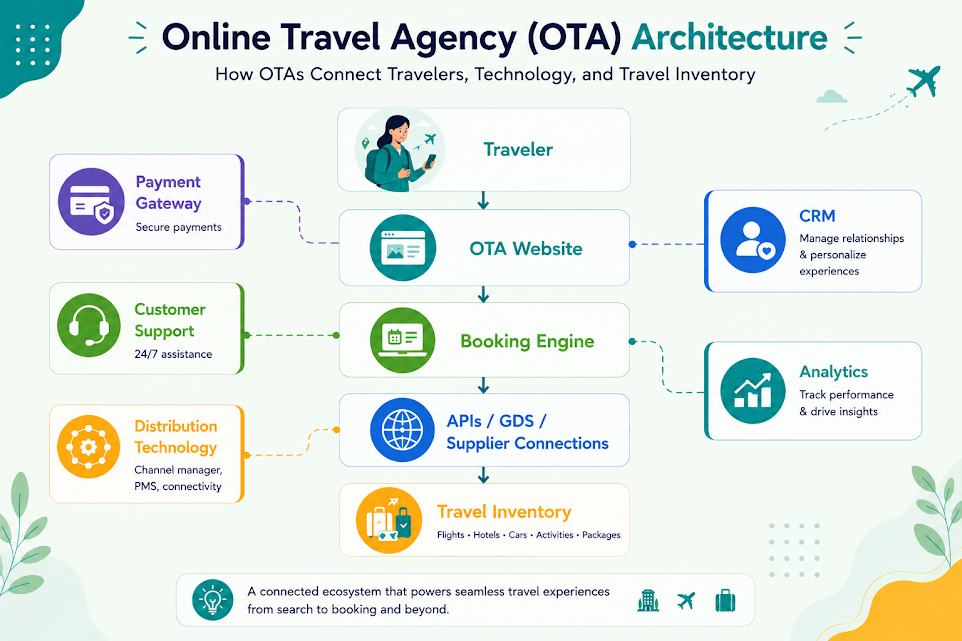
Image: The diagram above shows how the different technology layers of an OTA work together. The core booking flow connects the traveler and OTA website to the booking engine, supplier connections, and travel inventory, while supporting systems such as payments, CRM, analytics, customer support, and distribution technology help manage the wider booking and operational experience.
Here is what each component does:
- Booking engine: Handles search, availability, pricing, booking, and confirmation on the customer-facing platform.
- Travel APIs: Connect the OTA with external travel inventory and enable data such as availability, rates, and booking information to flow between systems.
- GDS: Provides access to travel inventory, particularly for businesses selling air travel and other GDS-supported products.
- Supplier connectivity: Connects the OTA directly with hotels, airlines, tour operators, aggregators, wholesalers, or other inventory providers.
- PMS/CRS connectivity: Relevant where the OTA needs to exchange reservation and inventory information directly with accommodation providers or their property systems.
- Payment gateway: Processes customer payments securely and supports the financial side of reservations.
- CRM and customer support: Helps manage customer information, enquiries, booking communication, and post-booking service.
- Analytics: Tracks searches, bookings, conversion, revenue, customer behaviour, and channel performance.
- Distribution technology: Helps manage inventory, rates, and availability across connected booking channels.
The important point is that these systems should work together rather than operate as isolated tools. As booking volume increases, connected technology can reduce manual updates, improve inventory accuracy, and simplify distribution and customer service.
How Can Hotels Increase Revenue Through Online Travel Agencies?
Online travel agencies can help hotels reach new customer segments, expand distribution, and generate additional booking demand. However, increasing OTA revenue is not simply about listing a property on more channels; hotels also need the right pricing, inventory, content, and channel strategy to turn OTA visibility into profitable bookings.
A growing OTA can focus on:
- List the right OTAs: Choose channels that match the hotel’s location, guest segments, room types, and target markets.
- Keep rates and availability accurate: Ensure inventory is updated across OTAs to reduce booking errors and missed sales opportunities.
- Improve OTA listings: Use strong photography, accurate descriptions, amenities, room details, and compelling content to improve conversion.
- Use pricing strategically: Adjust rates based on demand, seasonality, market conditions, and occupancy rather than relying on one static rate.
- Increase booking value: Promote room upgrades, packages, and relevant add-ons where appropriate.
- Manage reviews and guest experience: Strong ratings and recent reviews can influence booking decisions and visibility.
- Reduce distribution complexity: Use connected technology to manage multiple OTA channels without relying on manual updates.
- Track channel performance: Compare bookings, revenue, ADR, cancellations, and other relevant metrics across channels.
The goal is not simply to receive more OTA bookings. Hotels need to generate profitable bookings while maintaining rate control, inventory accuracy, and a healthy balance between third-party and direct distribution.
How AxisRooms Can Help Scale a Hotel Business Using an Online Travel Agency
For hotels looking to grow through online travel agencies, scaling is not simply about adding more distribution channels. Hotels also need accurate inventory, reliable connectivity, efficient booking processes, secure payments, and better visibility into rates and revenue. Managing these functions separately can become increasingly difficult as the number of channels and bookings grows.
AxisRooms provides a connected hospitality technology ecosystem that can support hotels across distribution, bookings, payments, property connectivity, and revenue management. Relevant capabilities include:
- 100+ OTA Integrations: Connect with online distribution channels and synchronise rates, availability, and booking information across connected channels.
- PMS Integrations: Connect property-management and reservation data with the systems involved in the hotel’s booking and operational workflows.
- Payment Gateways: Support secure online payment processing as part of the booking journey.
- Channel Manager: Centralise inventory, rates, and availability across connected distribution channels, reducing the need for manual updates.
- Revenue Management Services: Use demand and market insights to support pricing decisions and identify opportunities to improve revenue.
- Web Booking Engine: Enable direct bookings through the hotel’s website with real-time availability and a streamlined booking experience.
The value comes from connecting these functions rather than managing them separately. AxisRooms therefore acts as a technology enabler for hotels looking to strengthen their online distribution and scale their business through connected hospitality systems.
Conclusion
Starting an online travel agency in India requires more than launching a booking website. A viable OTA needs a focused market, reliable travel inventory, a sustainable revenue model, the right technology, and a practical approach to customer acquisition and operations.
The best approach is to start with a clear niche, validate demand, and build the technology and supplier network around actual customer needs. As bookings grow, you can expand inventory, marketing, integrations, and revenue opportunities without taking on unnecessary complexity from the beginning.
With the right strategy and connected technology, an online travel agency can build a scalable digital travel business while creating a smoother booking experience for customers.
Ready to build a more connected travel business? Book a free demo with AxisRooms today.