
Every hotel has a fixed number of rooms to sell each night, but not every room generates the same revenue. Selling too many rooms early at discounted rates can leave money on the table, while waiting for higher-paying guests can result in empty rooms if demand doesn’t materialize. This is where yield management in the hotel industry becomes a critical revenue strategy. By combining demand forecasting, dynamic pricing, and inventory control, hotels can maximize revenue from every available room without simply chasing higher occupancy.
From independent hotels and resorts to global hotel chains, yield management has become an essential part of modern hotel operations. When applied effectively, it enables hotels to respond to changing demand, optimize pricing decisions, and improve profitability throughout the year.
In this guide, we’ll explain what yield management is, how it differs from revenue management, how to calculate it, and the strategies and best software hotels can use to maximize revenue.
What Is Yield Management in the Hotel Industry?
Yield management in the hotel industry is the practice of maximizing revenue from a hotel’s fixed room inventory by selling the right room to the right guest, at the right price, at the right time, and through the right booking channel.
Unlike many other products, hotel rooms are perishable. If a room remains unsold for a night, the opportunity to generate revenue from that room is lost forever. Yield management helps hotels respond to changing demand by adjusting room rates and inventory availability to maximize revenue from their available inventory.
The concept was first introduced by American Airlines in the airline industry, where companies used demand-based pricing to maximize revenue from a fixed number of seats. Hotels soon adopted the approach because they faced a similar challenge: a limited inventory that loses all value once the day ends.
For example, a hotel may charge higher room rates during a major conference or holiday weekend when demand is strong, while offering promotional rates during quieter periods to attract more bookings and reduce unsold inventory.
What Is the Importance of Yield Management in Hotels?
When implemented effectively, yield management enables hotels to maximize revenue and profitability without increasing the number of rooms they sell.
Instead of relying solely on high occupancy, hotels use yield management to balance pricing with demand, ensuring rooms are neither underpriced during peak periods nor left vacant during slower seasons. Even small improvements in pricing decisions can have a significant impact on overall revenue.
Effective yield management helps hotels:
- Maximize revenue from every available room.
- Reduce revenue loss caused by underpricing during high-demand periods.
- Improve occupancy during low-demand periods through smarter pricing.
- Support better demand forecasting and inventory planning.
- Build a stronger foundation for long-term revenue growth.
Consider two hotels with the same number of rooms and similar occupancy levels. The hotel that adjusts its prices based on demand, booking pace, and seasonality is likely to generate higher revenue than the one that charges a fixed rate throughout the year. This is why yield management has become a fundamental practice for hotels looking to improve financial performance.
What Are the Key Concepts of Yield Management in the Hotel Industry?
Yield management is built on a few core principles that help hotels make smarter pricing and inventory decisions. Understanding these concepts makes it easier to see how hotels maximize revenue from a limited number of rooms, especially when demand changes throughout the year.
1. Perishable Inventory
A hotel room is a perishable asset because it can only be sold for one specific night. If a room remains vacant, the revenue opportunity disappears permanently.
This is why hotels constantly adjust rates and availability to reduce unsold inventory and capture as much revenue as possible.
2. Fixed Capacity
Hotels operate with a fixed number of rooms that cannot be expanded during periods of high demand. Whether a property has 50 rooms or 500, inventory remains limited until new rooms are built.
Because supply is fixed, increasing revenue depends on selling existing rooms more effectively rather than selling more rooms.
3. Demand Forecasting
Demand forecasting is the process of estimating future booking demand using historical data, seasonality, local events, booking pace, and market trends.
Accurate forecasts help hotels anticipate busy and slow periods, allowing them to make informed pricing and inventory decisions before demand changes.
4. Market Segmentation
Not every guest books for the same reason or is willing to pay the same rate. Business travelers, leisure guests, families, groups, and corporate clients all have different booking behaviors and price expectations.
Segmenting guests allows hotels to create pricing strategies that better match customer demand instead of offering the same rate to everyone.
5. Price Elasticity
Price elasticity refers to how sensitive guests are to changes in room rates.
During peak travel periods, travelers may continue booking even as prices increase. During low-demand periods, however, even a small reduction in room rates can encourage more bookings. Understanding this relationship helps hotels adjust prices without unnecessarily sacrificing revenue.
6. Length of Stay (LOS) Controls
Length of Stay (LOS) controls are booking restrictions that encourage guests to reserve rooms for a minimum number of nights or meet specific stay requirements.
Hotels often use these controls during periods of high demand to optimize room availability and maximize overall revenue.
Why these concepts matter
Each of these concepts supports a different aspect of yield management. Perishable inventory and fixed capacity explain why yield management exists, while forecasting, segmentation, price elasticity, and LOS controls influence how hotels make pricing and inventory decisions.
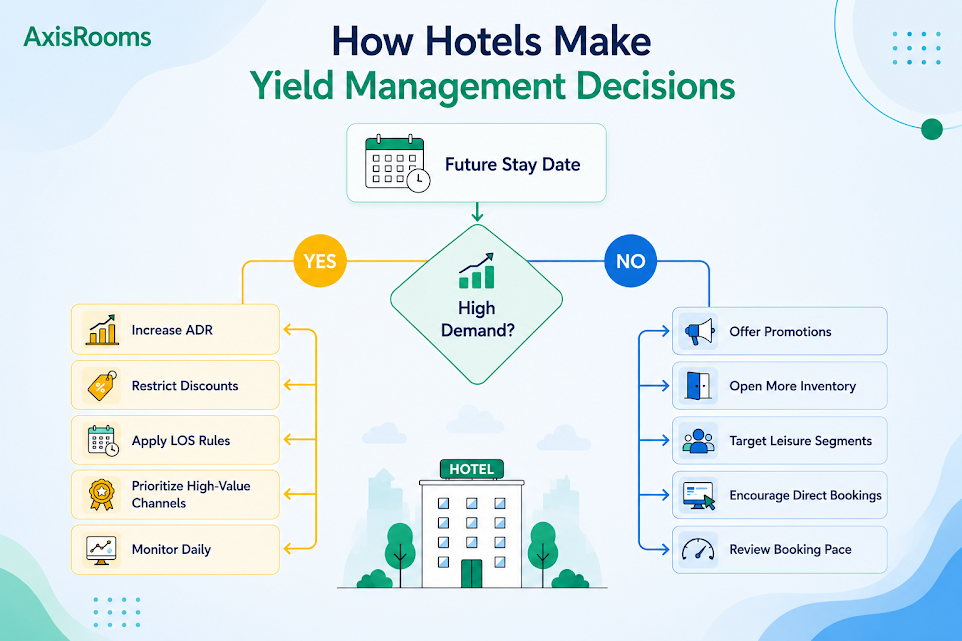
Figure: Yield management decisions begin with demand forecasting. When demand is expected to be high, hotels focus on maximizing revenue through pricing and inventory controls. During lower-demand periods, the priority shifts to stimulating bookings with targeted offers, channel optimization, and promotional strategies.
Yield Management vs Revenue Management: What’s the Difference?
Yield management and revenue management are closely related, but they are not the same. Yield management focuses on maximizing revenue from a hotel’s room inventory through pricing and inventory controls, while revenue management takes a broader approach by optimizing revenue across the entire business.
| Factor | Yield Management | Revenue Management |
| Primary Focus | Maximizing room revenue | Maximizing total hotel revenue |
| Scope | Rooms only | Rooms, F&B, spa, events, and ancillary revenue |
| Main Objective | Sell each room at the best possible price | Optimize overall profitability |
| Key Activities | Pricing, inventory control, LOS restrictions | Demand forecasting, pricing, distribution, channel mix, and ancillary revenue |
| Typical Users | Revenue managers | Revenue managers, commercial teams, and hotel management |
In simple terms, yield management focuses on selling rooms at the best possible price, while revenue management focuses on maximizing the hotel’s overall revenue. Most hotels use yield management as one component of a broader revenue management strategy.
How to Calculate Yield Management in a Hotel?
Yield management in a hotel is commonly measured by Yield Percentage, which compares the revenue a hotel actually earns to the maximum revenue it could have earned if every available room were sold at its highest achievable rate.
Yield Management Formula in Hotel
Yield (%) = (Actual Revenue ÷ Potential Revenue) × 100
Where:
- Actual Revenue = Total room revenue earned during a specific period.
- Potential Revenue = Maximum possible room revenue if every available room had been sold at the highest available rate.
A higher yield percentage indicates that a hotel is capturing a greater share of its revenue potential.
Example: Calculating Hotel Yield
Consider a hotel with:
- 100 available rooms
- Highest room rate: ₹10,000
- Actual room revenue earned: ₹7,20,000
Step 1: Calculate Potential Revenue
100 × ₹10,000 = ₹10,00,000
Step 2: Apply the Formula
Yield (%) = (₹7,20,000 ÷ ₹10,00,000) × 100
Yield = 72%
This means the hotel captured 72% of its maximum possible room revenue during that period. Revenue managers can use this figure alongside other hotel KPIs to evaluate pricing effectiveness and identify opportunities to increase revenue.
What Are the Benefits of Yield Management?
Yield management allows hotels to earn more from the same room inventory through smarter pricing and inventory decisions. Beyond increasing room revenue, it also strengthens profitability, improves demand planning, and makes better use of available capacity.
Some of the key benefits include:
- Maximizes room revenue: By adjusting room rates based on demand, hotels can earn more from the same inventory without adding new rooms.
- Improves occupancy during low-demand periods: Strategic pricing encourages bookings when demand slows, helping reduce unsold room nights.
- Increases profitability: Selling rooms at the right price and through the right channels improves revenue while protecting margins.
- Supports better demand forecasting: Analyzing booking trends and market conditions enables hotels to anticipate demand and make proactive pricing decisions.
- Optimizes inventory allocation: Hotels can decide which rooms to sell, when to sell them, and through which booking channels to maximize returns.
- Reduces unnecessary discounting: Instead of lowering prices across the board, hotels can adjust rates selectively based on demand, preserving their Average Daily Rate (ADR).
- Improves long-term business performance: Consistent yield management creates a more balanced approach to pricing, occupancy, and revenue, helping hotels remain competitive throughout the year.
While these advantages demonstrate the value of yield management, let’s examine how it operates in various hotel scenarios to observe these benefits in action.
Yield Management Example for a Hotel
The best way to understand yield management is to see how pricing decisions change as demand changes. The examples below show how hotels use the same principles to maximize revenue in different market conditions.
Example 1: Global Hotel Example
Imagine a 200-room hotel in New York during a major international conference.
Three months before the event, the hotel opens bookings with a standard room rate of $220 per night. As reservations come in faster than expected, occupancy reaches 80% well before the event begins. Based on this strong booking pace, the revenue manager gradually increases the room rate to $300, then $360, while limiting discounts and closing lower-priced promotional offers.
By the week of the conference, the remaining rooms are sold at premium rates because demand is significantly higher than supply.
| Stage | Occupancy | Room Rate | Revenue Strategy |
| Initial release | 20% | $220 | Attract early bookings |
| Demand increases | 80% | $300 | Raise rates as inventory becomes limited |
| Conference week | 98% | $360 | Maximize revenue from remaining rooms |
By increasing rates as demand strengthens, the hotel earns significantly more revenue than it would have if every room had remained priced at $220 throughout the booking window.
Example 2: Indian Hotel Example
Now consider a 120-room resort in Goa during the Christmas and New Year holiday season.
Six months before the holidays, the resort offers early-bird rates of ₹8,000 per night to encourage advance bookings. As occupancy rises and holiday demand strengthens, room rates increase to ₹12,000 and finally to ₹16,000 for the last few available rooms. At the same time, the hotel introduces a three-night minimum length of stay to reduce one-night bookings and maximize revenue during the peak period.
| Stage | Occupancy | Room Rate | Revenue Strategy |
| Early bookings | 30% | ₹8,000 | Encourage advance reservations |
| Holiday demand builds | 75% | ₹12,000 | Increase rates with rising demand |
| Peak festive period | 95%+ | ₹16,000 | Premium pricing with minimum stay restrictions |
By raising room rates and requiring a minimum three-night stay during the holiday period, the resort generates substantially more revenue than it would have by accepting shorter bookings at lower prices.
8 Hotel Yield Management Strategies That Increase Revenue
Effective yield management strategies maximize revenue by aligning room pricing and inventory with changing demand. Rather than relying on a single pricing technique, successful hotels combine multiple strategies to respond to booking patterns, seasonality, guest behavior, and market conditions.
The following strategies form the foundation of an effective hotel yield management plan.
1. Use Dynamic Pricing
Dynamic pricing adjusts room rates based on demand, booking pace, seasonality, competitor pricing, and local events. Instead of maintaining fixed prices, hotels increase rates when demand is high and offer more competitive pricing during slower periods to maximize revenue without sacrificing occupancy.
2. Forecast Demand Accurately
Demand forecasting uses historical booking data, seasonal trends, local events, and booking pace to predict future demand. Accurate forecasts enable hotels to adjust pricing and inventory before demand changes, reducing unnecessary discounts and improving revenue opportunities.
3. Segment Guests and Price Accordingly
Different guest segments have different booking behaviors and willingness to pay. By offering tailored pricing and packages for corporate travelers, families, leisure guests, and groups, hotels can attract the right customers while maximizing revenue from each segment.
4. Apply Length of Stay (LOS) Controls
Length of Stay (LOS) controls set minimum or maximum stay requirements during specific periods. This strategy is commonly used during holidays, festivals, and major events to encourage longer bookings, reduce room turnover, and increase revenue from limited inventory.
5. Optimize Distribution Across Booking Channels
Not every booking channel generates the same level of profitability. Hotels maximize revenue by balancing inventory across direct bookings, OTAs, and corporate channels while maintaining the right mix of occupancy, visibility, and distribution costs.
6. Use Controlled Overbooking
Because some guests cancel or fail to arrive, hotels may accept a limited number of bookings beyond available inventory. When supported by historical no-show data, controlled overbooking helps reduce revenue losses from empty rooms while minimizing guest disruption.
7. Adjust Pricing Based on Occupancy
Occupancy-based pricing adjusts room rates according to the number of rooms already sold. Hotels often use competitive pricing to stimulate demand at lower occupancy levels and gradually increase rates as availability becomes limited.
8. Create Value-Added Packages Instead of Heavy Discounts
Instead of relying on discounts, hotels can increase perceived value by bundling rooms with benefits such as breakfast, airport transfers, spa treatments, dining credits, or local experiences. This approach protects room rates while making offers more attractive to guests.
Which Yield Management Strategy Works Best for Different Hotel Types?
No single yield management strategy works for every hotel. The best approach depends on your property’s guest mix, booking patterns, and demand fluctuations.
| Hotel Type | Strategy to Prioritize | Why It Works |
| Business Hotel | Dynamic Pricing | Corporate demand fluctuates throughout the week, making flexible pricing essential. |
| Resort | Length of Stay (LOS) Controls | Encourages longer bookings during holidays and peak travel seasons. |
| Budget Hotel | Occupancy-Based Pricing | Competitive pricing helps maintain occupancy while protecting revenue. |
| Luxury Hotel | Value-Added Packages | Premium guests often respond better to exclusive experiences than discounts. |
Most successful hotels combine several of these strategies rather than relying on just one. The next step is knowing how to implement them effectively across pricing, inventory, and distribution processes.
How to Implement Yield Management in Hotels
Implementing yield management involves combining pricing, inventory management, demand forecasting, and continuous performance reviews into a structured process. Rather than making occasional pricing changes, successful hotels follow a repeatable approach that adapts to changing market conditions throughout the year.
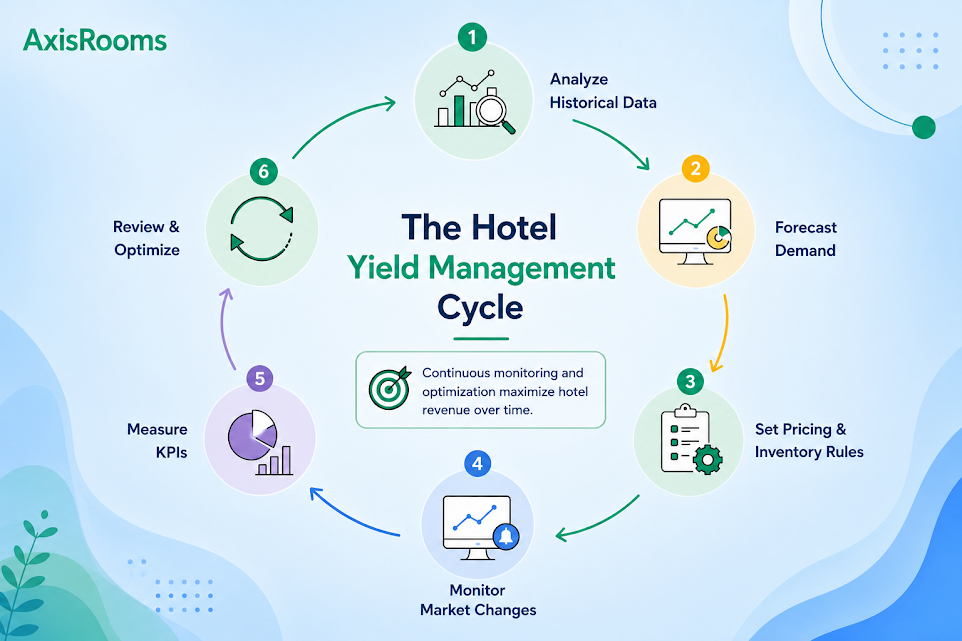
Image: Hotel yield management is a continuous process where hotels analyze booking data, forecast demand, adjust pricing and inventory, monitor market changes, and refine strategies to maximize revenue over time.
Step 1. Analyze Historical Booking Data
Start by reviewing historical occupancy, room rates, booking pace, cancellations, seasonality, and guest segments. Understanding past demand patterns provides the foundation for making informed pricing and inventory decisions.
Step 2. Forecast Future Demand
Use historical trends alongside local events, holidays, competitor activity, and market conditions to estimate future demand. Reliable forecasts identify when rates should increase, promotions may be needed, or inventory restrictions should be applied.
Step 3. Define Pricing and Inventory Rules
Based on expected demand, establish clear pricing strategies, room availability rules, distribution priorities, and Length of Stay (LOS) restrictions. Having predefined guidelines ensures pricing decisions remain consistent rather than reactive.
Step 4. Monitor Market Conditions Continuously
Yield management is an ongoing process, not a one-time exercise. Regularly monitor competitor pricing, booking pace, cancellations, and reservation trends so rates and inventory can be adjusted as market conditions evolve.
Step 5. Review Results and Refine Your Strategy
Evaluate whether your pricing and inventory decisions delivered the expected outcomes. Regular reviews reveal which strategies worked, where revenue opportunities were missed, and what should be refined.
Step 6. Support the Process with the Right Technology
As bookings increase across multiple channels, managing pricing and inventory manually becomes increasingly difficult. Integrated revenue management tools, channel managers, property management systems (PMS), and booking engines simplify pricing updates, inventory synchronization, and decision-making, allowing teams to respond more quickly to changing demand.
Successful implementation doesn’t end with setting prices. The next step is measuring whether those pricing and inventory decisions are delivering the expected business results.
Which KPIs Should Hotels Monitor for Effective Yield Management?
Yield management is only effective if hotels measure the results of their pricing and inventory decisions. Tracking the right Key Performance Indicators (KPIs) helps determine whether strategies are increasing revenue, improving occupancy, and maximizing profitability.
| KPI | What It Measures | Why It Matters |
| Occupancy Rate | Percentage of available rooms sold | Indicates how effectively room inventory is being utilized. |
| Average Daily Rate (ADR) | Average revenue earned per occupied room | Measures pricing performance and revenue generated from sold rooms. |
| Revenue per Available Room (RevPAR) | Revenue generated from available rooms | Combines occupancy and room rates to evaluate overall revenue performance. |
| Gross Operating Profit per Available Room (GOPPAR) | Operating profit generated per available room | Measures profitability by considering operating costs alongside revenue. |
| Average Length of Stay (ALOS) | Average number of nights guests stay per booking | Reveals guest stay patterns and opportunities to increase revenue through longer bookings. |
| Booking Pace | Speed at which reservations are made for future dates | Helps forecast demand early and supports timely pricing and inventory adjustments. |
While each KPI provides valuable insights individually, they deliver the greatest value when monitored together. For example, rising occupancy without stronger ADR may indicate unnecessary discounting, while improvements in RevPAR and GOPPAR often suggest that pricing decisions are contributing to healthier overall revenue performance.
Best Hotel Yield Management Software and Tools
Hotel yield management software helps automate pricing, demand forecasting, and inventory decisions using real-time booking data and market trends. Instead of relying on manual spreadsheets, these tools analyze demand patterns, competitor pricing, occupancy, and booking pace to recommend or automatically adjust room rates.
What Features Should Hotels Look for in Yield Management Software?
Not every revenue management solution offers the same capabilities. When evaluating hotel yield management software, look for features that support both revenue optimization and operational efficiency.
- Dynamic Pricing: Automatically adjusts room rates based on demand, occupancy, seasonality, and market conditions to maximize revenue.
- Demand Forecasting: Uses historical booking data, booking pace, and market trends to predict future demand and support pricing decisions.
- Competitor Rate Intelligence: Monitors competitor pricing and market positioning to help maintain competitive room rates.
- PMS Integration: Connects with your Property Management System to synchronize reservations, guest data, and room inventory in real time.
- Channel Manager Integration: Keeps rates and availability consistent across OTAs and direct booking channels while reducing manual updates.
- Booking Engine Integration: Applies pricing changes to your hotel’s direct booking engine, ensuring rate parity across all sales channels.
- Performance Dashboards: Provides a centralized view of key revenue metrics such as Occupancy, ADR, RevPAR, and Booking Pace.
- Reporting & Analytics: Delivers detailed reports on pricing performance, revenue trends, forecasting accuracy, and business performance to support better decision-making.
The best yield management software is the one that fits your hotel’s size, distribution strategy, and revenue management goals while integrating effortlessly with your existing technology stack.
Popular Hotel Yield Management Software
Each solution offers a different mix of features and capabilities, so the right choice depends on your property’s goals, budget, and existing technology stack.
| Software | Best For | Key Strength |
| IDeaS | Large hotels and chains | Enterprise revenue management with advanced forecasting and pricing optimization. |
| AxisRooms | Growing hotels and multi-property operators | Integrated hospitality platform combining Channel Manager, Booking Engine, OTA & PMS integrations, and Revenue Management Services |
| Duetto | Luxury hotels and hotel groups | Open pricing model with AI-driven revenue optimization. |
| Atomize | Boutique and independent hotels | Automated dynamic pricing powered by machine learning. |
| Lighthouse (formerly OTA Insight) | Hotels of all sizes | Market intelligence, competitor rate shopping, and demand insights. |
| RoomPriceGenie | Small and independent hotels | Easy-to-use automated pricing recommendations with minimal setup. |
| happyhotel | Independent and mid-sized hotels | Simple revenue management focused on dynamic pricing and ease of use. |
No single platform is the best choice for every hotel. While some platforms focus on advanced pricing optimization, others combine revenue management with distribution, inventory management, and PMS integrations.

Manage All Your OTAs from One Place
Request a DemoYield Management for Indian Hotels: What Makes It Different?
Yield management in India requires hotels to respond to highly seasonal demand, diverse traveler segments, and a rapidly evolving online distribution landscape. While the core principles remain the same worldwide, Indian hotels often face pricing and inventory challenges that require a more localized approach.
Some of the factors that make yield management unique in the Indian hospitality market include:
- High seasonal demand fluctuations: Festivals, school vacations, long weekends, and wedding seasons can cause demand to change dramatically within short periods.
- Strong OTA influence: Booking platforms such as MakeMyTrip, Goibibo, Booking.com, and Agoda generate a significant share of bookings, making channel-wise pricing and inventory management increasingly important.
- Price-sensitive travelers: Many guests compare rates across multiple platforms before booking, making competitive pricing essential without relying on excessive discounting.
- Diverse demand segments: Hotels often serve a mix of leisure travelers, corporate guests, destination weddings, religious tourism, medical tourism, and international visitors, each with different booking patterns and price sensitivities.
- Regional demand patterns: Demand varies widely across destinations. Business cities like Bengaluru, Hyderabad, and Gurugram experience different booking behavior than leisure destinations such as Goa, Jaipur, Kerala, or Udaipur.
- Growing preference for direct bookings: While OTAs remain important, many hotels are investing in direct booking strategies to reduce commission costs and strengthen guest relationships.
Hotels that understand these market dynamics can build pricing strategies aligned with local demand instead of relying solely on generic revenue management practices.
Common Yield Management Challenges (and How to Overcome Them)
Even with a well-defined pricing strategy, hotels often face operational and market challenges that make yield management difficult to execute consistently. Recognizing these challenges early helps hotels build more resilient revenue management processes.
| Challenge | How to Overcome It |
| Inaccurate demand forecasting | Use historical booking data, booking pace, local events, and market trends to improve forecasting accuracy. |
| Manual pricing updates | Automate rate changes through revenue management software and integrated distribution systems. |
| Rate parity issues across channels | Use a channel manager to maintain consistent pricing and inventory across all booking channels. |
| Over-reliance on discounts | Focus on value-based pricing, segmentation, and demand forecasting instead of frequent price reductions. |
| Poor inventory allocation | Allocate room inventory based on expected demand, booking channels, and guest segments. |
| Rapid market changes | Monitor competitor pricing, cancellations, and booking trends regularly to adjust pricing proactively. |
| Disconnected hotel systems | Integrate your PMS, channel manager, booking engine, and revenue management tools to create a single source of operational and pricing data. |
Most of these challenges are not caused by pricing decisions alone; they result from disconnected processes, manual workflows, and limited visibility into demand.
As operations become more complex, an integrated technology ecosystem becomes increasingly important for maintaining pricing accuracy, optimizing inventory, and responding quickly to changing market conditions.
How AxisRooms Helps Hotels Improve Yield Management
Successful yield management depends on more than just pricing decisions. Hotels also need accurate inventory, real-time distribution, smooth system integrations, and reliable performance data to respond quickly to changing demand.
AxisRooms brings these capabilities together through an integrated hospitality technology ecosystem, helping hotels implement yield management more effectively while reducing manual work.
- 100+ OTA Integrations: Connect with leading OTAs such as Booking.com, MakeMyTrip, Agoda, Expedia, and more to synchronize rates, availability, and inventory in real time. This helps maintain pricing consistency across channels while reducing the risk of overbookings.
- PMS Integrations: Integrate with your Property Management System to ensure reservations, room inventory, and guest data remain synchronized, providing a reliable foundation for pricing and revenue decisions.
- Payment Gateways: Offer guests secure and convenient payment options while streamlining payment collection and reducing booking friction throughout the reservation process.
- Channel Manager: Manage room inventory, rates, and availability across multiple distribution channels from a single dashboard, making it easier to react to market demand without manually updating every OTA.
- Revenue Management Services: Combine market insights, demand forecasting, and pricing expertise to support smarter revenue decisions and maximize profitability throughout the year.
- Web Booking Engine: Drive commission-free direct bookings with real-time availability and dynamic pricing while maintaining rate parity across all booking channels.
By connecting distribution, pricing, reservations, and payments into one ecosystem, AxisRooms enables hotels to execute yield management strategies with greater accuracy, efficiency, and confidence, helping hotels maximize revenue while delivering a smoother booking experience.
Conclusion
Yield management is no longer just a strategy for large hotel chains. As traveler behavior evolves and competition across booking channels increases, every hotel can benefit from making smarter pricing and inventory decisions. The key is to combine reliable data, the right technology, and continuous optimization rather than reacting to demand after it changes.
Whether you manage a boutique hotel, resort, business hotel, or multi-property portfolio, a structured yield management approach can unlock stronger revenue and long-term profitability.
Ready to put your yield management strategy into action? Book a free demo today and discover how AxisRooms can help you optimize pricing, distribution, and hotel revenue.